
Cabin Luggage Size Guide
Choosing the right cabin luggage is not simply about buying a suitcase labelled
“20-inch”, “21-inch”, or “carry-on”.
Airlines can apply different size, weight, and baggage rules depending on the airline,
route, fare type, travel class, and sometimes the aircraft operating your flight.
This guide explains how cabin luggage sizing works, how to measure a suitcase correctly,
and what to check before choosing luggage for your next journey.
Quick Answer
There is no single cabin luggage size that is guaranteed to be accepted by every airline.
Always compare the actual external dimensions and weight of your suitcase
with the baggage allowance published by the airline operating your flight.
What Is Cabin Luggage?
Cabin luggage, also commonly called carry-on luggage or
hand baggage, is luggage that may be taken into the aircraft cabin
instead of being checked into the aircraft hold.
A cabin suitcase is normally designed to fit in an aircraft overhead storage compartment,
provided that it complies with the size and weight restrictions applicable to the journey.
Cabin baggage rules are determined by the airline and may vary according to your ticket,
route, travel class, and other conditions.
Is There a Standard Cabin Luggage Size?
No universal cabin luggage size applies to every airline.
As a general reference, the International Air Transport Association (IATA) notes that
many airlines use maximum carry-on dimensions around
56 × 45 × 25 cm, including wheels and handles.
However, this should not be treated as a guaranteed or universal airline standard.
Individual airlines frequently publish smaller or differently proportioned limits.
For this reason, the safest approach is always to verify the baggage allowance
for your specific flight before travelling.
Why Cabin Luggage Dimensions Vary
Carry-on restrictions can vary for several reasons, including:
- The airline operating the flight.
- Economy, Premium Economy, Business, or First Class.
- Fare or ticket type.
- Route and destination.
- Aircraft type and available cabin storage.
- Airline operational or safety requirements.
This is why a suitcase that meets the published allowance of one airline
may exceed the limits of another.
20-Inch, 21-Inch and 22-Inch Cabin Luggage Explained

Luggage is frequently marketed using size descriptions such as
20-inch, 21-inch, or 22-inch.
These labels are useful for comparing suitcase size classes, but they should not be used
as proof that a suitcase will be accepted as cabin baggage.
Different manufacturers may measure or describe their luggage differently.
Two suitcases sold under the same nominal size may have different total external dimensions
because of their wheels, handles, shell design, pockets, or expansion system.
When airline compatibility matters, always check the product’s
full external dimensions in centimetres.
How to Measure Cabin Luggage Correctly
The most important measurement is the suitcase’s
total external size, not just the main body or packing compartment.
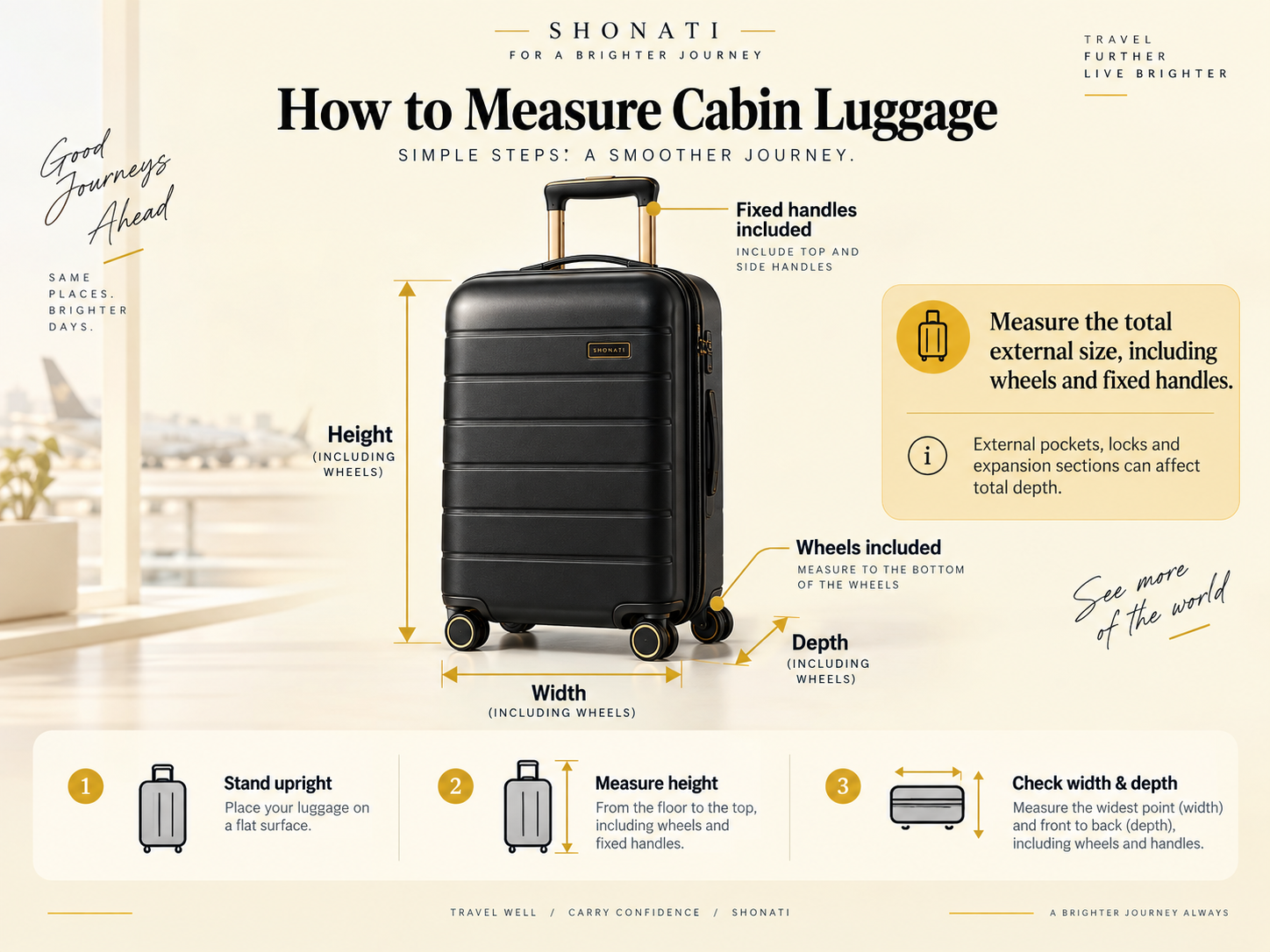
1. Measure the Total Height
Stand the suitcase upright on a hard, flat surface.
Measure from the lowest point of the wheels to the highest fixed point of the suitcase.
Include:
- Wheels.
- Fixed handles.
- Any part that remains outside the main suitcase body.
2. Measure the Width
Measure the suitcase from side to side at its widest point.
Include protruding components such as:
- Side handles.
- Locks.
- Protective elements.
- Other fixed external components.
3. Measure the Depth
Measure from the front of the suitcase to the furthest point at the back.
External pockets, shell contours, zippers, and expansion sections can increase
the total depth of the suitcase.
Wheels and handles count when measuring luggage.
Measuring only the main suitcase body can result in an incorrect size comparison.
Expandable Cabin Luggage
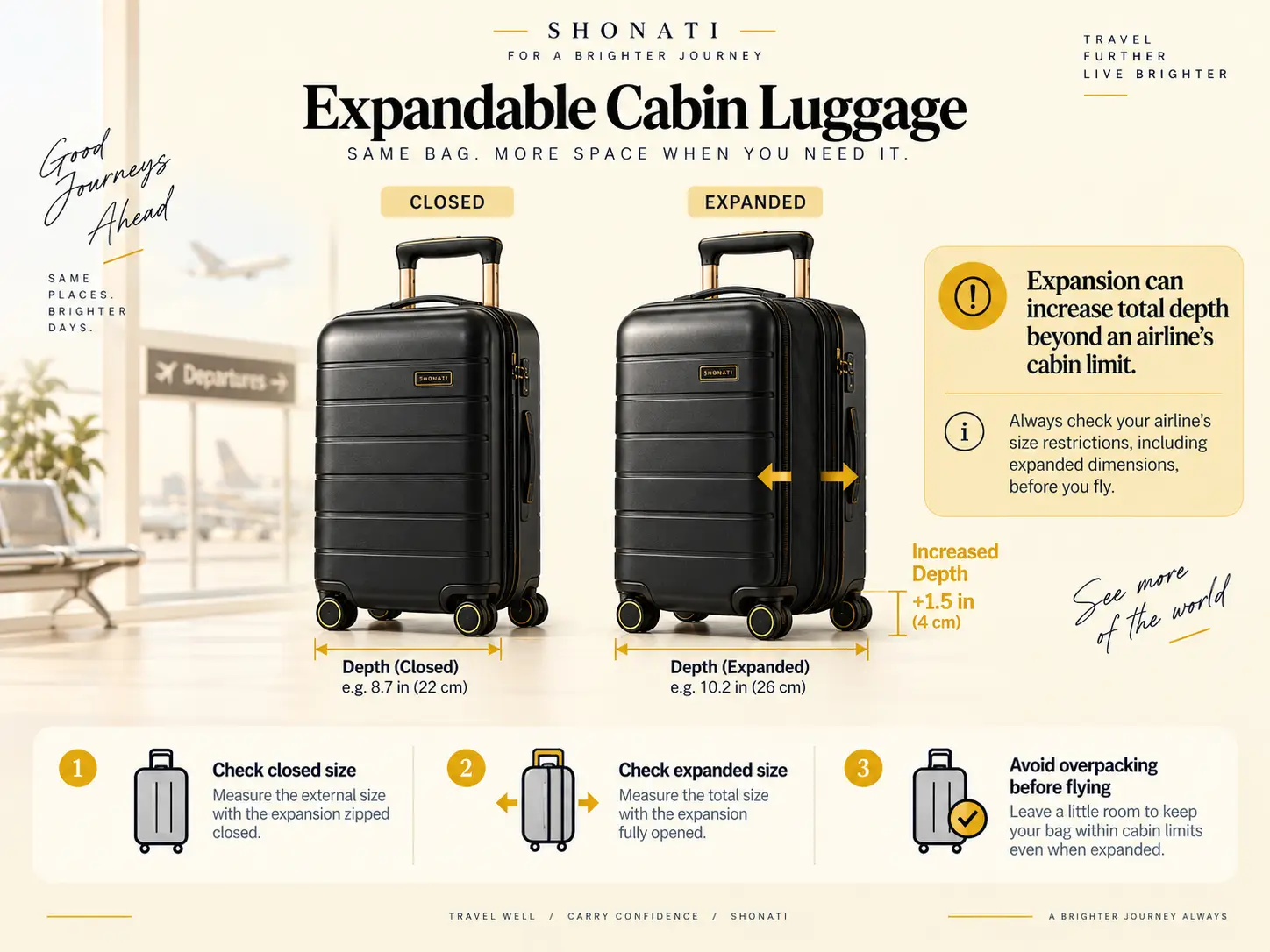
Expandable luggage provides additional packing space by increasing the depth
of the suitcase when the expansion zipper or mechanism is opened.
This can be useful during a trip, but expansion may also cause a suitcase
that fits within an airline’s published dimensions when closed to exceed those limits
when expanded.
If you plan to use the expansion feature during air travel,
compare the expanded external dimensions with your airline’s allowance.
Cabin Luggage vs Personal Item vs Checked Luggage
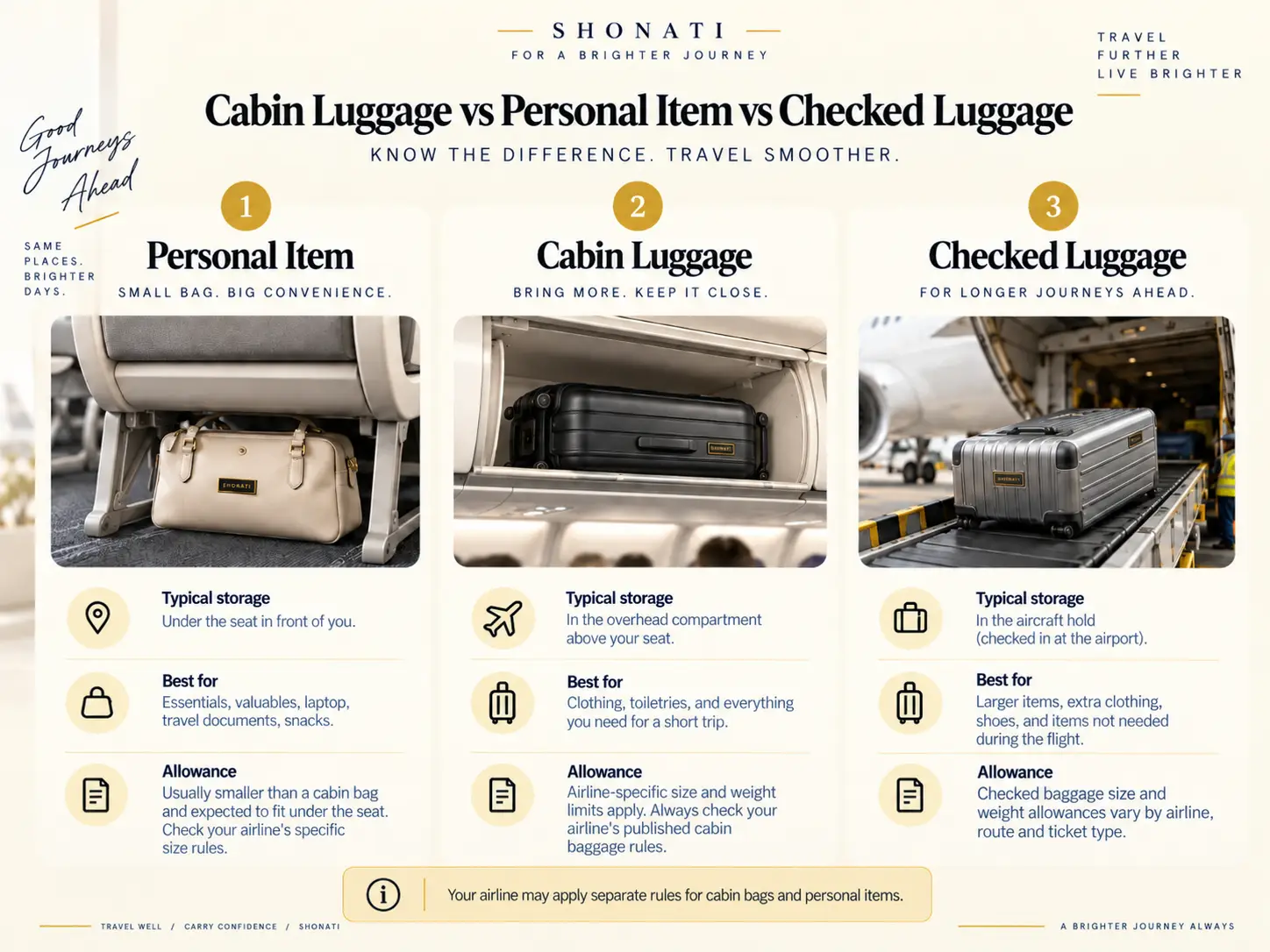
| Type | Where It Is Stored | Typical Use | Allowance |
|---|---|---|---|
| Cabin Luggage | Usually overhead compartment | Clothing and travel essentials | Airline-specific |
| Personal Item | Usually under the seat in front | Small handbag, laptop bag or small backpack where permitted | Airline and fare-specific |
| Checked Luggage | Aircraft hold | Larger quantities and longer journeys | Airline, route and fare-specific |
Cabin Luggage vs Personal Item
A cabin suitcase and a personal item should not automatically be treated as the same allowance.
Some airlines allow a main cabin bag together with a smaller personal item,
while others may impose different rules depending on the fare or travel class.
A personal item is commonly expected to be smaller than a cabin suitcase
and able to fit under the seat in front of the passenger.
Before travelling with both items, check whether your ticket includes
a separate personal-item allowance.
Cabin Luggage Size vs Cabin Luggage Weight
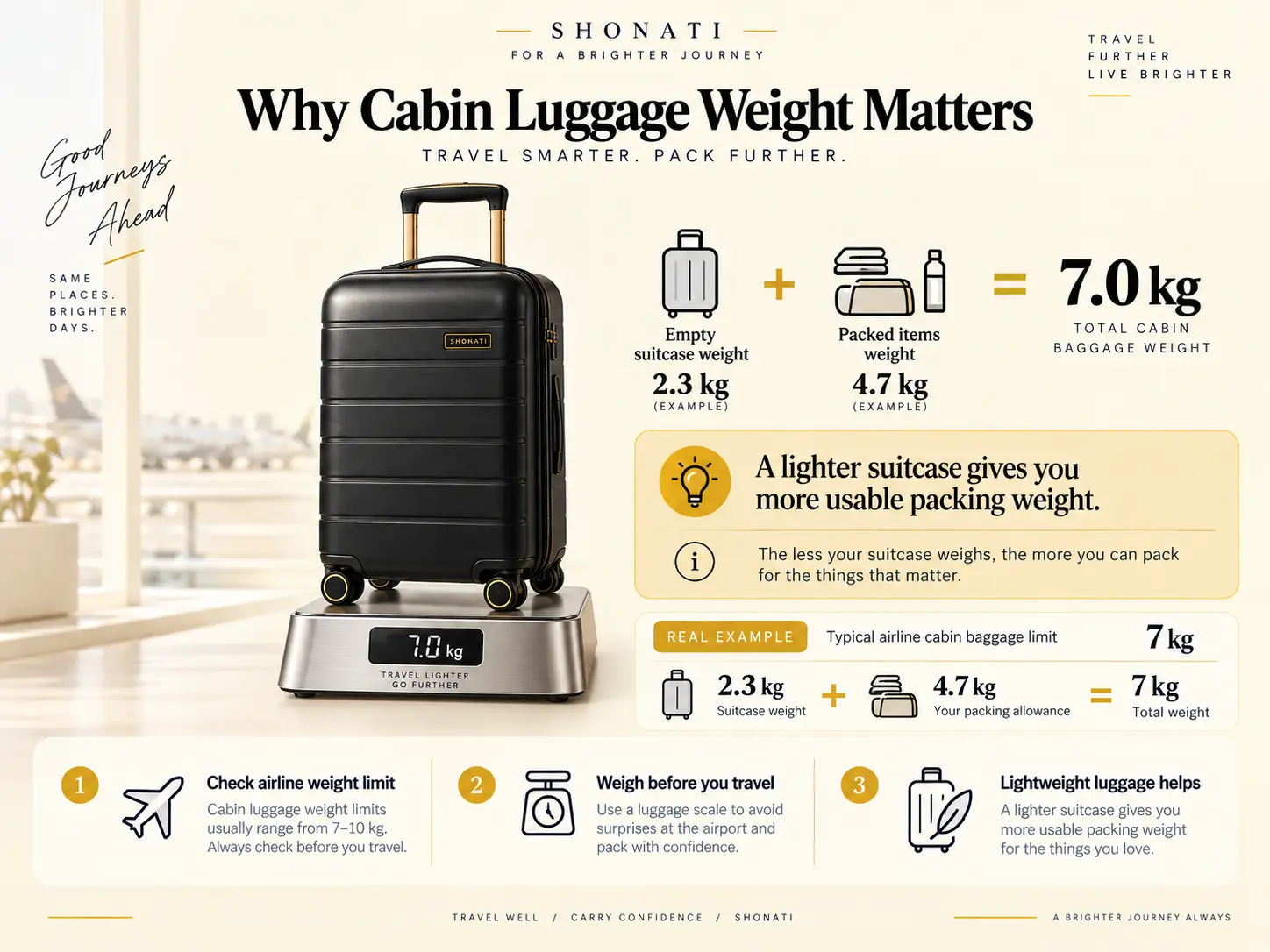
Meeting the size requirement does not automatically mean that your luggage
meets the airline’s cabin baggage rules.
Airlines may apply both:
- A maximum external size.
- A maximum permitted weight.
Your suitcase therefore needs to comply with both conditions where they apply.
The empty weight of your luggage also matters.
If your airline applies a weight limit, every kilogram of suitcase weight reduces
the remaining weight available for your belongings.
How to Choose Cabin Luggage for Your Trip
The right cabin suitcase depends on much more than dimensions alone.
Consider how you travel, how much you normally pack, and the baggage rules
you are likely to encounter.
Weekend & Short Trips
Cabin luggage can be a practical choice for short trips when you prefer
to travel with fewer belongings and avoid checking a larger suitcase.
Business Travel
Business travellers may benefit from cabin luggage that combines low empty weight,
organised compartments, smooth mobility, and easy access to frequently used items.
Multi-City & Connecting Trips
If your journey includes several flights or different airlines,
check the baggage conditions for every flight segment.
When different cabin limits apply, choosing luggage that meets the more restrictive
published requirement can reduce the risk of problems during your journey.
Longer Trips
Cabin-only travel may still work for longer journeys for travellers who pack efficiently,
but space and airline weight restrictions become increasingly important.
If you require substantially more clothing or equipment,
checked luggage may be the more practical option.
Hard-Shell or Soft-Side Cabin Luggage?
Both formats can work well as cabin luggage.
The better choice depends on your packing habits and travel requirements.
Hard-Shell Cabin Luggage
- Provides a rigid outer structure.
- Can help protect the contents from external pressure.
- Maintains its general shape when packed.
- External dimensions should still include wheels and handles.
Soft-Side Cabin Luggage
- May offer external pockets and flexible storage.
- Some models include expandable capacity.
- Overpacking may increase the total external depth.
- The widest and deepest packed dimensions should be considered.
Four-Wheel vs Two-Wheel Cabin Luggage
Wheel configuration can affect mobility and the overall dimensions of a suitcase.
Four-wheel spinner luggage is designed for easy multidirectional movement,
while two-wheel designs may have a different packing-space-to-external-size relationship.
Regardless of wheel type, the wheels form part of the suitcase’s total external dimensions.
Before Buying Cabin Luggage: 8 Things to Check
- Check your airline:
Find the published cabin baggage allowance for your flight. - Check your fare:
The cheapest or most restrictive fare may have different baggage conditions. - Check external dimensions:
Compare height, width, and depth—not just the advertised inch size. - Include wheels and handles:
They are part of the suitcase’s total size. - Check suitcase weight:
A lighter empty suitcase leaves more of the airline weight allowance available for packing. - Check expansion:
An expanded suitcase may exceed the airline’s maximum depth. - Check personal-item rules:
Do not assume a laptop bag, handbag, or backpack is automatically included. - Check again before departure:
Airline baggage policies can change.
What Happens If Cabin Luggage Is Too Large or Too Heavy?
The final decision on baggage acceptance is made by the airline.
If cabin luggage exceeds the airline’s published size, weight,
or number-of-items allowance, the airline may require the passenger to:
- Repack the bag.
- Remove items.
- Check the suitcase into the aircraft hold.
- Pay an applicable baggage or gate fee.
Policies and charges vary between airlines.
What Does “Cabin Approved” Mean?
Terms such as cabin size, carry-on,
or cabin approved should not be interpreted as a guarantee
that a suitcase will be accepted by every airline.
Airline acceptance depends on the actual luggage dimensions,
packed weight, applicable ticket conditions, and the airline’s current baggage policy.
At SHONATI, we recommend comparing the exact product specifications
with your airline’s published allowance before travelling.
Cabin Luggage Checklist Before You Travel

- Confirm the airline operating your flight.
- Check your travel class and fare type.
- Verify the maximum cabin luggage dimensions.
- Verify the maximum permitted weight.
- Confirm whether a personal item is included.
- Measure the suitcase including wheels and fixed handles.
- Measure expandable luggage in the configuration you plan to use.
- Weigh the fully packed suitcase before leaving for the airport.
- Review the airline’s restricted and prohibited items rules.
Frequently Asked Questions
Is a 20-inch suitcase always accepted as cabin luggage?
No. A 20-inch description does not guarantee airline acceptance.
Check the suitcase’s total external dimensions and packed weight
against the rules for your specific flight.
Is 56 × 45 × 25 cm the official worldwide cabin size?
No. IATA identifies 56 × 45 × 25 cm as a general reference used by many airlines,
including wheels and handles, but individual airlines determine their own baggage allowances.
Do suitcase wheels count in cabin luggage measurements?
Yes. Total external measurements should include wheels, fixed handles,
and other protruding parts of the suitcase.
Do handles count in luggage measurements?
Yes. Fixed or non-retracting parts that contribute to the suitcase’s total external size
should be included.
Can an expandable cabin suitcase become too large?
Yes. Opening the expansion section increases the depth of the suitcase
and may cause it to exceed an airline’s published cabin baggage dimensions.
Can I carry a laptop bag as well as cabin luggage?
It depends on the airline, fare, and travel class.
Some airlines provide a separate personal-item allowance while others apply different conditions.
Always check your specific booking.
Does cabin baggage weight matter if the suitcase fits?
Yes. An airline may apply both size and weight limits.
A suitcase that fits within the permitted dimensions may still exceed the permitted weight.
Should I check cabin baggage rules again before flying?
Yes. Airline baggage policies can change,
so the latest information should always be confirmed directly with the airline
before departure.
Find the Right Cabin Luggage at SHONATI
When choosing cabin luggage, focus on verified external dimensions,
empty weight, packing capacity, mobility, and the baggage requirements
that matter for your journey.
SHONATI offers a multi-brand selection of luggage across different sizes,
designs, materials, and price ranges, allowing you to compare options
based on your travel requirements.
Important Travel Notice:
Airline cabin baggage rules can change and may vary by airline,
route, aircraft, fare type, travel class, or other conditions.
Information in this guide is provided to help with product selection
and should not replace the baggage conditions published for your booking.
Always verify the latest baggage allowance directly with the operating airline before travel.
Guide last reviewed: September 2026