
Handbag Size Guide: What Fits in Mini, Small, Medium & Large Bags?

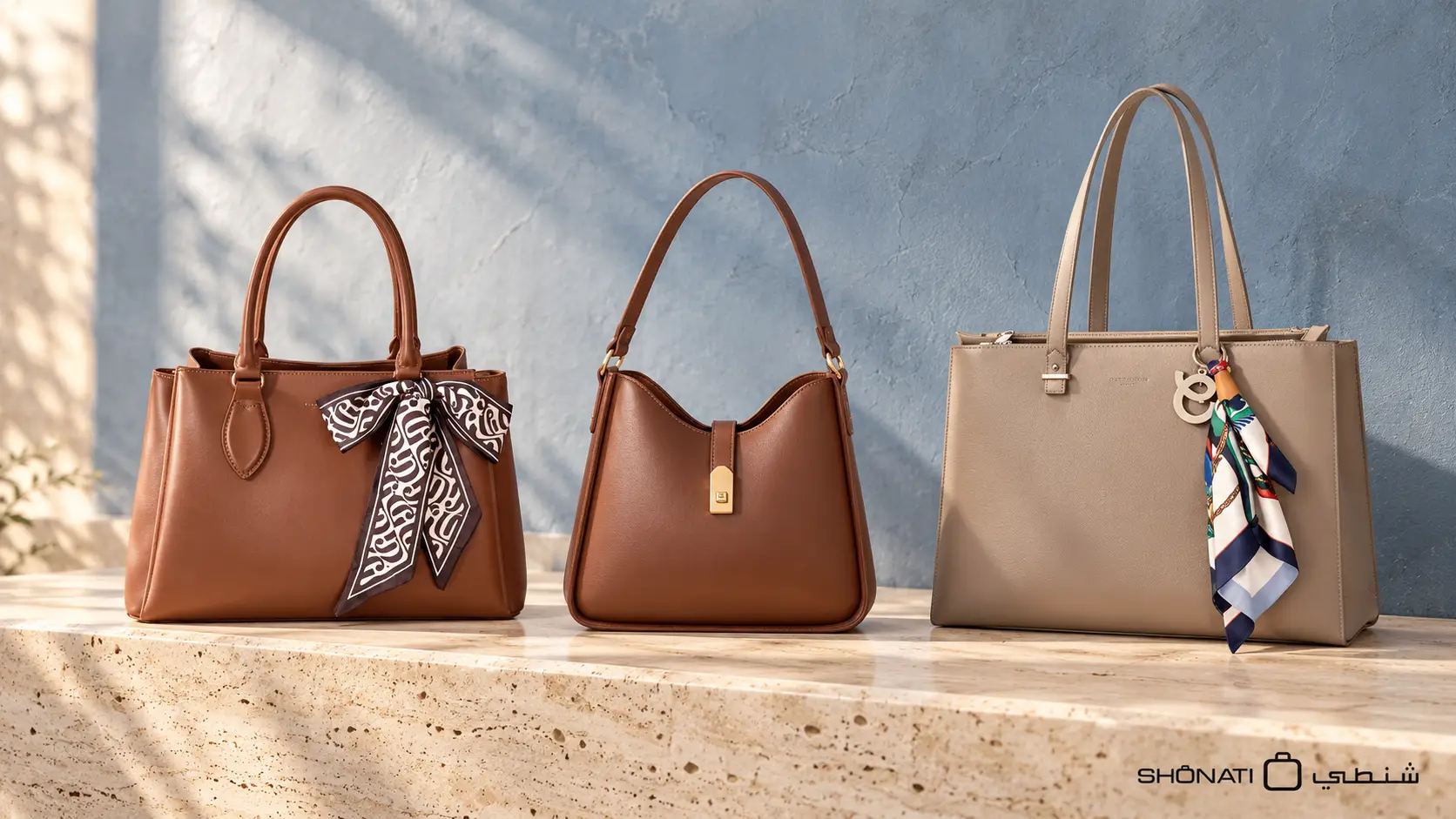
A handbag can look the right size online and still leave you choosing between your phone and your sunglasses. The problem is often the opening, the shape of the compartments or the thickness of your belongings—not simply whether the label says “small”.
Choose your handbag size around the items you carry together. Mini bags suit a deliberately short essentials list; small bags are a starting point for compact everyday carry; medium bags give you room to consider extras; and large bags are worth comparing when documents or bulkier belongings are part of your day. Each model still needs its own fit check.
This handbag size guide explains how to compare those sizes, read measurements and shortlist real CHRISBELLA and David Jones designs at SHONATI.
Mini, small, medium or large: where should you start?
Use the table to choose which bags to investigate first. The item lists are shopping checklists, not verified packing results: a slim phone case and card holder take up different space from a protective phone case and a full wallet.
| Size label | Items to check together | Main limitation to check |
|---|---|---|
| Mini | Phone, card holder, keys and a small personal item | Phone access, divided compartments and bulky key fobs |
| Small | Your essentials, plus a compact wallet or a small pouch | Whether an eyewear case or extra pouch crowds the closure |
| Medium | Essentials with selected extras, such as a notebook, bottle or cosmetics pouch | Whether those extras fit together within the actual compartments |
| Large | A broader daily load, documents or bulkier belongings | Document access, loaded weight and finding smaller items |
Why there is no universal handbag size chart in centimetres
“Mini” and “medium” describe a position within a brand or collection; they are not universal measurements. A wide, shallow shoulder bag and a narrow, deep crossbody can have very different uses even when a retailer places them in the same size category.
Read the exact model measurements before comparing labels. Also separate size from carrying style: crossbody, shoulder bag, top-handle and tote describe designs or ways of carrying, rather than a fixed capacity.
How to read handbag measurements before buying
First check the order of the numbers. One listing may use width × height × depth, while another uses width × depth × height. A number without an axis label can easily lead to the wrong comparison.
- Width: the side-to-side measurement. Establish whether it refers to the base or the widest part of the body.
- Height: the height of the bag body, excluding handles unless the listing says otherwise.
- Depth: the front-to-back measurement. This matters when several thicker objects share a compartment.
- Opening: the usable access space with the closure open. Curves, zip ends and folded sides may restrict it.
- Internal space: the room inside each usable compartment, after allowing for lining, seams and dividers.
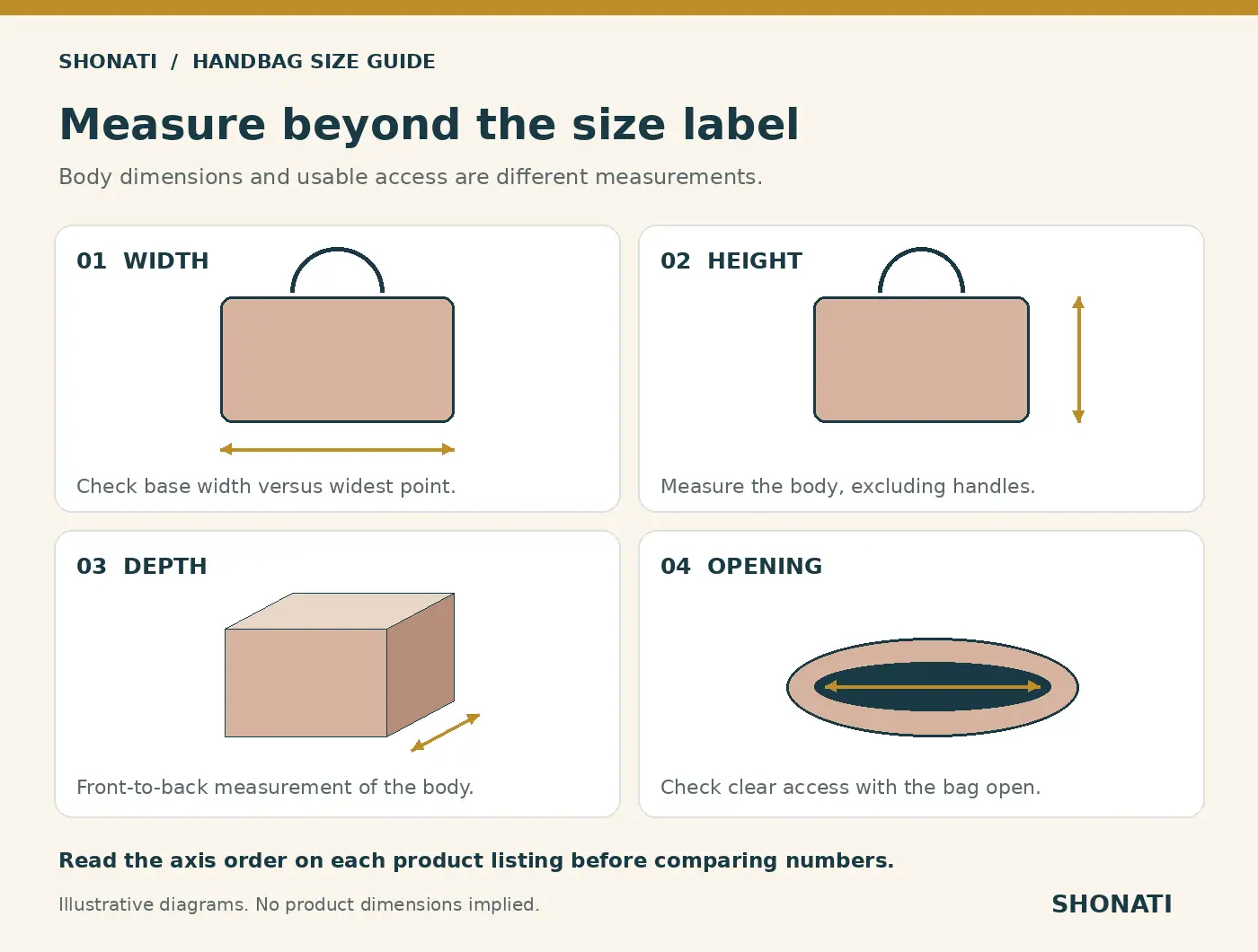
For example, an external width of 21 cm does not establish that a 20 cm object will enter comfortably. You still need to know the opening, the internal width and the object’s thickness.
Do not multiply the exterior measurements and treat the result as usable litres. A handbag is rarely an empty rectangular box, and there is no reliable fixed percentage to subtract for every lining or shape.
Check the strap separately from the bag body
Handle drop describes the clearance between the top of the bag and the handle above it. Strap length describes the strap itself; it is not the same measurement. For adjustable straps, check the shortest and longest settings.
Compare these with a bag you already enjoy carrying. Think about the clothes you wear, where you want the bag to sit and whether you can reach inside comfortably. A larger body does not automatically come with a longer strap or more shoulder clearance.
What should you expect from each handbag size?
Mini bags: choose around the essentials you cannot leave behind
Start with your phone in its usual case, then add your keys and the cards you need. If any of these are bulky, check them before choosing space for optional items. A small lipstick may be easy to accommodate; a rigid glasses case can change the decision entirely.
A wallet-on-chain can also look similar to a mini handbag while offering a flatter interior. Check whether you need card organisation or a compartment with enough depth for three-dimensional objects.
The CHRISBELLA AA012601068 dual-zip mini bag illustrates another useful distinction: it has two separately zipped main compartments. That can help separate belongings, but your largest item needs to fit inside one compartment. You cannot treat the two sections as one uninterrupted space.
Small bags: check the extra item that makes them useful
For a small everyday bag, identify what you want beyond the minimum: perhaps a compact wallet, a personal-care pouch or sunglasses. Put that item into your comparison from the beginning.
Two bags with the same front width may perform differently because one is flatter, more curved or divided internally. Look at the side view and the open interior as closely as the front photograph.
If you are moving down from a larger bag, try a compact wallet or a smaller pouch while keeping the essentials you actually need. The aim is a manageable daily load, not a list that only works for the product photograph.
Medium bags: allow for your normal day, including the awkward objects
A medium-labelled bag is a useful place to start when you carry more than a phone-and-wallet kit. Build your shortlist around the combination you use: glasses case plus cosmetics pouch, or notebook plus bottle, for example.
Check how the interior is divided. Several compartments may suit flat items and regular organisation, while a single wider space may be easier for an unusually shaped object. Neither arrangement is automatically better; the useful one matches your belongings.
Large bags: distinguish room for documents from room for a device
A large bag becomes relevant when your normal load includes larger items rather than occasional “just in case” extras. Check whether documents can enter and sit without bending, and whether smaller belongings remain easy to find.
A4 paper measures 21 × 29.7 cm, but a folder is larger. Likewise, a laptop’s advertised screen size measures the display diagonally, not its complete body or protective sleeve. A4 compatibility alone does not confirm laptop fit or protection.
Check these everyday items before deciding
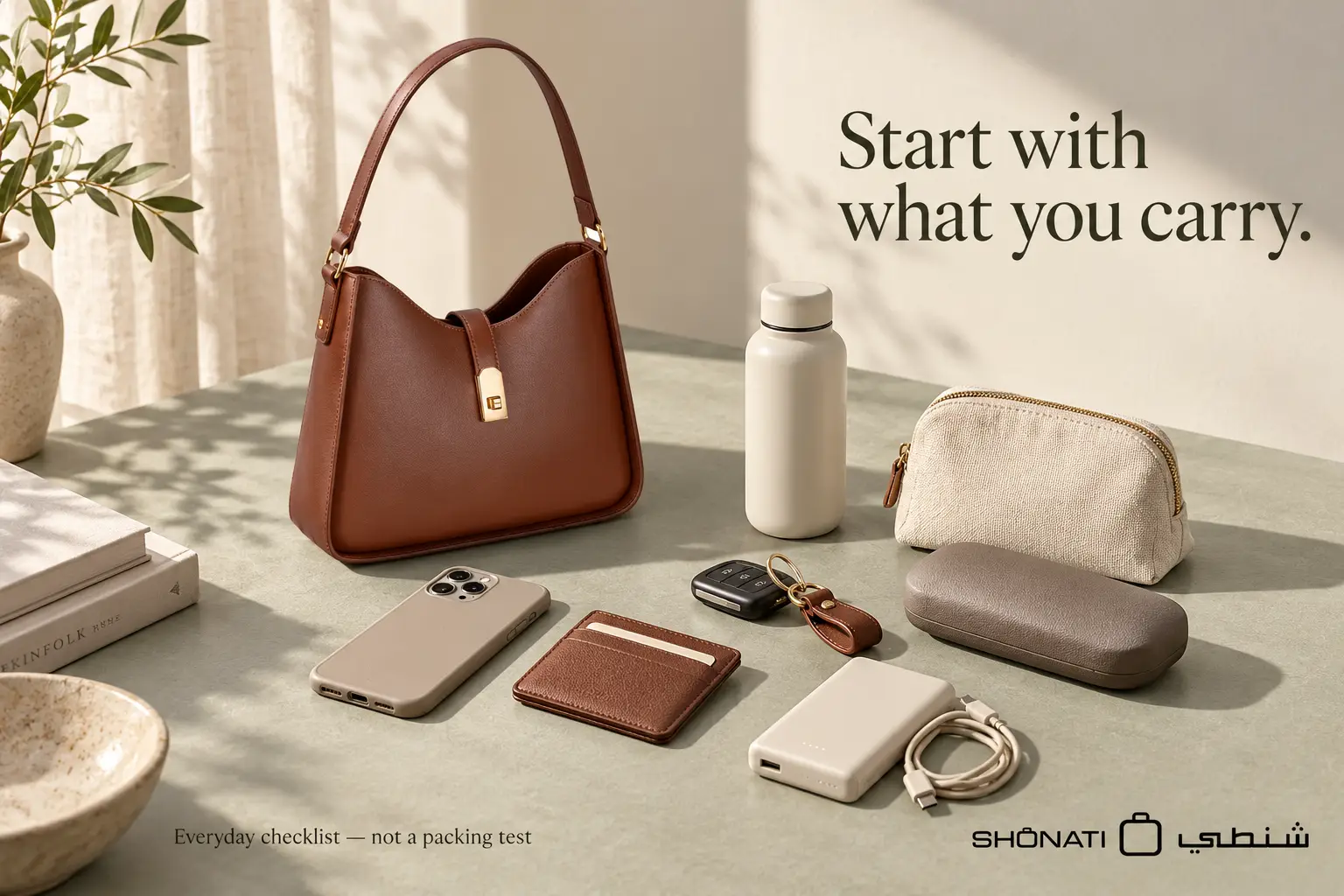
Your phone, including its case
Measure length, width and thickness with the case attached. Include protruding grips or accessories. Check the opening and the intended compartment, then consider whether you can remove the phone without unloading the bag.
If you carry two phones, compare them as part of the same load. A statement that one phone fits does not answer whether two phones, keys and a wallet fit together.
Your wallet and keys
Measure the wallet while it contains your usual cards and cash. A long wallet needs enough straight space and a comfortable route through the opening. Include the whole key set: a car fob, key ring and attachments can be much bulkier than a single key.
Your glasses case
Use the case you normally carry. A hard shell, a folding case and a soft sleeve have different footprints. Do not assume that a photograph of sunglasses beside a bag proves there is space for your protective case inside it.
Your water bottle
Measure the bottle’s height and widest diameter, including its lid. Millilitres describe the liquid capacity, not the bottle’s external shape. Decide whether it needs to stand upright and check that position alongside your other belongings.
Do not assume a handbag has a bottle holder or a leakproof compartment unless the product details confirm it.
Pouches, chargers and personal essentials
Pack the pouch you actually use, including toiletries or personal-care items. Add the power bank and cables if they travel with you. An organiser can make retrieval easier, but its walls and pockets also occupy space; assess it inside the bag rather than as an invisible extra.
Compare real SHONATI bags by their published dimensions
The examples below show different body proportions and layouts. Measurements are presented consistently as width × height × depth. They are published product dimensions, not measurements of usable internal capacity.
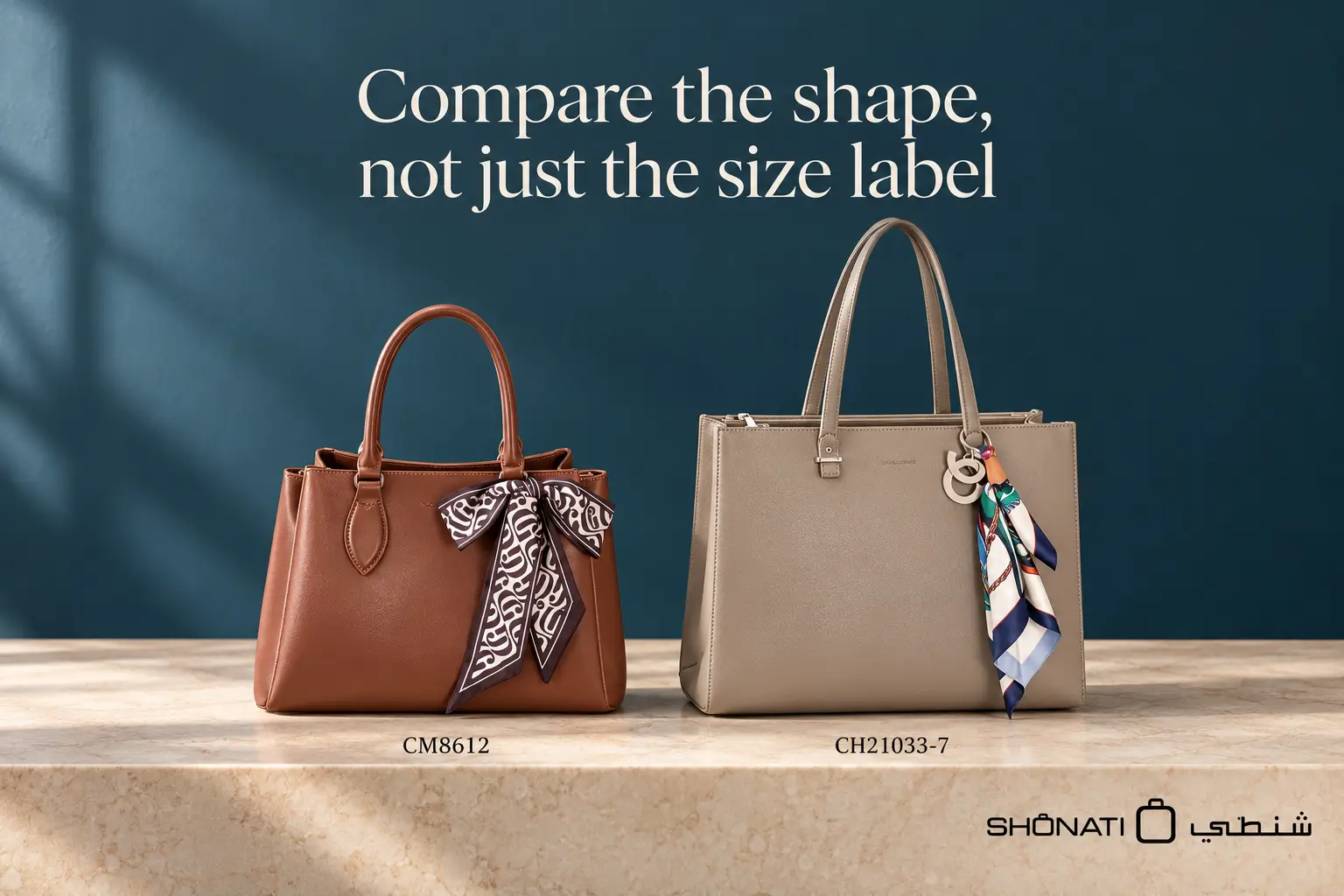
| Model | Width × height × depth | What to investigate |
|---|---|---|
| David Jones CM8612 trapeze handbag | 34 × 24 × 13 cm | Its structured shape and divided interior: compare your largest item with the compartment you intend to use. |
| David Jones CH21033-7 A4 tote | 39 × 30 × 15 cm | A4 document compatibility is listed. Check a thicker folder or device separately, including the opening. |
| CHRISBELLA AA012601326 large handbag with pouch | 44 × 28 × 20.5 cm | The wider, deeper body and included pouch: consider the complete load and how you will retrieve smaller belongings. |
The CHRISBELLA product listing uses width × depth × height; its measurements have been reordered in this table. No packing test has been carried out for this guide, so the table does not promise that a particular phone, bottle or laptop will fit.
Notice that the widest example is not the tallest. The CHRISBELLA is 44 cm wide and 28 cm high, while the David Jones A4 tote is 39 cm wide and 30 cm high. Decide which dimensions matter for your belongings rather than choosing the largest first number.
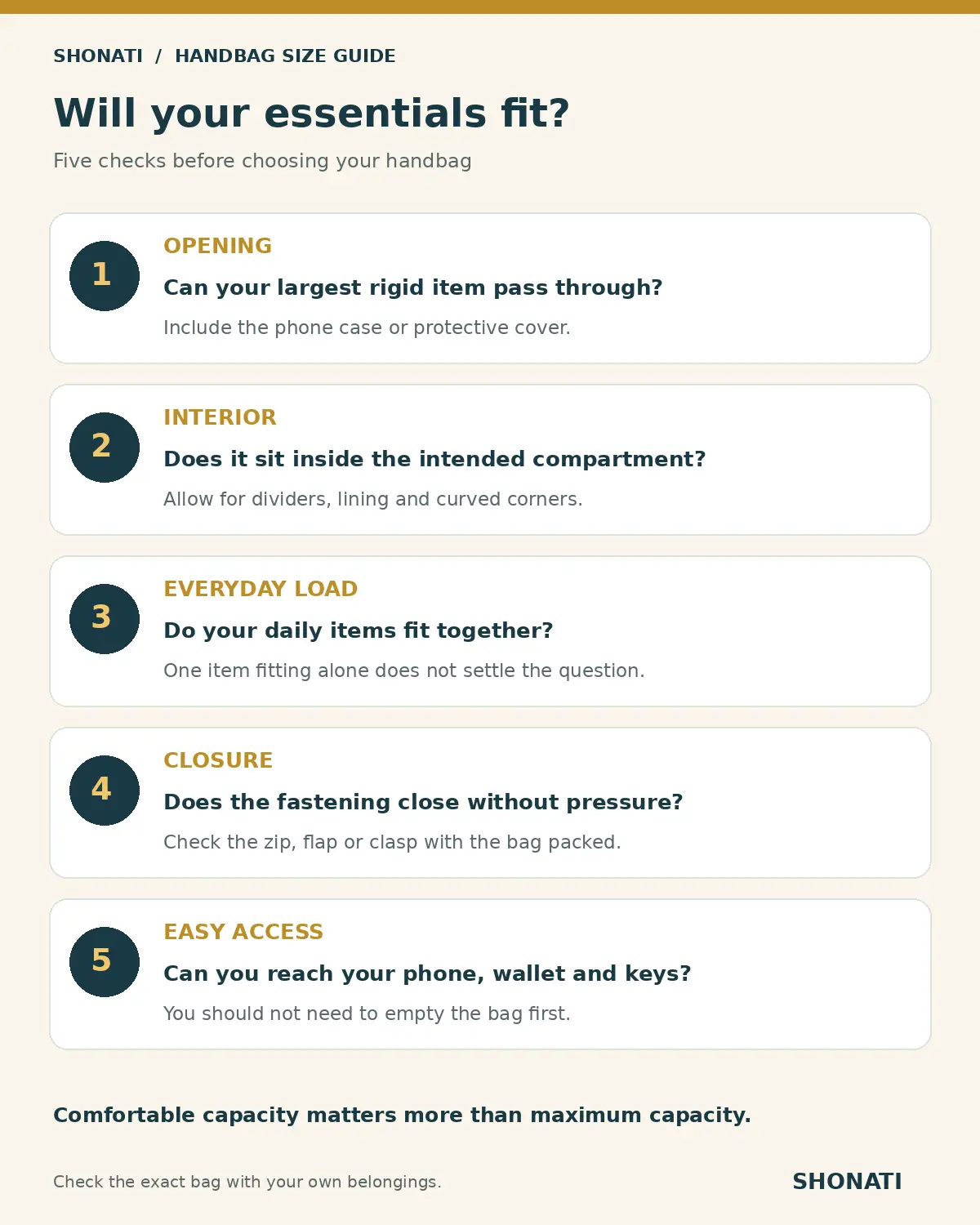
Use this five-step handbag fit check
- Opening: can the largest rigid item pass through comfortably?
- Interior: can it sit inside its intended compartment without being forced against a corner?
- Complete load: do the rest of your everyday items fit alongside it?
- Closure: does the zip, flap or fastening close without pressure from the contents?
- Retrieval: can you take out your phone, wallet or keys without emptying the bag?
When comparing in person, test your normal load and check how the bag feels when carried. Space that is only usable with a strained fastening or difficult access is not a comfortable everyday fit.
How to compare a bag when shopping online
Measure a bag you already own using the same axes as the listing. Note what you like about its capacity and which item causes a problem. This gives the new measurements a familiar reference.
A paper outline of the stated width and height can help you picture scale, but it cannot reproduce the opening, depth or interior. Treat it as a visual aid, not a fit test.
If a critical measurement is missing, ask about the exact model and the exact object. “Can you check the usable opening for my phone, which measures 16.5 × 8 × 1.2 cm with its case?” is more useful than “Does it fit a big phone?” Those numbers are an example of how to ask, not a specification for a particular phone.
Frequently asked questions
What size handbag is best for everyday use?
The best starting point is the smallest bag that handles your normal belongings comfortably. Compare small designs for a compact essentials kit and medium or larger designs when you regularly add a case, pouch, notebook or bottle. Confirm the complete load, not just the size label.
Will a mini bag fit a large phone?
Some will and some will not. Measure the phone with its case and compare it with the usable opening and individual compartment. A diagonal position may also make retrieval awkward, even if the phone can be placed inside.
Does a deeper bag always hold more?
Depth is useful information, but it does not settle capacity by itself. Width, height, shape and divisions also matter. A deeper bag can still have a narrow opening or compartments that do not suit your items.
Can a bag that fits A4 documents carry a laptop?
Do not assume so. Compare the laptop’s body and sleeve with the opening and interior, and check whether the bag provides suitable support or a dedicated protective compartment. A4 compatibility is a document specification.
Can I rely on a model photograph to judge size?
Use it alongside measurements. Camera distance, perspective and the model’s height can change how large a bag appears. A stated model height helps with proportion, but does not establish what fits inside.
Should I choose a larger bag just in case?
Separate items you carry most days from occasional extras. If those extras are frequent, include them in the comparison. If they are rare, consider whether carrying a larger bag every day is worth the additional bulk.
Find a bag that fits your day
Use your item checklist to compare CHRISBELLA handbags and David Jones bags at SHONATI . Open the individual product page to check its dimensions, layout and colour options.
For help with a particular model, contact SHONATI or find our Sharjah and Wafi Mall, Dubai stores . Share the model code and your essential item’s measurements, and check model availability before visiting.
About this guide: Product examples use SHONATI’s published specifications, checked on 4 October 2026. They illustrate dimensions and layouts rather than results from a physical packing test. Individual item and case sizes still need to be compared with the exact bag.
Further reading: The Ferragamo bag size guide explains its approach to sizing; the Zatchels shoulder bag size guide provides examples of separate external and internal measurements. These references do not establish the capacity of SHONATI’s product examples.