
How to Pack a 23 kg Suitcase: SHONATI Weight-Test Guide

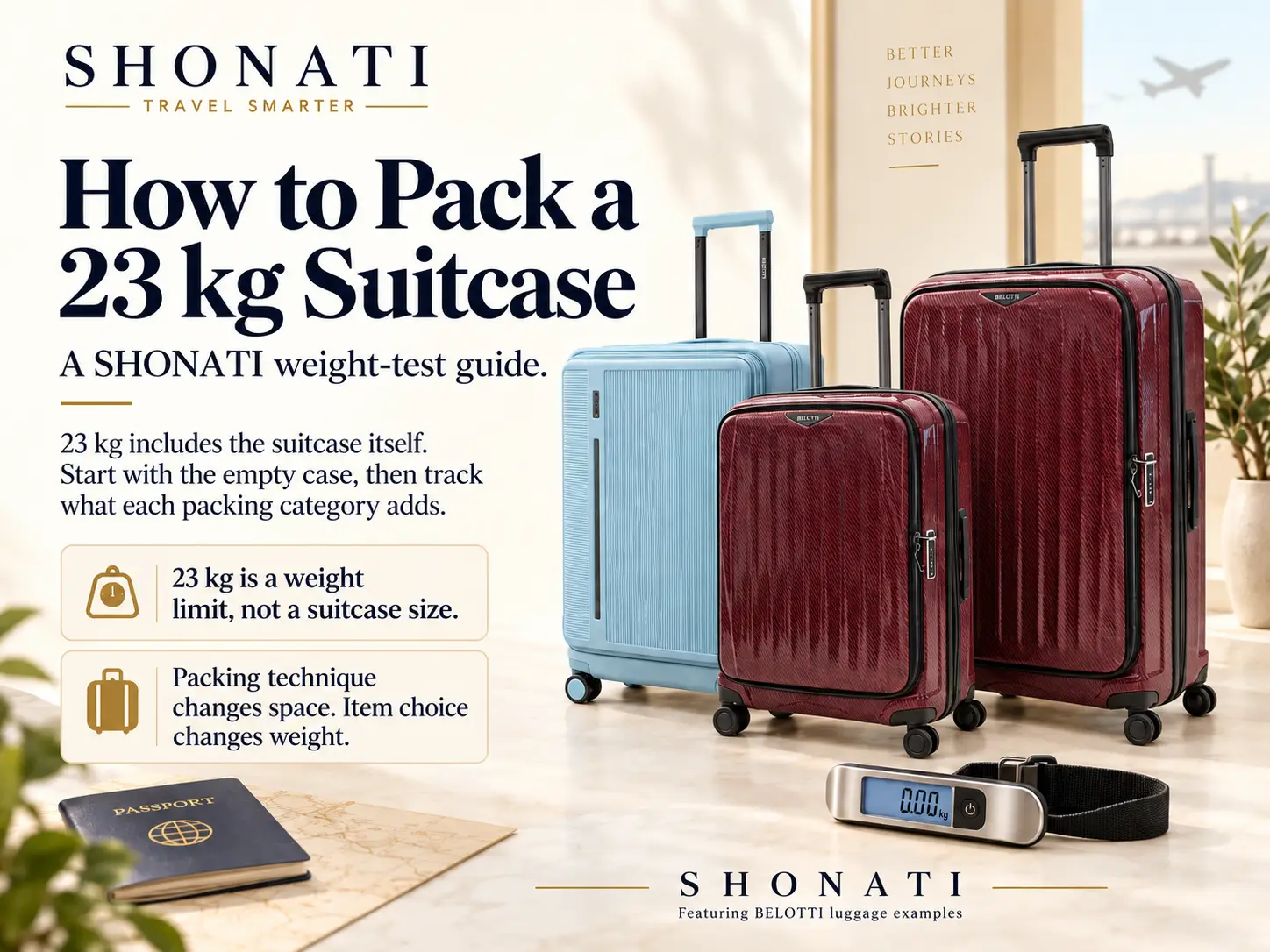
A 23 kg baggage allowance does not mean you have 23 kg available for clothes, shoes and toiletries.
The suitcase itself is part of that weight.
If your empty case weighs 3.3 kg, a 23 kg limit leaves a theoretical maximum of 19.7 kg for everything you put inside. If another suitcase weighs 6.1 kg, the same 23 kg allowance leaves only 16.9 kg.
That difference is why packing a checked suitcase should start with a scale — not with a packing hack.
In this guide, SHONATI breaks down the relationship between airline allowance, empty suitcase weight, suitcase size and the weight of what you actually pack.
If you first need to confirm how much checked baggage your ticket includes, see our UAE checked baggage guide for Emirates, Etihad, flydubai and Air Arabia.
Important: this guide uses 23 kg as a practical packing example. A 23 kg checked-baggage allowance does not apply to every airline, fare or route. Always use the allowance shown on your own booking as the final reference.
First: 23 kg Is a Weight Limit, Not a Suitcase Size
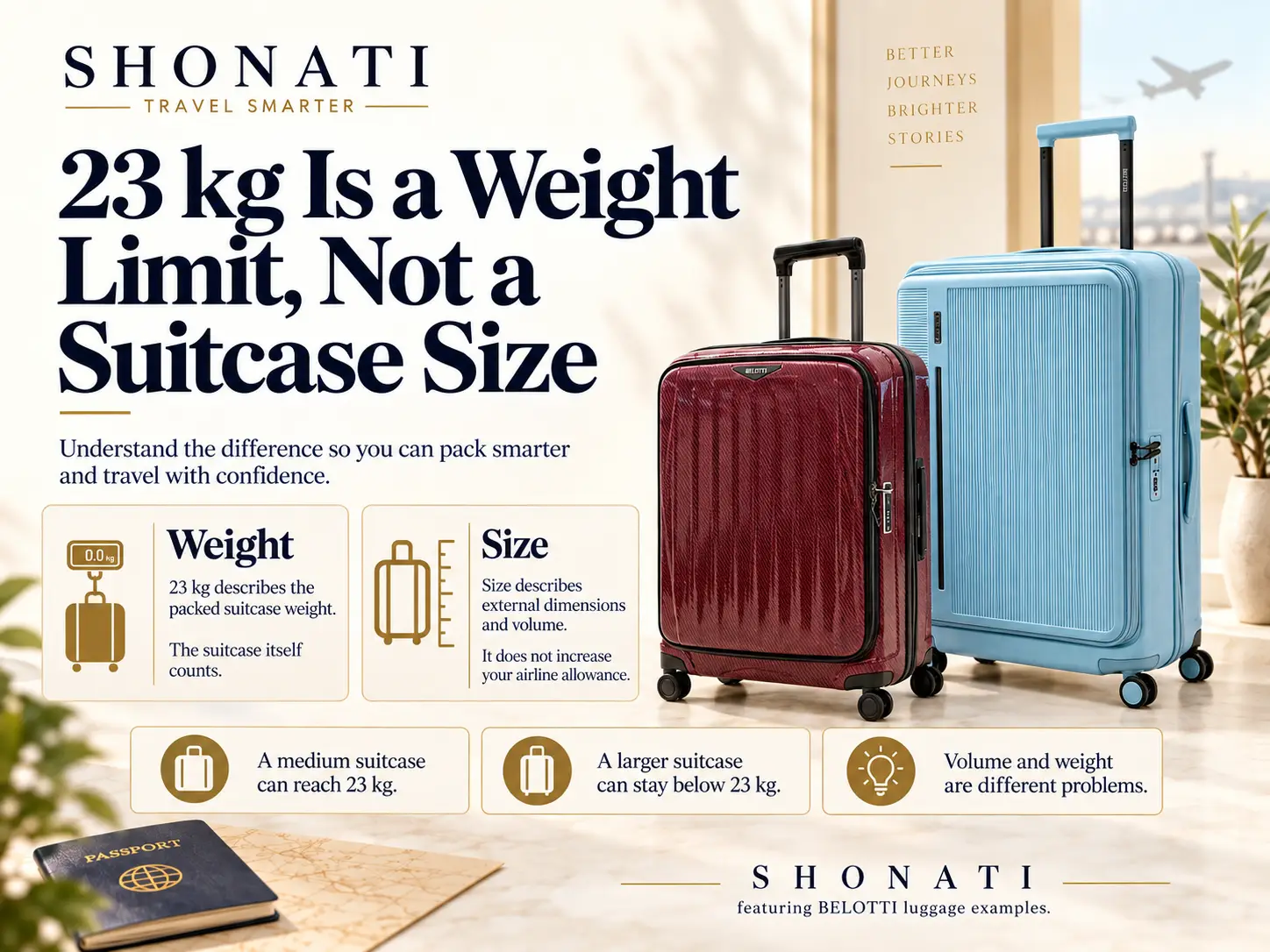
There is no universal suitcase size called a “23 kg suitcase”.
23 kg describes weight. It does not tell you whether the suitcase should be 24 inches, 25 inches, 28 inches or 29 inches.
A medium suitcase can reach 23 kg if you fill it with dense items. A much larger suitcase can remain well below 23 kg if it contains lightweight clothing.
This means you are dealing with two separate questions:
- Volume: is there enough physical space for your belongings?
- Weight: does the complete packed suitcase remain within your allowance?
A larger suitcase solves the first problem. It does not increase your airline weight allowance.
If you are still deciding between suitcase sizes, read our complete luggage size guide or compare 20 vs 24 vs 28 inch luggage.
How Much of Your 23 kg Allowance Is the Suitcase Itself?
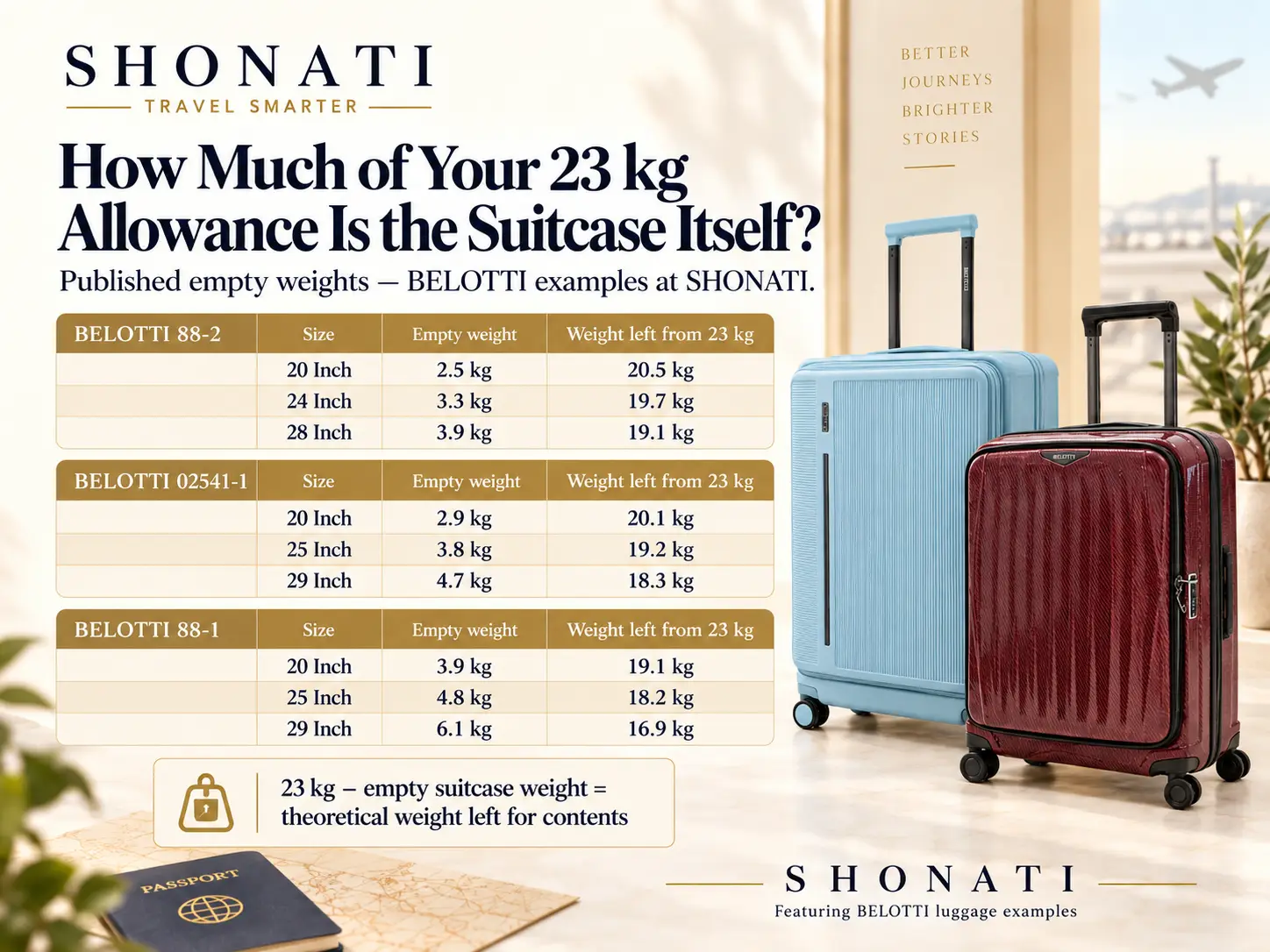
Before packing a single item, the suitcase has already consumed part of your allowance.
Current BELOTTI luggage sold by SHONATI provides a useful real-world example because different suitcase families have noticeably different empty weights. SHONATI measured and verified the empty weight and external dimensions for each model and size listed here, and these specifications are recorded on the product tags.
| BELOTTI Model | Size | Verified Empty Weight (Product Tag) | Theoretical Weight Left From 23 kg |
|---|---|---|---|
| 88-2 | 20 Inch | 2.5 kg | 20.5 kg |
| 88-2 | 24 Inch | 3.3 kg | 19.7 kg |
| 88-2 | 28 Inch | 3.9 kg | 19.1 kg |
| 02541-1 | 20 Inch | 2.9 kg | 20.1 kg |
| 02541-1 | 25 Inch | 3.8 kg | 19.2 kg |
| 02541-1 | 29 Inch | 4.7 kg | 18.3 kg |
| 88-1 | 20 Inch | 3.9 kg | 19.1 kg |
| 88-1 | 25 Inch | 4.8 kg | 18.2 kg |
| 88-1 | 29 Inch | 6.1 kg | 16.9 kg |
The final column is a simple mathematical comparison:
23 kg − verified measured empty suitcase weight = calculated weight remaining for packed contents.
It does not account for airline scale differences, additional wrapping, luggage straps, tags or anything attached to the case at check-in.
The SHONATI “Usable Weight Budget”
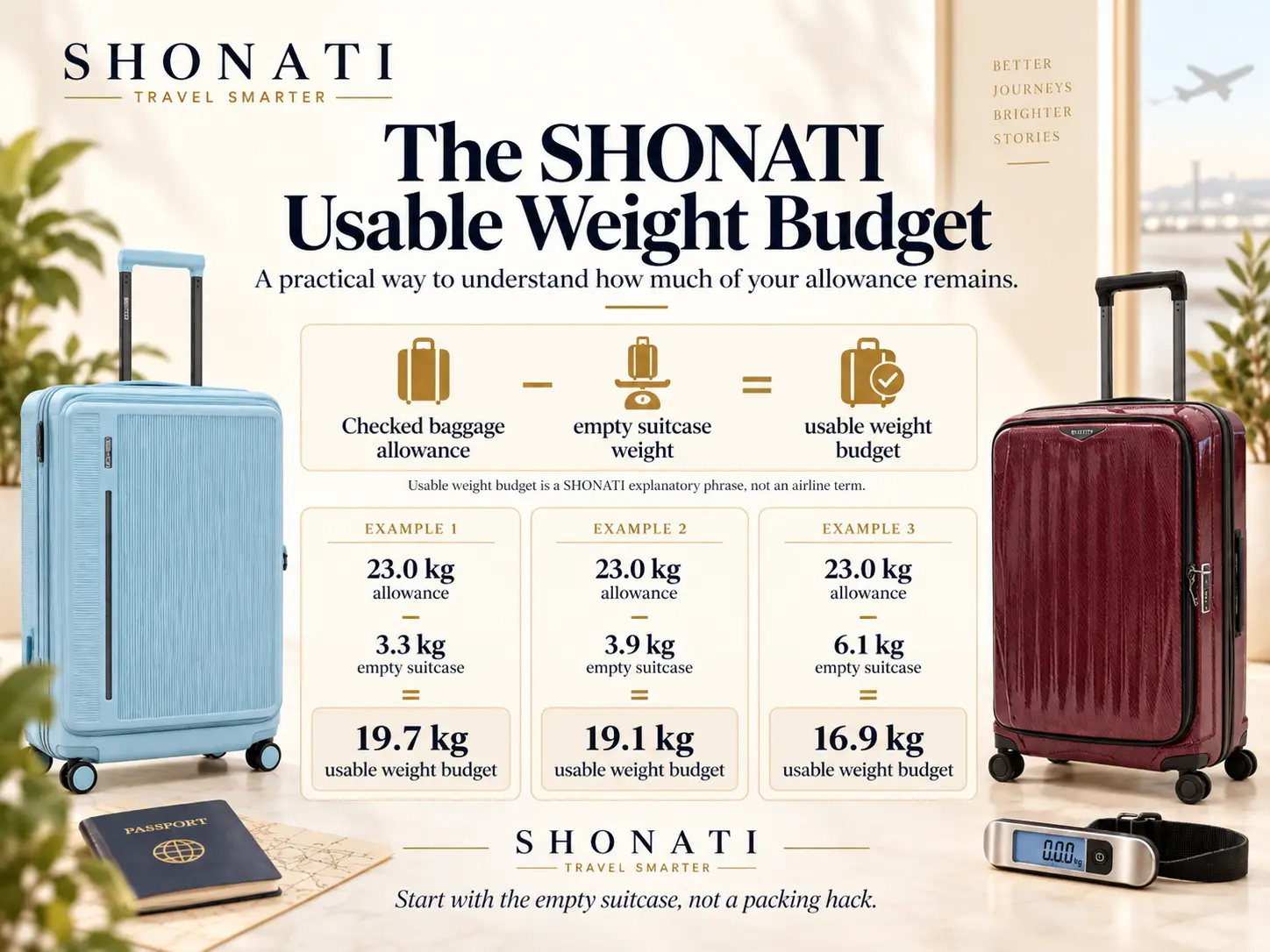
For this guide, we use the phrase usable weight budget as a simple way to understand how much of your baggage allowance remains after accounting for the empty suitcase.
It is not an airline term or an official baggage standard.
The formula is:
Checked baggage allowance − empty suitcase weight = usable weight budget
For example:
23.0 kg allowance
− 3.3 kg empty suitcase
= 19.7 kg theoretical usable weight budget
This calculation changes the way you should compare luggage.
You are no longer asking only:
“Which suitcase has more space?”
You are also asking:
“How much of my allowance does the suitcase itself consume before I pack?”
Same 23 kg Allowance, Different Suitcase Weight
The difference becomes particularly clear when we compare larger suitcases.
| Large Suitcase | Verified Empty Weight (Product Tag) | Theoretical Weight Left |
|---|---|---|
| BELOTTI 88-2 28 Inch | 3.9 kg | 19.1 kg |
| BELOTTI 02541-1 29 Inch | 4.7 kg | 18.3 kg |
| BELOTTI 88-1 29 Inch | 6.1 kg | 16.9 kg |
The difference between the lightest and heaviest case in this comparison is:
6.1 − 3.9 = 2.2 kg
That means two travellers with the same 23 kg allowance could start with a 2.2 kg difference in theoretical packing weight simply because they chose different empty suitcases.
This does not make the lighter suitcase automatically better. Construction, shell material, size, organisation, wheels, handles, durability requirements and other features also matter.
But if maximising usable weight is important to you, empty suitcase weight deserves serious attention.
Being Under 23 kg Does Not Automatically Mean the Suitcase Meets the Size Rule
Weight and external dimensions are separate checks.
Consider three large BELOTTI cases:
| Model | Verified External Dimensions (Product Tag) | Linear Total |
|---|---|---|
| BELOTTI 88-2 28 Inch | 50.5 × 32 × 74.5 cm | 157 cm |
| BELOTTI 02541-1 29 Inch | 51.5 × 32 × 75.5 cm | 159 cm |
| BELOTTI 88-1 29 Inch | 52 × 33 × 77 cm | 162 cm |
Those numbers matter because airlines can impose dimensional limits in addition to weight limits.
For example, Air Arabia’s checked-baggage rules currently publish a maximum total dimension of 158 cm per checked bag.
Using the verified product-tag dimensions above, one large suitcase totals 157 cm, another 159 cm and another 162 cm.
If the 158 cm rule applies to your journey, the cases measured at 159 cm and 162 cm exceed that limit on paper. Do not assume they will be accepted as standard checked baggage. Confirm the rule for your booking and measure the complete packed suitcase, including wheels and handles; the airline’s measurement and decision at check-in are final.
The lesson is simply:
Check both weight and external dimensions.
The SHONATI 23 kg Packing Test
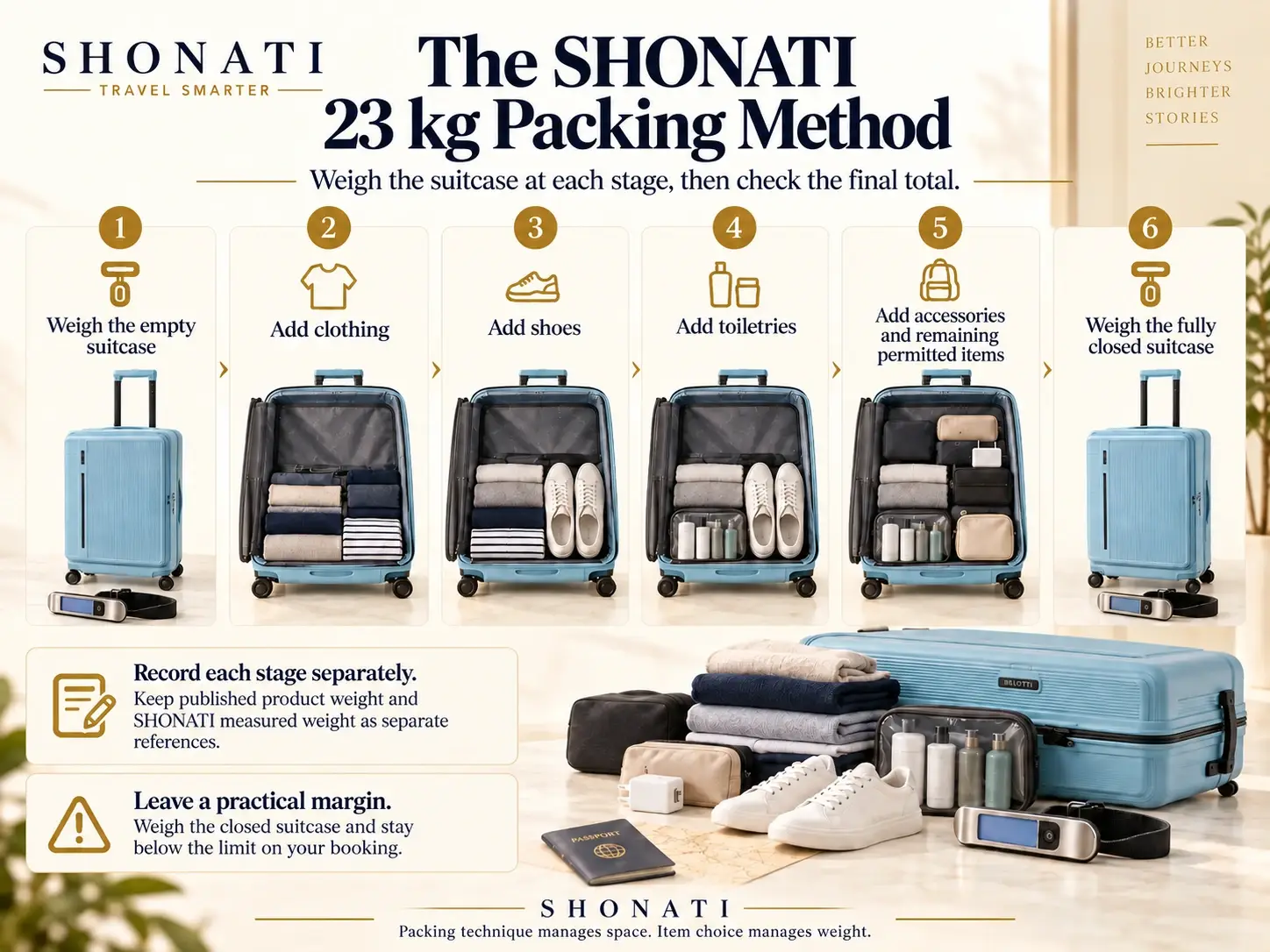
To move beyond generic packing advice, this guide sets out a staged weight-test method. The category-by-category packed-weight results will be added after the physical packing test.
The selected model for the staged test is the BELOTTI 88-2 24-Inch Medium Suitcase.
Its measured and tagged specifications are:
- External dimensions: 45.5 × 29 × 64 cm
- Measured empty case weight (product tag): 3.3 kg
- Shell: PC / polycarbonate hardshell
Using the verified measured empty weight:
23.0 − 3.3 = 19.7 kg
So the theoretical maximum available for contents is 19.7 kg before allowing for any practical margin.
Step 1: Weigh the Empty Suitcase
Start with the suitcase completely empty.
Remove anything that will not travel with the bag and make sure the same accessories remain attached throughout the entire test.
The selected BELOTTI 88-2 24-inch case has a measured and verified empty weight of 3.3 kg, recorded on its product tag. This is the confirmed empty-case starting weight used in the calculations and weight timeline below. When carrying out the staged packing test, weigh this same empty case before adding contents and keep any attached travel accessories consistent through the final reading.
Step 2: Add Clothing
Add the clothing selected for the test and weigh the complete suitcase again.
Do not estimate the clothing separately unless you actually weigh it.
Clothing added: {{CLOTHING_WEIGHT}}
Running suitcase total: {{TOTAL_AFTER_CLOTHING}}
Step 3: Add Shoes
Shoes can vary significantly in weight. Lightweight trainers, formal shoes and boots are not interchangeable packing units.
For a real comparison, weigh the exact pair or pairs used in the test.
Shoes added: {{SHOES_WEIGHT}}
Running suitcase total: {{TOTAL_AFTER_SHOES}}
Step 4: Add Toiletries
Toiletries can add weight quickly because liquids and their packaging are relatively dense.
Rather than packing full-size products automatically, carry the quantities you realistically expect to use and make sure every item complies with the rules of your journey.
Toiletries added: {{TOILETRIES_WEIGHT}}
Running suitcase total: {{TOTAL_AFTER_TOILETRIES}}
Step 5: Add Accessories and Remaining Items
Add the remaining permitted items that belong in the checked suitcase.
This may include belts, non-restricted accessories, chargers without prohibited spare batteries, packing organisers and other travel items.
Accessories added: {{ACCESSORIES_WEIGHT}}
Running suitcase total: {{TOTAL_AFTER_ACCESSORIES}}
Final Pack
Close the suitcase exactly as it will travel and weigh it one final time.
Final measured weight: {{FINAL_PACKED_WEIGHT}}
Remaining margin below 23 kg: {{FINAL_MARGIN}}
Where Did the Weight Go?
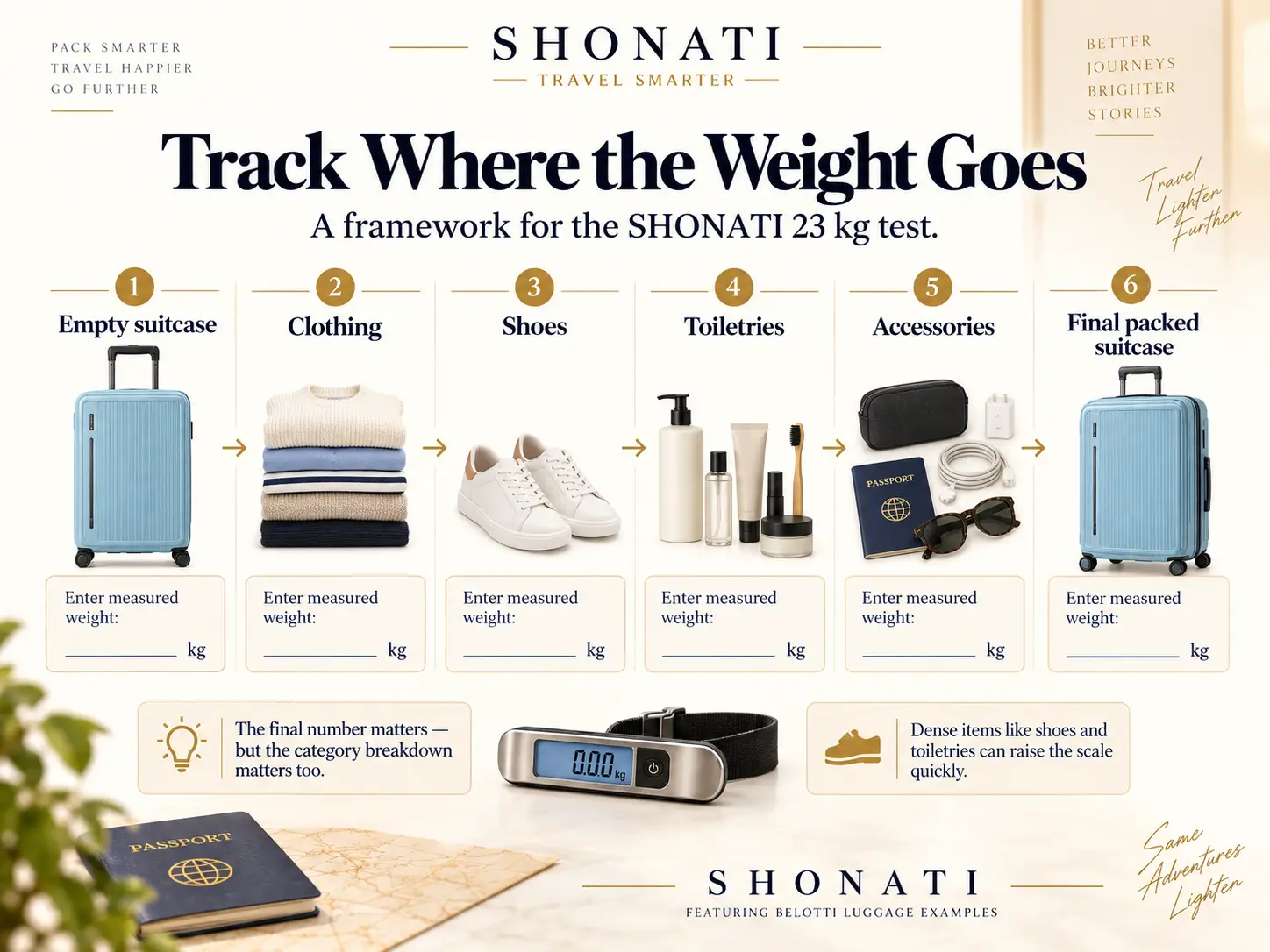
Once the physical test is complete, the most useful result is not simply the final number.
We want to see how each category contributed to the total.
| Stage | Added Weight | Running Total |
|---|---|---|
| Empty suitcase | 3.3 kg | 3.3 kg |
| Clothing | {{CLOTHING_WEIGHT}} | {{TOTAL_AFTER_CLOTHING}} |
| Shoes | {{SHOES_WEIGHT}} | {{TOTAL_AFTER_SHOES}} |
| Toiletries | {{TOILETRIES_WEIGHT}} | {{TOTAL_AFTER_TOILETRIES}} |
| Accessories and remaining items | {{ACCESSORIES_WEIGHT}} | {{TOTAL_AFTER_ACCESSORIES}} |
| Final adjustments | {{FINAL_ADJUSTMENT_WEIGHT}} | {{FINAL_PACKED_WEIGHT}} |
Should You Use a Medium or Large Suitcase for 23 kg?
There is no universal answer.
A medium suitcase may be enough if your belongings are relatively dense or your packing list is controlled.
A large suitcase provides more physical volume, which can be useful for bulky clothing, longer journeys or family-related items — but the extra space makes it easier to keep adding things until you exceed the weight allowance.
Compare the BELOTTI 88-2 family:
| Size | Dimensions | Empty Weight | Theoretical Weight Left From 23 kg |
|---|---|---|---|
| 24 Inch Medium | 45.5 × 29 × 64 cm | 3.3 kg | 19.7 kg |
| 28 Inch Large | 50.5 × 32 × 74.5 cm | 3.9 kg | 19.1 kg |
The Large case gives you more volume but starts 0.6 kg heavier.
That trade-off is why the question should not be:
“Which suitcase holds 23 kg?”
Instead ask:
“Which suitcase gives me enough volume without encouraging me to carry more than my weight allowance?”
Packing Technique Changes Space. Item Choice Changes Weight.
This distinction removes a lot of confusing packing advice.
Rolling clothes, folding them differently or using compression organisers can change how efficiently you use the suitcase volume.
They do not make the same belongings physically weigh less.
Packing technique manages space.
Item selection manages weight.
Do Packing Cubes Reduce Luggage Weight?
No.
Packing cubes are useful for organisation and may help use the suitcase space more efficiently, but they do not reduce the mass of the items inside them.
The cubes themselves also have weight.
Compression cubes can reduce the volume occupied by soft items such as clothing, but the clothes still weigh the same.
There is another practical risk: once compression creates more room, it can tempt you to add more items and increase the final suitcase weight.

Rolling vs Folding: What Actually Changes?
Rolling and folding are packing methods, not weight-loss methods.
Depending on the clothing and suitcase layout, either method can affect:
- how efficiently the space is used;
- how easily items can be accessed;
- how much clothing creases;
- and how organised the case remains.
But if you pack exactly the same clothes, changing from folding to rolling does not remove kilograms from the suitcase.
Which Items Add Weight Fastest?
The items that create weight problems are often not the items that take up the most space.
Toiletries and liquids
Liquids can add substantial weight in a relatively small volume. Full-size shampoo, conditioner, shower products and lotions can add up quickly once their containers are included.
Pack quantities that match the trip rather than automatically carrying every full-size container.
Shoes
Different footwear can have very different weights. Do not rely on a generic assumption for “one pair of shoes”.
If weight matters, weigh the actual footwear you intend to pack.
Books and documents
Paper is relatively dense. A few books may occupy less volume than bulky clothing but contribute significantly to the scale reading.
Heavy clothing
Denim, jackets and cold-weather clothing can contribute more weight than lightweight travel clothing even when the number of garments appears similar.
Gifts and return-trip purchases
This is where many outbound packing plans fail.
You may leave home under the limit and return with additional shopping, gifts or souvenirs.
Should You Pack to Exactly 23.0 kg?
SHONATI does not recommend deliberately targeting the exact published limit.
There are several practical reasons:
- your home scale and the airport scale may not display exactly the same reading;
- you may add small last-minute items;
- luggage straps, wrapping or accessories may add weight;
- and you may need some flexibility for the return journey.
Leave a practical margin rather than treating 23.0 kg as the target.
The exact allowance on your ticket remains the actual limit.
Some Items Should Not Use Your Checked-Baggage Weight Budget at All
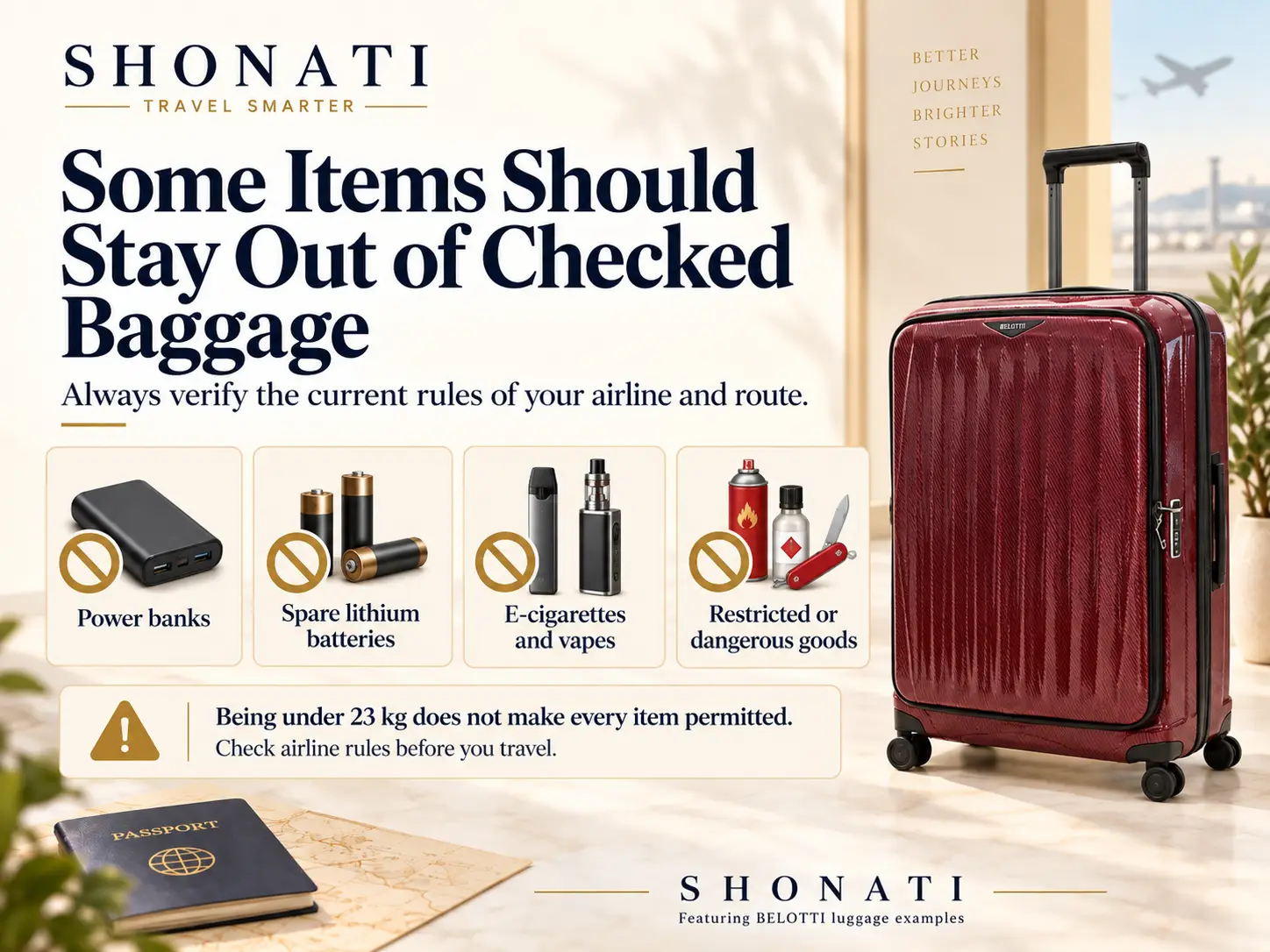
Being under 23 kg does not mean every item inside the suitcase is permitted.
For example, power banks are treated as spare lithium batteries and should not be packed in checked baggage under the applicable rules. See Etihad’s current guidance and Emirates’ power-bank rules, then check the requirements of your own airline.
Before packing, check your airline’s current restrictions for:
- power banks;
- spare lithium batteries;
- e-cigarettes and vaporizers;
- battery-powered devices;
- medications;
- valuable or essential documents;
- and restricted or dangerous goods.
Rules can differ by airline, device, battery rating and destination.
Do not use your 23 kg allowance for something that should not be inside checked baggage in the first place.
Leave Weight and Space for the Return Journey
Return-trip planning involves two different buffers:
Weight buffer
Leave enough allowance for purchases, gifts or anything added during the journey.
Space buffer
Leave enough physical room to pack those items without forcing the case closed or overloading the zipper and shell.
You can have spare space but no weight allowance left.
You can also have weight allowance remaining but no usable physical space.
That is another reason weight and volume should always be treated separately.
23 kg Suitcase Packing Checklist
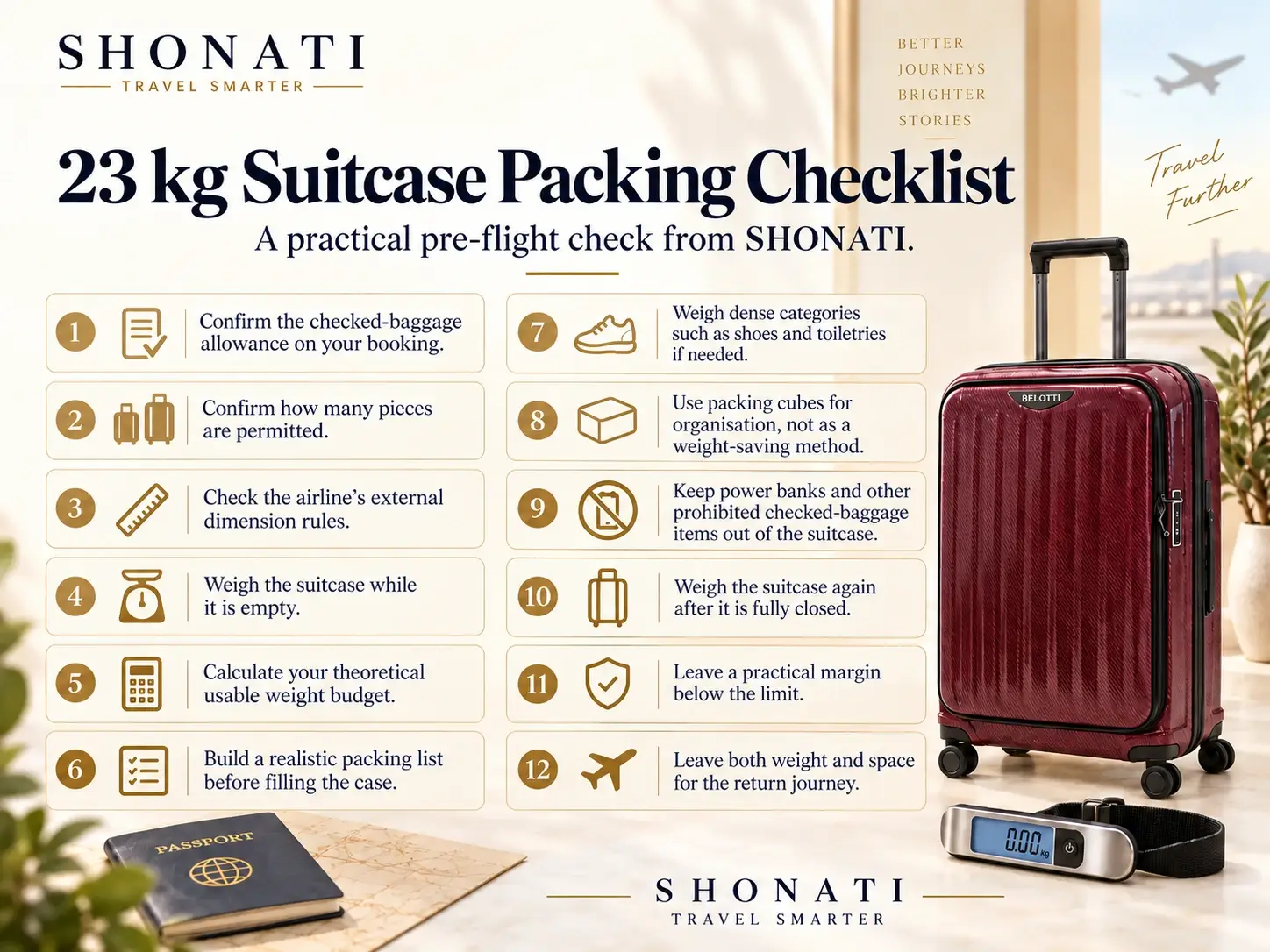
- Confirm the checked-baggage allowance on your actual booking.
- Confirm the number of pieces permitted.
- Check the airline’s external dimension rules.
- Weigh the suitcase while it is empty.
- Calculate your theoretical usable weight budget.
- Build a realistic packing list before filling the case.
- Weigh dense categories such as shoes and toiletries separately if needed.
- Use packing cubes for organisation, not as a weight-saving method.
- Keep power banks and other prohibited checked-baggage items out of the case.
- Weigh the suitcase again after it is fully closed.
- Leave a practical margin below the limit.
- Keep both weight and physical space available for the return journey when possible.
Compare Checked Luggage at SHONATI
If baggage weight matters to your journey, compare more than suitcase size.
At SHONATI, you can browse luggage online and compare available models by:
- empty suitcase weight;
- external dimensions;
- size;
- shell construction;
- interior organisation;
- wheels and handles;
- and current product specifications.
The BELOTTI 88-2, BELOTTI 02541-1 and BELOTTI 88-1 examples in this guide show how much empty weight can vary even between suitcases serving broadly similar travel roles.
You can also compare selected luggage in person at SHONATI Sharjah beside City Centre Sharjah or SHONATI at Wafi Mall, Dubai.
If you already know the baggage allowance for your flight, bring the details with you and compare the suitcase dimensions and empty weights against the requirements of your journey.
View SHONATI store locations and contact details.
Frequently Asked Questions
Does the suitcase itself count toward a 23 kg baggage allowance?
Yes. The airline weighs the packed suitcase as one complete item. The empty case, clothing, shoes, toiletries and everything else inside all contribute to the final weight.
What size suitcase do I need for 23 kg?
There is no fixed suitcase size for 23 kg. Medium and large cases can both reach 23 kg depending on what you pack. Choose enough physical volume for your belongings, then control the final packed weight.
Will a medium suitcase hold 23 kg?
It can. A medium suitcase can reach or exceed 23 kg when packed with dense items. The important question is whether its volume suits your belongings and whether the final packed weight remains within your allowance.
Is a 28-inch suitcase suitable for a 23 kg allowance?
A 28-inch suitcase can be used with a 23 kg allowance if its actual packed weight and dimensions comply with your booking. The size label alone does not guarantee airline acceptance.
How much can I fit in a 23 kg suitcase?
There is no reliable universal number of outfits or items. The answer depends on the suitcase’s empty weight and the density of what you pack. Clothing, shoes, toiletries and books can produce very different combinations of weight and volume.
Is 23 kg enough for one week?
For many travellers it can be, but there is no universal answer. Climate, clothing type, footwear, personal items and packing habits can change the required weight significantly.
Is 23 kg enough for two weeks?
It can be for some travellers, particularly when clothing can be repeated or washed during the trip, but trip length alone does not determine baggage weight.
Do packing cubes reduce suitcase weight?
No. Packing cubes can improve organisation and sometimes reduce the volume occupied by clothing, but they do not reduce the actual mass of the belongings.
Is rolling clothes lighter than folding them?
No. Rolling and folding can change how efficiently clothes use the available space, but the same clothing weighs the same either way.
Should I pack my suitcase to exactly 23 kg?
It is more practical to leave some margin instead of deliberately targeting the exact limit. Scales can differ slightly and last-minute additions can increase the final weight.
Can I put a power bank in my checked suitcase?
Power banks are treated as spare lithium batteries by major UAE airlines and are generally not permitted in checked baggage. Check the current requirements of your airline before travelling.
Does staying below 23 kg guarantee my suitcase will be accepted?
No. Airlines can apply dimensional limits, piece limits and restrictions on specific contents in addition to the weight allowance.
Final Takeaway
Packing a 23 kg suitcase becomes much easier when you stop treating 23 kg as a suitcase size.
It is a weight budget.
Start with the empty suitcase.
Subtract its weight from the allowance.
Then monitor the categories that actually add weight as you pack.
Remember:
Packing technique changes space. Item choice changes weight.
A medium suitcase may be enough. A large suitcase may give you useful extra volume. A lighter empty case may preserve more of the allowance for your belongings.
But the final decision should always consider weight, dimensions, packing needs and the exact baggage rules attached to your booking.
Explore luggage at SHONATI online, or compare suitcase weights and sizes in person at our Sharjah and Wafi Mall Dubai stores.
How this guide was prepared: SHONATI used measured and verified empty weights and external dimensions recorded on the product tags for the BELOTTI models shown here. The remaining capacity figures are arithmetic based on a 23 kg example. The staged packing-test method is provided separately; category-by-category packed-weight results will be added only after that test is performed. Airline baggage rules can change by fare, route and operating carrier, so your current booking and airline remain the final authority.