
Luggage Size Guide: Cabin, Medium & Large Suitcases Explained

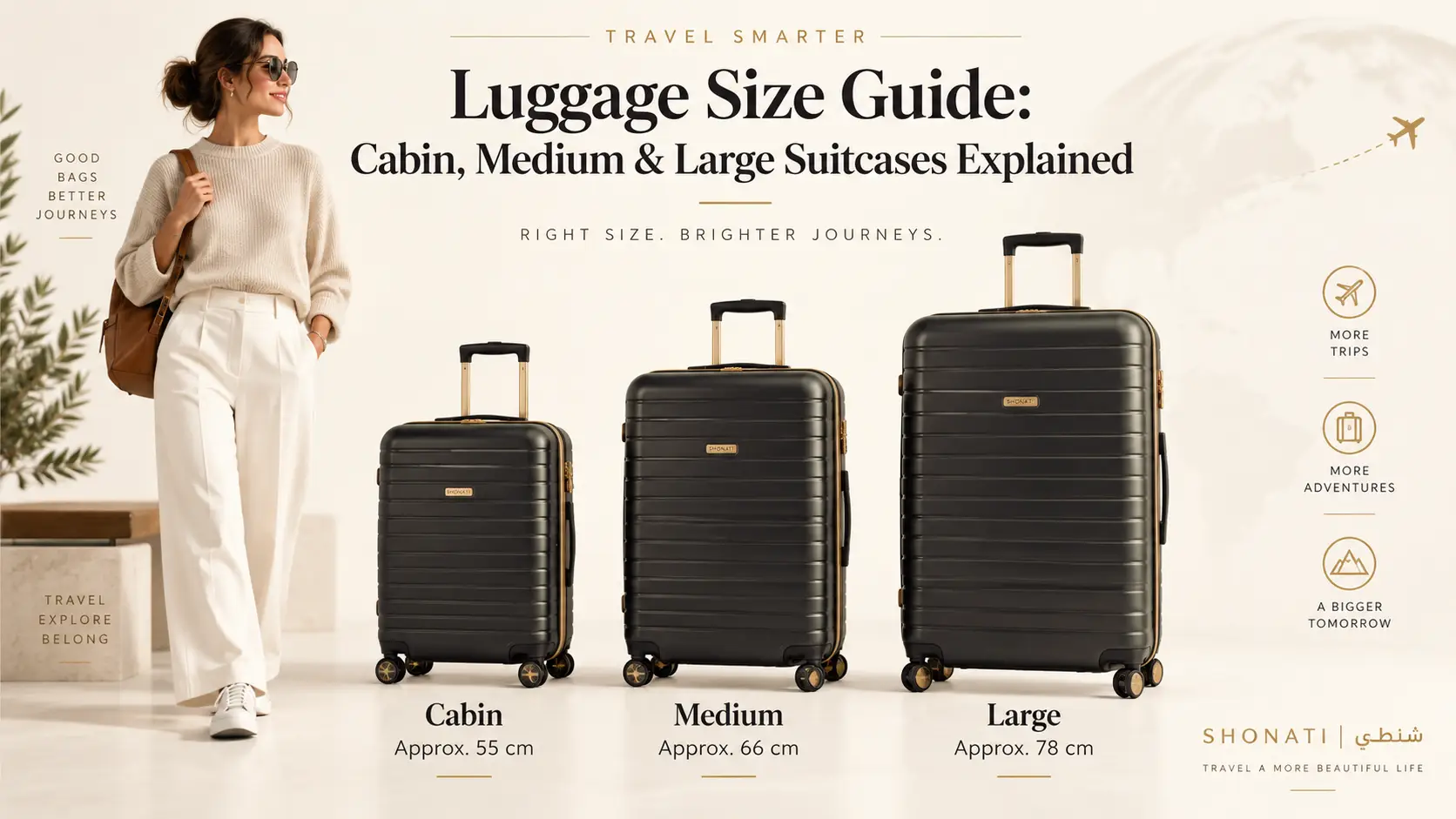
Luggage Sizes at a Glance
| Luggage Type | Common Retail Size | Typical Height* | Best For | Travel Type |
|---|---|---|---|---|
| Cabin / Carry-On | 19–22 in | Approx. 50–56 cm | Short trips, business travel, light packing | Cabin baggage if airline rules allow |
| Medium | 24–27 in | Approx. 60–70 cm | Mid-length trips and many 5–10 day journeys | Checked baggage |
| Large | 28–31 in | Approx. 70–80 cm | Long trips, families and extra shopping | Checked baggage |
*These are practical shopping ranges, not official airline standards. Exact dimensions vary by brand and model.
Compare Real Cabin, Medium and Large Suitcase Dimensions
These examples use the specifications listed on SHONATI product pages. They show why the complete measurements matter more than the size label. Follow each link for current colours, prices and availability.
| Size | Example model | External dimensions (H × W × D) | Empty weight |
|---|---|---|---|
| Cabin | American Tourister Aerojoy 55cm | 55 × 40 × 20 cm | 2.6 kg |
| Medium check-in | DELSEY Air Armour 68cm | 68 × 44 × 29.5 cm; depth expands to 32 cm | 3.8 kg |
| Large check-in | Eminent Vertica 76cm | 76 × 51 × 31 cm | 5.4 kg |
These are model examples, not airline-approval recommendations. Compare cabin limits in our UAE cabin baggage guide and confirm the allowance on your booking. Expansion changes the external depth, and the empty case weight counts towards your packed baggage weight.
Which Luggage Size Should You Choose?
Choose Cabin Luggage If:
- You usually take short trips.
- You prefer travelling light.
- You travel frequently for business.
- You want easier movement through airports.
- You prefer keeping your luggage with you when airline rules allow.
Choose Medium Luggage If:
- You commonly travel for around one week.
- You need more packing space than a cabin suitcase.
- You want a practical all-round checked suitcase.
- You usually carry several outfits and shoes.
- You want some extra room for shopping.
Choose Large Luggage If:
- You are travelling for an extended period.
- You are packing for more than one person.
- You need space for bulky or winter clothing.
- You expect to return with shopping or gifts.
- Maximum packing capacity is a priority.
What Is Cabin Luggage?
Cabin luggage, also known as carry-on luggage, is designed to travel with you inside the aircraft cabin when it meets the airline’s permitted dimensions and weight limits.
A height of around 55 cm is common among cabin suitcases, but height alone does not determine whether a suitcase will be accepted.
Airlines may consider:
- Height
- Width
- Depth
- Weight
- Wheels
- Fixed handles
- Expanded dimensions
SHONATI Tip: Never assume that every 20-inch or 55 cm suitcase automatically qualifies as cabin luggage. Always compare the complete external dimensions with your airline’s latest baggage rules.
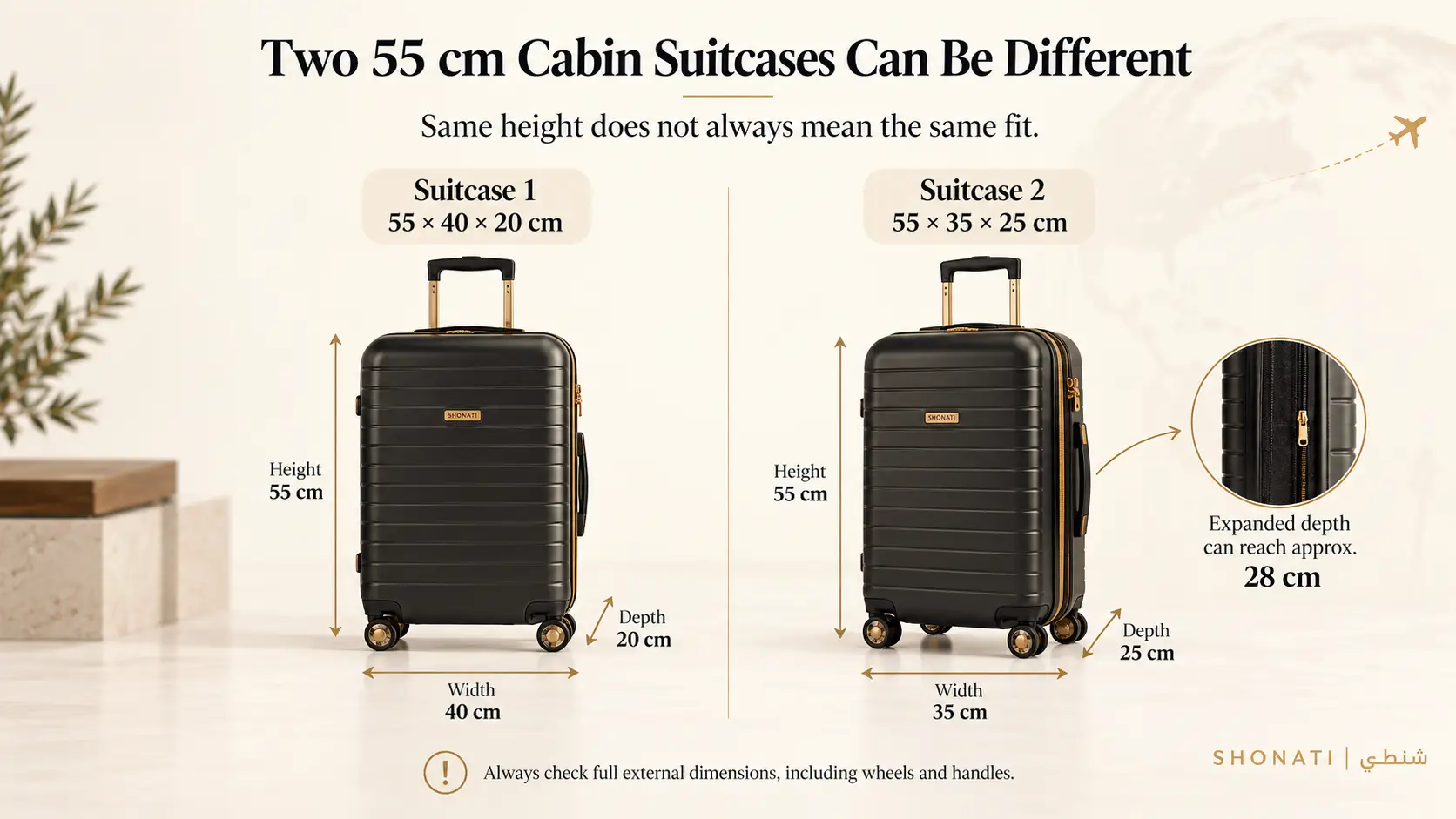
Why Two 55cm Suitcases Can Be Different
Two suitcases can both be marketed as 55 cm cabin luggage while having noticeably different width or depth measurements.
For example, one suitcase may measure:
55 × 40 × 20 cm
while another may measure:
55 × 35 × 25 cm
Both are 55 cm high, but their total external dimensions are different.
This is why comparing only the height or inch label can be misleading.
What Is Medium Luggage?
Medium luggage sits between cabin luggage and large checked luggage and is one of the most versatile choices for many travellers.
A medium suitcase commonly falls somewhere around 60–70 cm in height, although the actual dimensions vary by brand and collection.
Medium luggage usually works well for:
- Week-long holidays
- 5–10 day trips
- Business trips requiring additional clothing
- Travellers carrying several pairs of shoes
- Trips involving some shopping
- Couples who pack efficiently
For many travellers looking for one practical checked suitcase, medium luggage is often the best place to start.
What Is Large Luggage?
Large luggage prioritises packing space and is normally used as checked baggage.
Large suitcases commonly sit around 70–80 cm in height, although the exact size depends on the manufacturer and model.
Large luggage can be particularly useful for:
- Long holidays
- Family travel
- Cold-weather trips
- Bulky clothing
- Extended international travel
- Shopping trips
- Packing belongings for more than one person
Is Bigger Always Better?
No. A larger suitcase gives you more packing space, but it can also encourage overpacking.
Before choosing the biggest suitcase available, consider:
- Your airline’s checked baggage allowance
- The empty weight of the suitcase
- Whether you can lift it comfortably
- Taxi or car boot space
- Stairs and public transport
- How much capacity you realistically need
What Luggage Size Do You Need for Your Trip?
Trip length is only a starting point. Clothing, footwear, laundry access and return shopping can change how much space you need. Use our suitcase size guide for 3, 7, 10 and 14 days to build a shortlist around your packing needs.
20 vs 24 vs 28 Inch Luggage
Retailers often describe luggage using inch-based labels:
- 20-inch: often marketed as cabin luggage
- 24-inch: often marketed as medium luggage
- 28-inch: often marketed as large luggage
However, these labels are only useful shortcuts.
Two 24-inch suitcases from different brands can have different:
- External dimensions
- Capacity
- Empty weight
- Wheel systems
- Interior layouts
- Expansion depth
Always compare the actual height × width × depth measurements instead of relying only on the inch label.
Need a closer size comparison? Read our 20 vs 24 vs 28 Inch Luggage Guide to compare cabin, medium and large suitcases and choose a practical size for your trip.
How to Measure a Suitcase Correctly
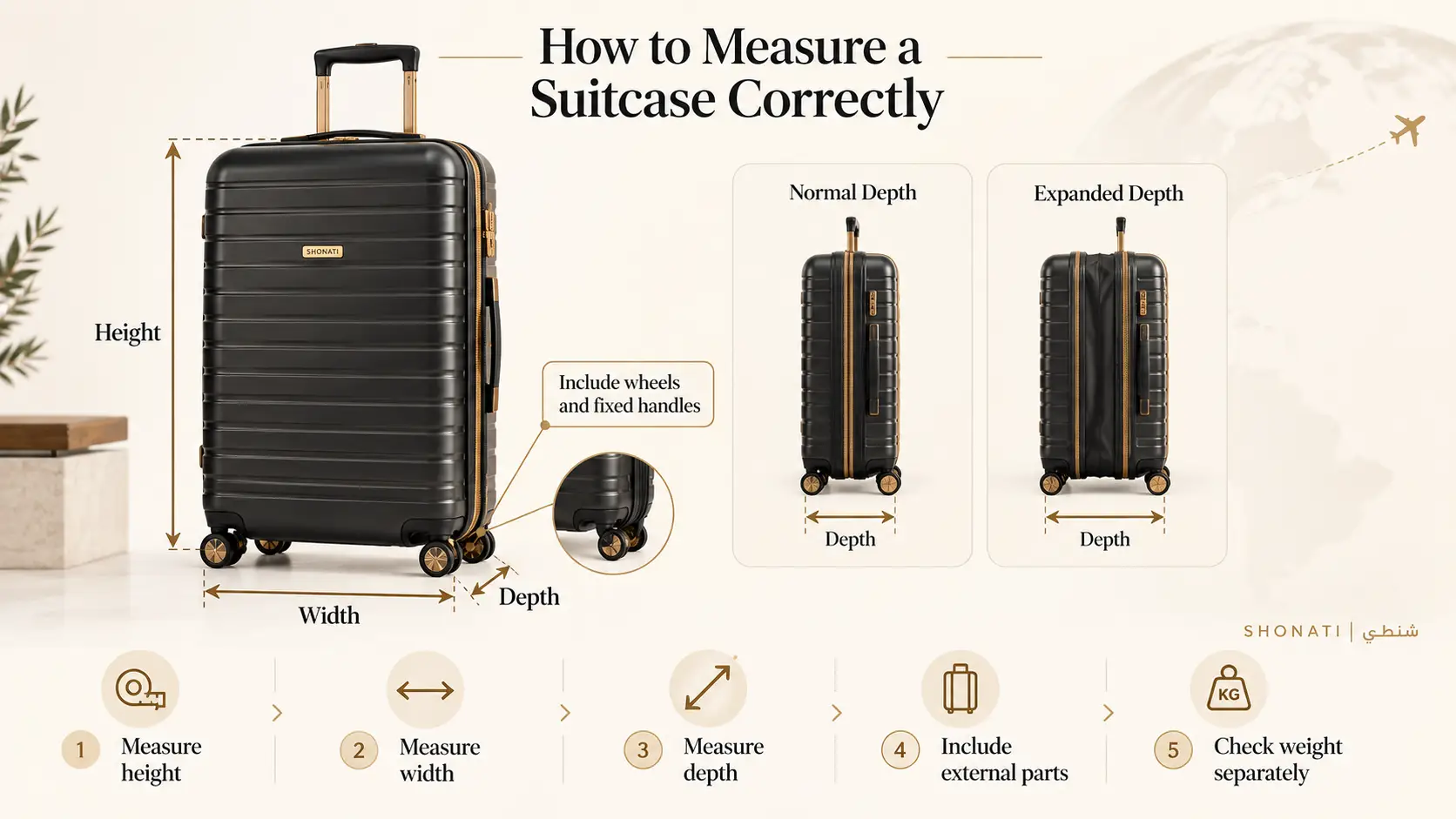
1. Measure the Height
Measure from the floor to the highest external point of the suitcase.
Include the wheels.
2. Measure the Width
Measure across the widest external part of the suitcase.
3. Measure the Depth
Measure from the front to the back of the suitcase.
If the suitcase is expandable, check both:
- Normal depth
- Expanded depth
4. Include External Parts
Depending on the suitcase design, the external dimensions may include:
- Wheels
- Fixed handles
- Side handles
- Exterior pockets
- Protective feet
5. Check Weight Separately
Dimensions tell you whether a bag fits within a physical size limit.
Weight tells you whether it stays within your baggage allowance.
You need to check both.
Does a 55cm Suitcase Always Count as Cabin Luggage?
No.
A 55 cm height does not automatically guarantee cabin acceptance.
Your airline may have different limits for:
- Width
- Depth
- Weight
- Total external dimensions
Rules may also vary depending on the airline, fare, cabin class, route or aircraft.
Important: If your suitcase is expandable, recheck the dimensions after expansion. A suitcase that fits within a cabin limit when closed may exceed the permitted depth when expanded.
Check your airline’s cabin baggage limits: Read our UAE Cabin Baggage Guide to compare cabin bag dimensions and weight limits for Emirates, Etihad, flydubai and Air Arabia before choosing your suitcase.
Should You Choose Luggage by Capacity in Litres?
Capacity in litres can be useful when comparing suitcases, but it should not be your only consideration.
Two suitcases with similar exterior dimensions may pack differently because of:
- Shell construction
- Wheel placement
- Telescopic handle design
- Interior dividers
- Compression systems
- Front-opening layouts
- Curved shells
- Expansion systems
For a better comparison, look at both external dimensions and internal organisation.
6 Common Luggage Size Mistakes
1. Assuming Every 20-Inch Suitcase Is Cabin Compliant
It is not guaranteed. Check the actual dimensions.
2. Looking Only at Height
Width and depth matter too.
3. Forgetting the Wheels
Wheels form part of the suitcase’s external dimensions.
4. Expanding Cabin Luggage Without Rechecking the Size
Expansion can push the suitcase beyond an airline’s permitted depth.
5. Buying the Biggest Suitcase “Just in Case”
More capacity can also mean more weight and harder handling.
6. Forgetting About the Return Journey
This is especially important if your trip includes shopping. Leave some usable space for the journey home.
Cabin vs Medium vs Large: Final Decision
| If Your Priority Is… | Start With |
|---|---|
| Short trips and easy airport movement | Cabin |
| A versatile suitcase for many holidays | Medium |
| More room for longer journeys | Large |
| Family travel | Large or Luggage Set |
| Frequent business travel | Cabin |
| Shopping trips | Medium or Large |
Compare Luggage Sizes in Person at SHONATI
Reading dimensions online is useful, but the difference between cabin, medium and large luggage becomes much easier to understand when the suitcases are standing next to each other.
At SHONATI, you can compare selected luggage sizes across different brands, materials, wheel systems, handles and interior layouts before making your decision.
You can visit our Sharjah store or our Wafi city Dubai showroom. If you are looking for a particular model, size or colour, we recommend checking current availability before your visit.
Choose the suitcase that fits your journey — not simply the biggest suitcase you can buy.
Visit or Contact SHONATI →
|
Explore Our Brands →
Frequently Asked Questions
What is a medium luggage size in centimetres?
A medium suitcase is commonly around 60–70 cm high. Width and depth vary: the DELSEY Air Armour 68cm example above measures 68 × 44 × 29.5 cm before expansion. Medium luggage is normally checked baggage.
What size suitcase do I need for 23 kg?
23 kg is a weight allowance, not a suitcase dimension. A medium or large case may be suitable depending on what you pack. Check your airline’s size limit, add the empty suitcase weight to the contents and weigh the packed bag before departure.
What does 158 cm luggage mean?
It means the sum of height, width and depth, not the suitcase’s height. For example, 76 + 51 + 31 = 158 cm. Apply this calculation only when your airline specifies a combined-dimension limit; check weight and route-specific rules separately.
What is the best luggage size for a 7-day trip?
For many travellers, a medium suitcase is a practical starting point for a seven-day trip. Light packers may manage with cabin luggage, while bulky clothing, multiple shoes or planned shopping may make a larger suitcase more comfortable.
Is 24-inch luggage cabin size?
Usually not. A 24-inch suitcase is commonly marketed as medium checked luggage, but always check the product’s actual external dimensions.
Is a 28-inch suitcase considered large?
Yes, a 28-inch suitcase is commonly marketed as large checked luggage. Exact dimensions and capacity still vary between models.
Is 55cm luggage allowed in the cabin?
Sometimes, but not automatically. Always compare the complete height, width, depth and weight with your airline’s current cabin baggage rules.
Which luggage size is best for international travel?
There is no single best size. Cabin luggage can work for shorter trips, medium luggage is versatile for many holidays, and large luggage is useful for longer or higher-volume travel.
Should I buy medium or large luggage?
Choose medium if you want easier handling and enough capacity for many normal holidays. Choose large if you need substantially more room for longer trips, family packing, bulky clothing or shopping.
Final Takeaway
The right luggage size comes down to three things:
Your airline. Your trip. Your packing style.
Use labels such as cabin, medium, large, 20-inch, 24-inch and 28-inch as a starting point. Then check the suitcase’s actual dimensions, empty weight, interior layout and your airline’s current baggage rules before making the final decision.
A few minutes spent comparing the right details can make the entire journey easier.