
Tote vs Shoulder vs Crossbody Bag: Which Fits Your Day?

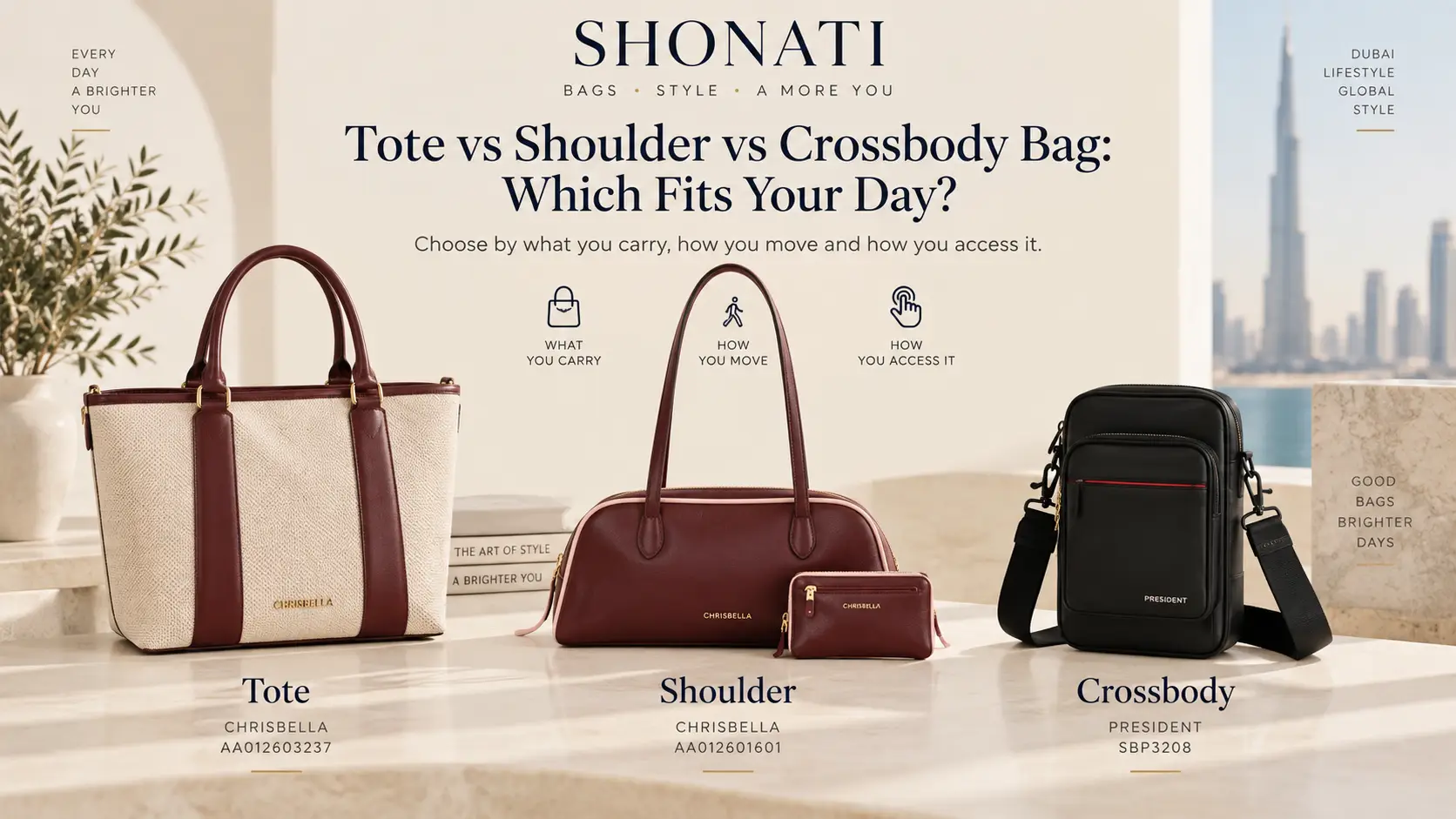
A tote, shoulder bag and crossbody bag can all work for everyday use, but they solve different carrying problems.
A tote usually gives you more open packing space, a shoulder bag keeps everyday belongings close and easy to reach from one side, and a crossbody bag uses a longer strap across the body to keep both hands free and reduce how much the bag moves while you walk.
That is only the starting point.
Two bags with the same label can have completely different dimensions, openings, straps, closures and usable interior space. The better way to choose is to start with what you actually carry, how long you carry it and how you want to access it during the day.
This SHONATI guide compares tote, shoulder and crossbody bags by real-world use rather than treating one style as universally better than another.
Product examples reviewed: 27 September 2026. Product availability, colours and specifications can change. Always check the individual product page or the physical bag before making a final decision.
Tote vs Shoulder vs Crossbody: Quick Answer
| Decision Factor | Tote Bag | Shoulder Bag | Crossbody Bag |
|---|---|---|---|
| Typical carrying position | Hand or shoulder, depending on handle drop and straps | From one shoulder | Across the torso with a longer strap |
| Typical capacity | Often medium to large, but varies by model | Small to medium, with larger options available | Often compact to medium, but not always small |
| Hands-free use | Depends on the handles or additional strap | Usually, although the bag may need repositioning | Usually |
| Access | Often a broad opening | Usually close to one side of the body | Often easy to bring toward the front of the body |
| Walking stability | Depends heavily on the carry method and load | Can move on one shoulder depending on strap and weight | Often stays closer to the body when adjusted correctly |
| Useful for | Workdays, shopping, larger daily loads and extra items | Everyday use, work, casual outings and social plans | Walking, commuting, errands, sightseeing and lighter daily loads |
| Main trade-off | More space can encourage overpacking | Comfort depends strongly on handle drop, strap and load | Capacity may be more limited and strap position is a personal preference |
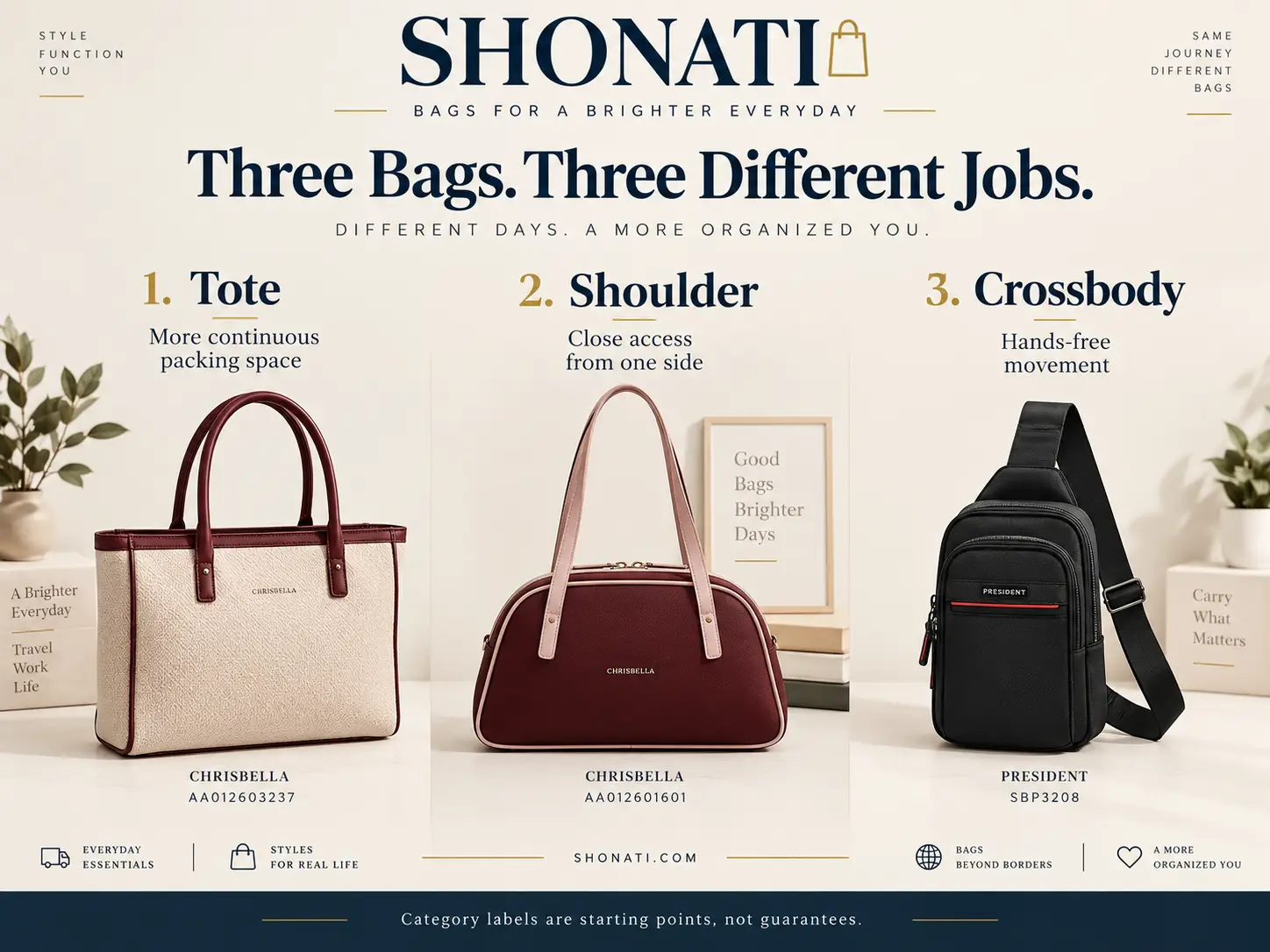
The most important point: these are tendencies, not rules. A compact tote can hold less than a large shoulder bag, and a large crossbody can carry more than a small shoulder bag. Always evaluate the actual model.
The Difference Is Not Just Size
Bag names are useful because they describe the general carrying format, but the label alone does not tell you how practical a specific bag will be.
For example, two tote bags can behave very differently if one has short handles and an open top while the other has longer handles, a zip closure and an adjustable shoulder strap.
The same applies to shoulder and crossbody bags. Before deciding, look beyond the category name and check:
- external dimensions;
- usable opening;
- empty weight;
- handle drop;
- strap length and adjustability;
- whether the strap can be removed;
- closure type;
- number and position of compartments;
- shape of the base;
- and what actually fits inside without forcing the closure.
This is why SHONATI recommends comparing the actual bag, not simply choosing from a label such as tote, shoulder or crossbody.
What Is a Tote Bag?
A tote is generally built around a relatively open, accessible main body with handles rising from the top of the bag.
Traditional totes are often carried by hand or over the shoulder, but modern tote designs can include detachable long straps, zipped openings, internal pockets and more structured bases.
Where a tote can work well
A tote can be a useful starting point when your daily load includes more than a phone and wallet. Depending on the model, that may include a notebook, pouch, small umbrella, bottle, charger or other everyday items.
The advantage is not simply “bigger is better”. A wider opening and more continuous interior space can make larger items easier to arrange.
What to watch for
Extra space makes it easier to carry more than you intended. As the load becomes heavier, handle shape, strap width, empty bag weight and how the bag sits on your shoulder become increasingly important.
Also check the closure. A wide tote with a full top zip behaves differently from an open-top tote, even if the two bags have similar external dimensions.
What Is a Shoulder Bag?
A shoulder bag is designed primarily to hang from one shoulder using one or more straps or handles.
The category covers a wide range of shapes. Some are compact and curved, while others are long, structured or spacious enough for a larger everyday load.
Why shoulder bags are versatile
The bag normally sits close enough for quick access without requiring you to hold it in your hand. That can make a shoulder bag practical for work, shopping, lunches, appointments and everyday movement between different settings.
What determines comfort
The category label does not tell you whether a shoulder bag will stay comfortably in place.
Check:
- how far the handles drop from the shoulder;
- how wide the handles or strap are;
- how heavy the empty bag feels;
- how the bag behaves after loading;
- and whether the shape stays close to the body or moves while walking.
Shoulder shape and personal carrying preference also matter. A design that stays comfortably in place for one person may need frequent repositioning for another.
What Is a Crossbody Bag?
A crossbody bag uses a strap long enough to pass over one shoulder and across the torso, placing the bag on the opposite side or toward the front or back of the body.
This gives the bag a different carrying behaviour from a conventional shoulder bag.
Why people choose crossbody bags
A properly adjusted crossbody strap can keep the bag relatively close while leaving both hands available. That can be useful when walking, commuting, shopping, using public transport or moving through airports and city streets.
Crossbody does not automatically mean small
Some crossbody bags are designed only for compact essentials. Others are larger messenger or sling formats with multiple compartments.
Do not use the word “crossbody” as a capacity measurement. Check the real dimensions, opening and interior layout instead.
Tote vs Shoulder vs Crossbody: Side-by-Side Comparison
| Question | Tote | Shoulder | Crossbody |
|---|---|---|---|
| Need more uninterrupted packing space? | Often a strong option | Depends on shape | Usually more limited in compact models |
| Want both hands free? | Only if handles or strap allow it | Usually | Usually |
| Walking for a long part of the day? | Depends on load and carry method | Depends on strap and stability | Often practical when adjusted close to the body |
| Need quick access? | Often good with a broad opening | Often good | Often good when worn toward the front |
| Carrying a heavier daily load? | Can provide the required space, but check comfort | Possible in larger models | Check strap width, bag size and load carefully |
| Want a compact everyday bag? | Less typical, but compact totes exist | Many options | Many options |
| Need a secure closure? | Choose a model with an appropriate zip or closure | Depends on the model | Depends on the model |
| Need maximum style versatility? | Look for extra shoulder straps | Look for adjustable or removable straps | Look for adjustable and detachable straps |
There is no universal winner. The useful question is not “Which category is best?” but “Which actual bag fits the way I move through my day?”
What Fits? Use the Same-Items Test
One of the easiest ways to compare handbags fairly is to stop judging them empty.
Use the same set of everyday belongings for every bag.
A practical test set can include:
- smartphone;
- wallet;
- keys;
- sunglasses case;
- 10,000 mAh power bank;
- small cosmetic or personal-care pouch;
- tissue pack;
- 500 ml water bottle;
- A5 notebook;
- and a small umbrella.
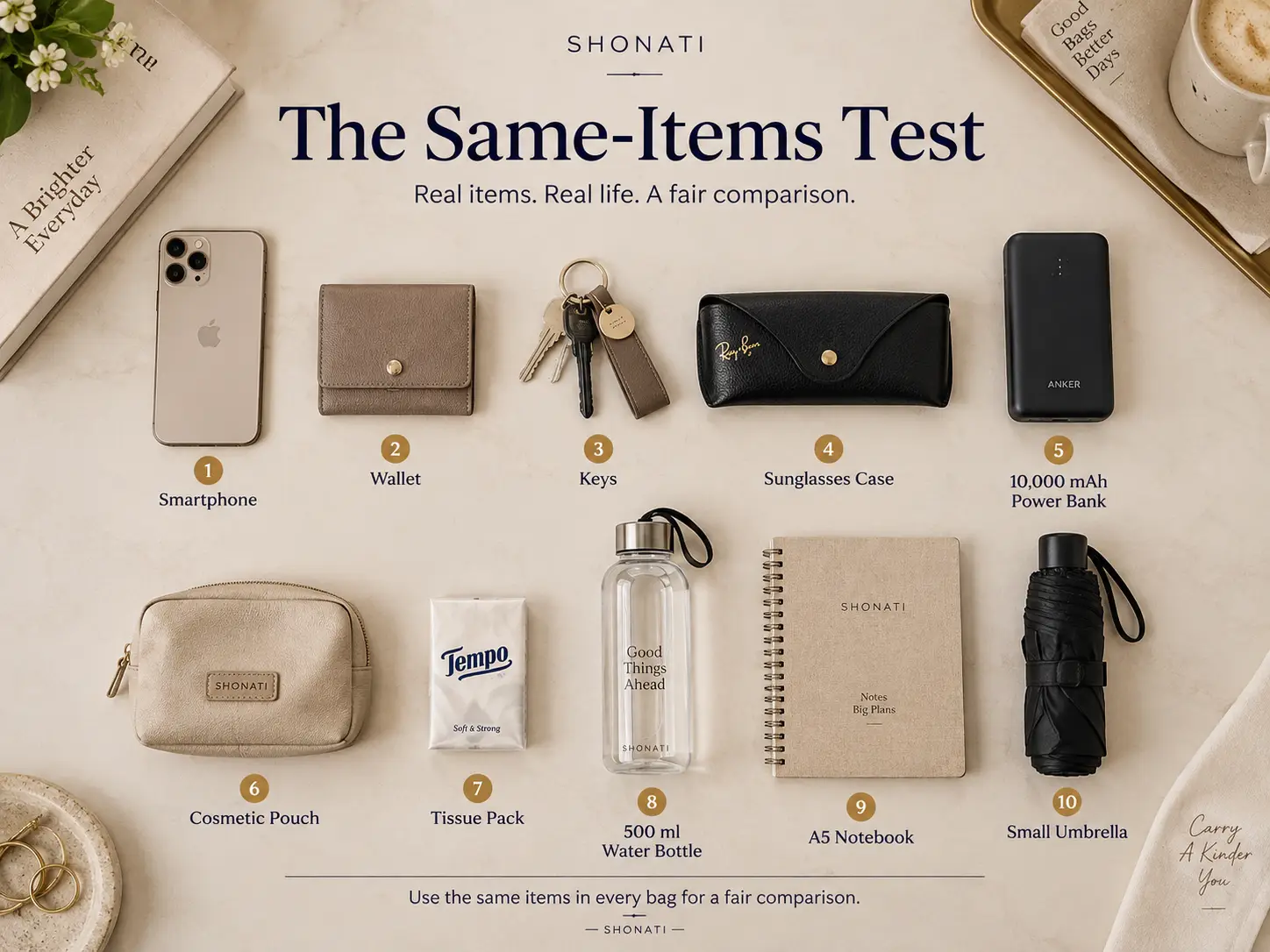
Then load each bag in the same order.
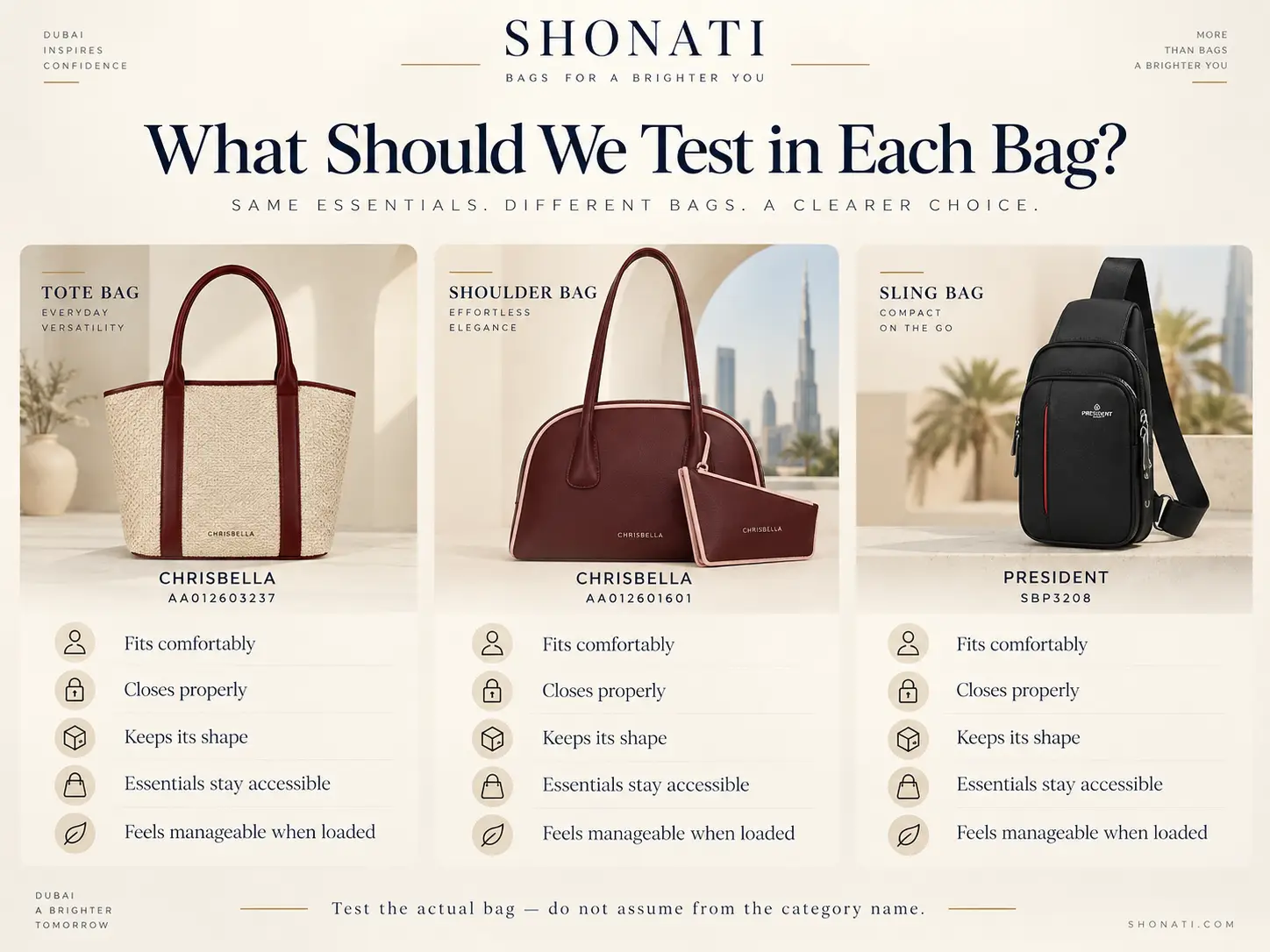
Record:
- which items fit comfortably;
- whether the bag still closes properly;
- whether the shape becomes distorted;
- whether frequently used items remain accessible;
- and how the bag feels once loaded.
Do not force an item into a bag simply to mark it as “fits”. A realistic fit means the bag should still close correctly and the contents should not place obvious stress on the zipper, seams or structure.
Why exterior dimensions are not enough
Two bags can have similar external dimensions but very different usable interiors.
The opening may be narrower than the base. A curved silhouette may reduce usable corner space. Internal dividers and pouches may improve organisation while reducing one large uninterrupted compartment.
That is why a real fit test is more useful than calculating capacity from exterior dimensions alone.
Which Bag Is Easier to Carry?
Comfort depends more on the specific bag, load and strap setup than on the category name.
When comparing bags, consider five things.
1. Empty weight
A bag begins adding load before you put anything inside it. If the empty weight is not published, compare the models physically in store rather than assuming a larger-looking bag is always heavier.
2. Strap width
A narrow strap concentrates the contact area differently from a wider strap. The difference becomes easier to notice as the bag gets heavier.
3. Strap length and drop
A shoulder bag needs enough drop to sit where you want it. A crossbody needs sufficient adjustment to place the bag at a comfortable height rather than too high or too low.
4. How close the bag stays to the body
A compact crossbody worn with a properly adjusted strap may move less while walking than a loose bag hanging from a long handle. That does not mean every crossbody will feel better; shape, strap and load still matter.
5. What you actually put inside
A bag that feels effortless with a phone and wallet can feel completely different after adding a bottle, power bank, notebook and other daily items.
Which Bag Is Easier to Access?
Fast access is not determined only by whether a bag is a tote, shoulder or crossbody.
Ask:
- Is the main opening wide enough?
- Does the closure require one movement or several?
- Can you reach your phone without removing the bag?
- Is the wallet buried below larger items?
- Does the bag remain stable while you open it?
- Are small essentials separated into pockets or mixed together?
A wide tote can provide excellent visibility into the main compartment. A shoulder bag can keep the opening close to one side. A crossbody can often be moved toward the front without fully removing the strap.
The best result comes from matching the access pattern to the items you use most often.
Which Bag Is Better for Work?
Start with your actual work load.
If you carry only a phone, wallet, keys, notebook and a few personal items, many shoulder and crossbody bags may provide enough space.
If you regularly carry a larger notebook, bottle, charger, documents or tablet, a roomier tote may be easier to organise.
If you carry a laptop, do not assume that a large tote automatically fits it.
Compare the laptop’s actual body dimensions with:
- the bag opening;
- usable internal width and height;
- interior shape;
- and whether the bag provides appropriate protection for the device.
If your regular daily load includes a laptop, charger, bottle and work documents, you may also want to compare a dedicated backpack with a handbag before deciding.
Which Bag Is Better for Shopping and Everyday Errands?
For errands, think about movement first.
If you regularly carry extra small purchases or more daily items, a tote can provide useful spare space.
If your load is moderate and you want easy access without carrying the bag by hand, a shoulder bag can be a practical middle ground.
If you want both hands available while walking between shops, using your phone or carrying something else, a crossbody can be particularly convenient.
Again, closure matters. A zipped tote, shoulder bag and crossbody all behave differently from versions with open tops, flaps or magnetic closures.
Which Bag Is Better for Walking, City Days and Travel?
For a day involving a lot of walking, the best bag is usually the one that carries your essential load without encouraging you to add unnecessary weight.
A crossbody can be useful because it keeps both hands available and can usually be positioned toward the front when you need frequent access.
A shoulder bag can also work well if the strap stays comfortably in place and the bag is not overloaded.
A tote may make more sense when you genuinely need additional capacity, but a large tote filled with unnecessary items can become tiring to carry over a long day.
For airports or sightseeing, also consider how easily the bag works alongside your luggage, whether its closure is easy to manage and whether travel documents remain accessible.
What About Security?
No tote, shoulder bag or crossbody should be described as automatically secure or theft-proof simply because of its category.
Instead, look at the actual design.
Useful factors include:
- a main zip or other secure closure;
- how close the bag can be positioned to the body;
- whether frequently used pockets can be closed;
- how exposed the opening is in crowded spaces;
- and whether valuable items can be separated from the easiest-access compartment.
A crossbody may be easier to keep in front of the body in a crowded environment, but that does not replace normal awareness or a secure closure.
Can One Bag Work as Both a Shoulder Bag and a Crossbody?
Yes — but only when the strap system allows it.
Look for:
- a long adjustable strap;
- enough strap length for crossbody positioning;
- attachment points placed appropriately on the bag;
- and detachable hardware if you want to switch carrying styles.
Do not assume every bag with a “long strap” will work equally well crossbody. Strap length, bag size and your preferred carrying position all affect the result.
A real SHONATI example of category overlap
The CHRISBELLA Textured Tote Bag AA012603237 is classified as a tote, but its published design includes both double rounded top handles and a detachable, adjustable long shoulder strap.
That does not change the bag’s basic tote construction, but it shows why real products do not always fit neatly into one carrying category.
Real Bag Examples at SHONATI
The following products illustrate three different approaches to everyday carrying. They are not presented as a capacity ranking, because the products use different shapes and construction and not every page publishes the same measurements.
| Example | Carry Format | Published Size | Closure | Useful Detail |
|---|---|---|---|---|
| CHRISBELLA Textured Tote AA012603237 | Tote with handheld and shoulder options | 36 × 13 × 25.5 cm | Top zip | Double handles plus detachable, adjustable long strap |
| CHRISBELLA Dome Shoulder Bag AA012601601 | Shoulder bag | 39 × 14 × 19 cm | Top zip | Double shoulder handles plus separate zipped pouch |
| PRESIDENT SBP3208 Sling Crossbody | Sling / crossbody | 7.5-inch nominal format; full external dimensions are not published on the current product page | Zip | Adjustable, detachable crossbody strap and multiple external zip sections |
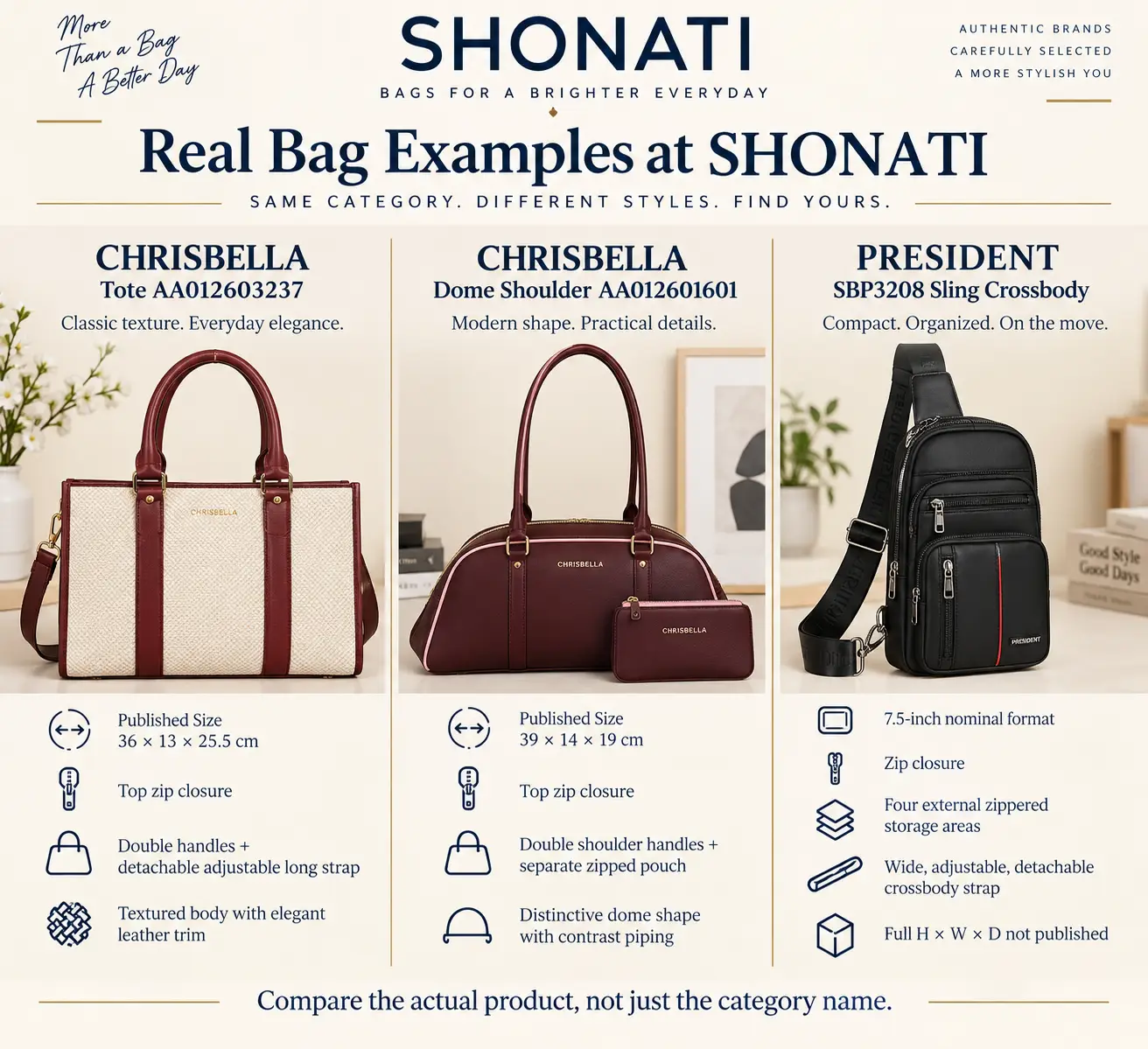
The table demonstrates why direct comparison needs context.
The two CHRISBELLA fashion bags publish full external dimensions. The PRESIDENT example uses a nominal 7.5-inch format on its current page rather than a complete H × W × D measurement. We therefore do not convert that into an estimated capacity or pretend that all three measurements are directly equivalent.
If you want to compare women’s fashion bags specifically, browse the current SHONATI handbag collection, explore CHRISBELLA handbags, or compare additional everyday styles from BAGCO and Vernika.
How to Choose Based on What You Carry
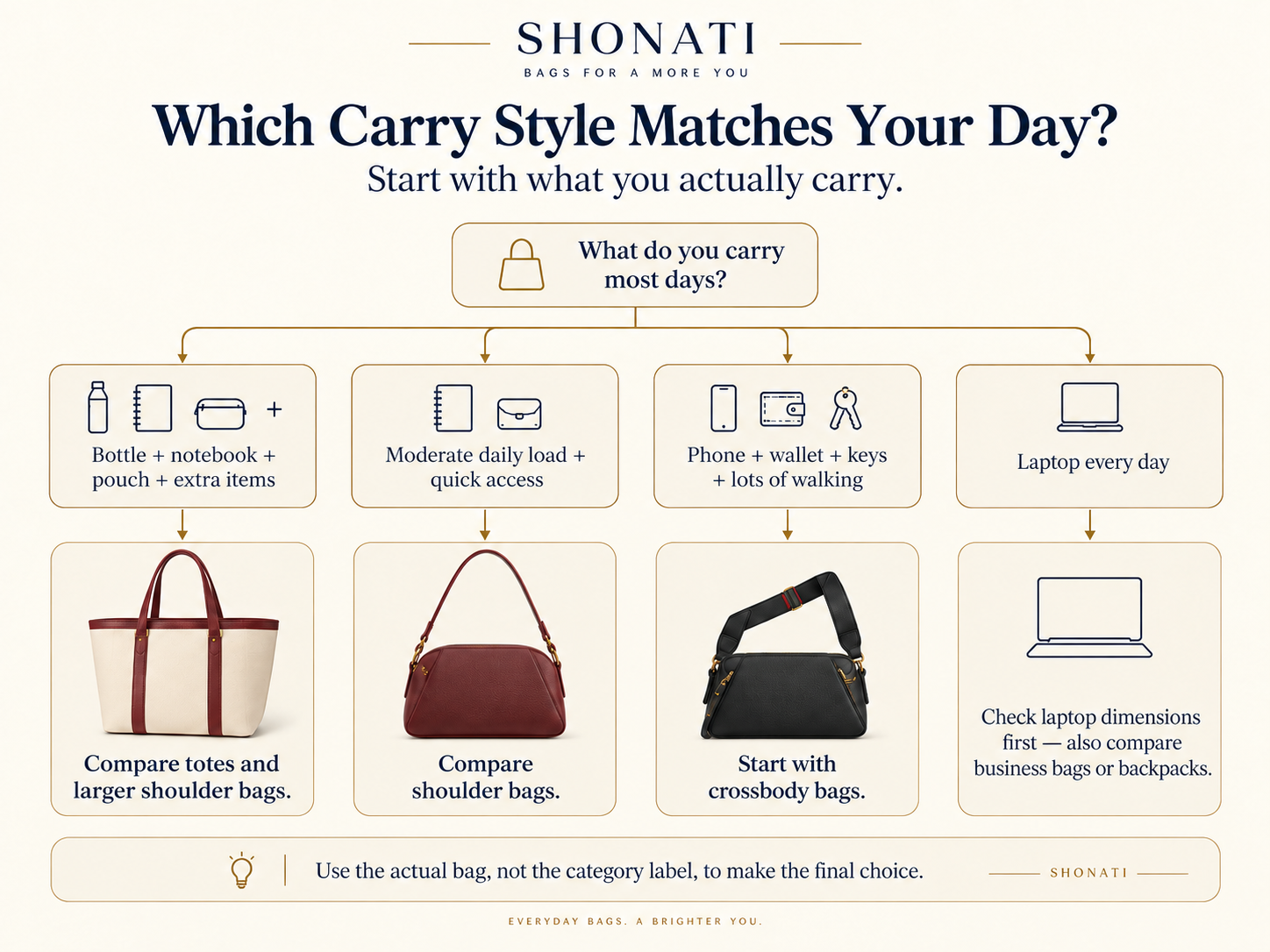
If you carry a bottle, notebook, pouch and several daily extras
Start by comparing totes and larger shoulder bags. Do not choose by category alone — make sure the opening and internal shape work with the largest items you carry.
If you carry a moderate everyday load and want quick access
A shoulder bag can provide a useful balance between capacity and accessibility. Check that the handle drop works for you after the bag is loaded.
If your priority is walking with both hands available
Start with a crossbody. Compare the strap adjustment range, closure, loaded weight and how close the bag sits while moving.
If you want more than one carrying style
Look for a bag with an adjustable or detachable long strap rather than assuming you need two separate bags.
If you carry a laptop every day
Do not start from the words tote or shoulder. Start from the laptop’s actual dimensions and the protection you need. A dedicated business bag or backpack may be a more suitable solution.
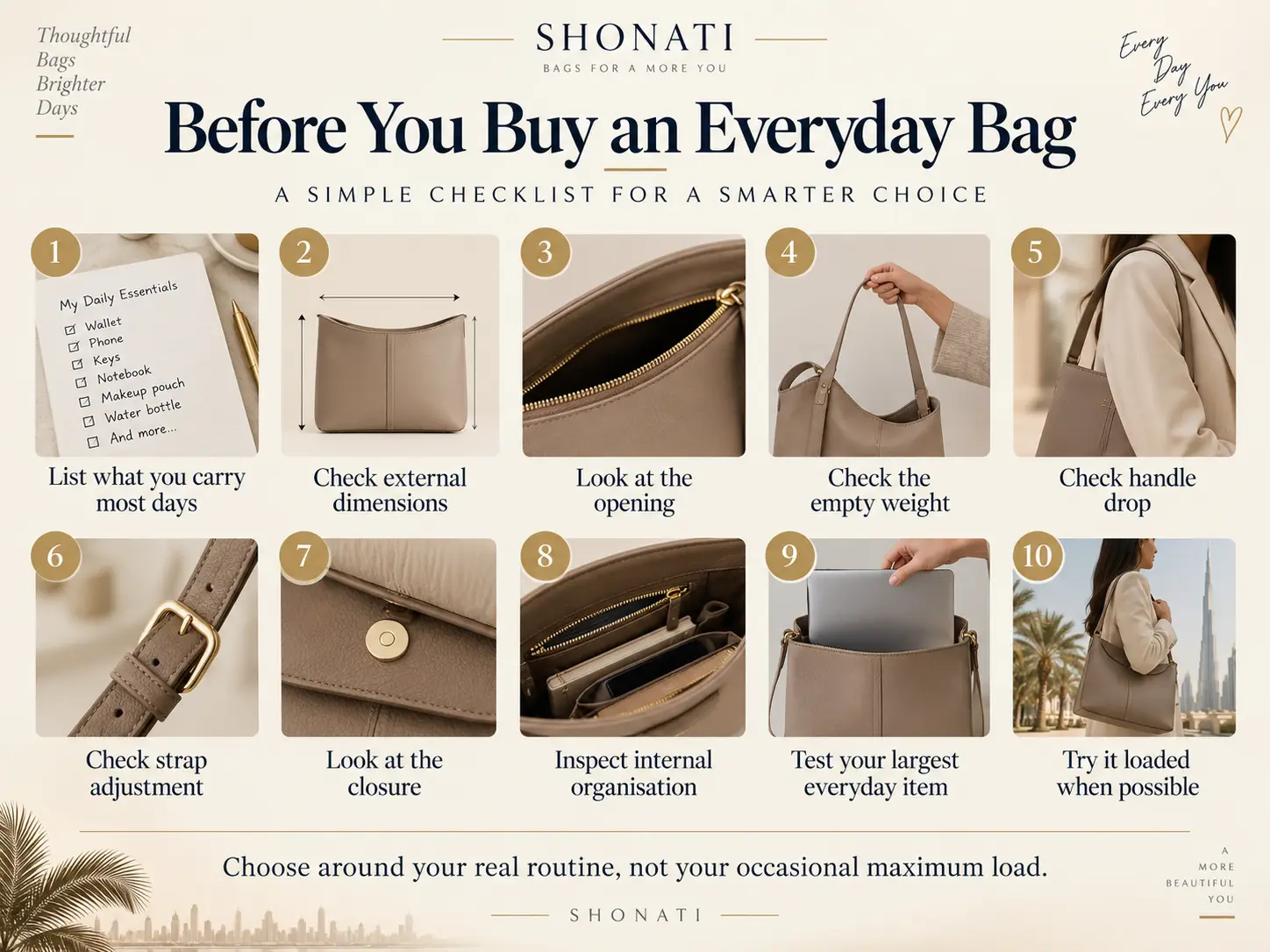
Before You Buy an Everyday Bag: 10 Things to Check
- List what you carry most days. Choose around your real routine rather than your occasional maximum load.
- Check external dimensions. Size labels alone do not tell you what will fit.
- Look at the opening. The opening may be smaller than the widest part of the bag.
- Check the empty weight. A heavy bag leaves less comfortable carrying margin once loaded.
- Check handle drop. Especially important for shoulder carry.
- Check strap adjustment. Especially important for crossbody positioning.
- Look at the closure. Zip, flap, magnetic closure and open-top designs behave differently.
- Inspect internal organisation. More compartments can improve organisation but may reduce one large continuous space.
- Test your largest everyday item. A notebook, bottle, tablet or laptop can determine whether the bag works.
- Try it loaded when possible. How a bag feels empty may not tell you how it behaves during a full day.
Compare Tote, Shoulder and Crossbody Bags at SHONATI
You can browse handbags online at SHONATI and compare available designs by colour, dimensions, carrying style, closure and practical features.
If you prefer to compare bags physically, visit SHONATI Sharjah beside City Centre Sharjah or SHONATI at Wafi Mall, Dubai. Bring the items you regularly carry — or at least note their approximate dimensions — and compare the actual bags side by side.
Product availability can vary by location and colour, so if you are looking for a particular model, check availability before visiting.
View SHONATI store locations and contact details.
Frequently Asked Questions
What is the difference between a tote bag and a shoulder bag?
A tote is generally built around a relatively open main body with top handles and often more continuous packing space. A shoulder bag is designed primarily to hang from one shoulder. The categories can overlap, especially when a tote includes a longer shoulder strap.
Is a tote bag the same as a shoulder bag?
No. They describe different design and carrying concepts, although one real bag can include features of both. Always look at the handles, strap and actual construction rather than relying only on the product category.
Should I choose a shoulder bag or a crossbody bag?
Choose based on how you move and what you carry. A shoulder bag can provide quick access and a traditional one-shoulder carrying position. A crossbody keeps the strap across the torso and is often practical when you want both hands available.
Which is better for everyday use: a tote or a crossbody?
Neither is universally better. A tote may suit a larger daily load, while a crossbody may be easier when you carry fewer items and walk frequently. Compare the actual model, not just the category.
Can you wear a crossbody bag as a shoulder bag?
Often yes, if the strap can be shortened enough and the bag sits comfortably on one shoulder. Strap design and adjustment range differ by model.
Can a shoulder bag be worn crossbody?
Only if its strap is long enough and the attachment points support that carrying position. A conventional short shoulder handle does not automatically make a bag crossbody-compatible.
Does a tote bag fit a laptop?
Some do, but “tote” does not guarantee laptop compatibility. Compare the laptop’s actual width, height and thickness with the bag opening and usable interior, and consider whether the bag provides suitable protection.
Which bag is better when walking a lot?
A well-adjusted crossbody is often practical for walking because it can stay close while leaving both hands available. However, loaded weight, strap width, adjustment and personal preference are more important than the category name alone.
Which bag carries the most?
Totes are often associated with more continuous packing space, but there is no universal capacity ranking. A large shoulder or crossbody can hold more than a small tote. Compare actual dimensions and usable interior space.
Is a crossbody bag safer in crowded places?
A crossbody can be positioned close to the front of the body, but the category alone does not make a bag secure or theft-proof. Closure type, pocket placement and how you carry the bag still matter.
What should I check before buying an everyday handbag?
Check dimensions, opening, empty weight, strap design, closure, compartments and what your largest everyday items actually need. When possible, compare bags loaded rather than empty.
Final Takeaway
A tote, shoulder bag and crossbody bag are not three levels of the same product. They are different approaches to carrying.
Choose the tote when the actual model gives you the space your routine needs.
Choose the shoulder bag when its handle position, access and capacity match the way you carry every day.
Choose the crossbody when hands-free movement and close-to-body carrying matter more than maximum capacity.
Most importantly, do not choose from the label alone.
Check the actual dimensions, opening, strap, closure and loaded behaviour of the specific bag you are considering.
Explore women’s handbags and everyday bags at SHONATI online, or compare selected models in person at our Sharjah and Wafi Mall Dubai stores.
How this guide was prepared: SHONATI reviewed current handbag and crossbody products available on shonati.com and compared their published dimensions, carrying systems, closures and storage layouts. We do not treat category labels as proof of capacity or comfort, and we do not estimate missing product dimensions. Product specifications and availability can change, so check the current product page or physical item before purchase.