
2 Wheel vs 4 Wheel Luggage: Which Should You Choose?


When comparing 2 wheel vs 4 wheel luggage, start with where you will walk. A four-wheel spinner is a good starting point for smooth terminals, queues and hotel corridors. A two-wheel suitcase deserves a closer look for longer walks over uneven paving. The better purchase still depends on the exact wheels, packed weight, overall size and handling.
Picture the whole journey: leaving home, reaching the terminal, changing trains and covering the final stretch to your accommodation. A case that suits one part of that route may feel quite different on another. This guide helps you compare those trade-offs before you buy.
2 wheel vs 4 wheel luggage at a glance
The central difference is how the suitcase moves. Two-wheel cases normally tilt and follow behind you. Four-wheel spinners can stay upright and change direction beside you. Travelpro’s comparison of the two layouts explains these movement patterns and why neither format suits every traveller.
| Question | Two-wheel suitcase | Four-wheel spinner |
|---|---|---|
| How does it move? | Tilted and pulled, with wheels facing a fixed direction. | Upright, with swivelling wheels for changes of direction. |
| Where should I try it? | A straight walking route and any permitted change of floor surface. | Straight walking, a tight turn and a sideways queue movement. |
| What happens when I stop? | It commonly rests on wheels and support feet. Check its balance. | It can move on a slope. Keep control of the handle. |
| Will it fit my baggage allowance? | Check total dimensions, including the wheels and handles. | Check total dimensions, including the wheels and handles. |
| Which is lighter or roomier? | Read the specifications for the exact size. | Read the specifications for the exact size. |
| Can the wheels be repaired? | Confirm the correct parts and service route for the model. | Confirm the correct parts and service route for the model. |
Use this table to build a shortlist. Wheel count alone does not tell you how a particular suitcase will feel after packing.
What do 2-wheel, 4-wheel and 8-wheel labels mean?
Two-wheel luggage: the tilt-and-pull layout
A conventional two-wheel upright has two rolling wheels at the rear and usually support feet at the front. The wheels turn along the direction of travel but do not swivel sideways like spinner assemblies. Some are partly recessed into the case. Retailers may call these bags rollers or uprights; Travelpro uses the name Rollaboard® for its two-wheel luggage.
Four-wheel luggage: the spinner layout
A spinner normally has a swivelling wheel assembly at each of its four base corners. This lets you change direction without first pointing the entire suitcase down a new path. Both hard and soft cases can use spinner wheels, so shell material and wheel layout are separate choices. DELSEY’s spinner and roller guide describes the two formats.
Eight-wheel luggage: usually four pairs
An “eight-wheel” suitcase is usually a double-wheel spinner: four corner assemblies, with two individual wheels in each assembly. A listing that says “four double wheels” may therefore describe the same layout as one that says “eight wheels”. Check the base photographs and the exact model description.
The distinction between single and paired wheels matters, but the bigger number is not a durability rating. The specialist Suitcase Repair wheel guide describes trade-offs in both constructions. Judge the complete assembly and its movement, rather than assuming eight individual wheels automatically outperform four.
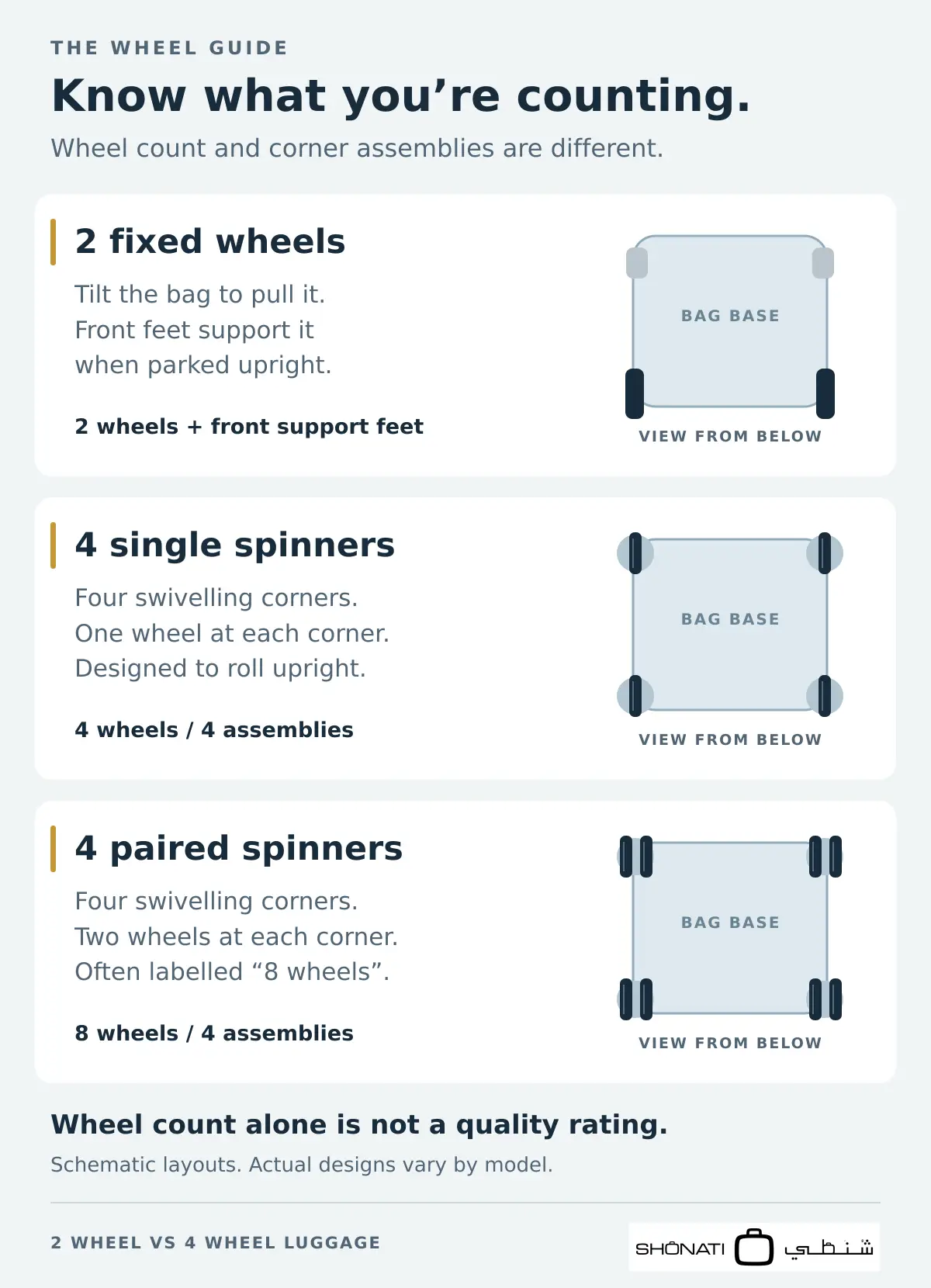
An eight-wheel spinner usually has four corner assemblies with two wheels each. Wheel count alone does not establish quality.
Choose for the route you actually travel
A useful starting point is the part of the journey where moving the bag is hardest. Samsonite’s upright guidance highlights two-wheel handling on uneven surfaces, while spinner movement is particularly useful indoors. Treat that as a shortlist rule, then compare the models you can actually buy.
| Your journey | Start by trying | The deciding question |
|---|---|---|
| Taxi, airport and hotel transfers | A four-wheel spinner. | Can you steer it comfortably beside you and turn without catching your feet? |
| Long walks over uneven city paving | A two-wheel case with wheels suited to that surface. | Does the actual wheel size and clearance suit the route? |
| Busy terminals and slow queues | A four-wheel spinner. | Can you move it sideways and keep it close without repeated lifting? |
| Train changes with stairs | Both layouts, in a manageable size. | Can you lift the packed bag and control it while waiting? |
| Family travel with several bags | The arrangement each traveller will handle. | Who manages each bag during transfers and at steps? |
| A strict cabin allowance | Only models within the relevant size and weight limits. | Which compliant option packs and handles better for you? |
Consider two travellers leaving the UAE for the same city. One takes a taxi directly to a hotel with a lift. The other changes trains and walks along older streets to a guesthouse. The destination is identical, but their luggage priorities differ. Plan around the transfers you have booked, including the return journey.
For mixed routes, ask how often you face difficult surfaces and whether a different transfer would remove that difficulty. A short paved walk need not determine the entire purchase; a daily walk over broken paving deserves more weight in the decision.
On steps and high kerbs, plan to lift the suitcase using its carry handles rather than dragging its wheel housings over edges. A wheel preference cannot solve an unmanageable packed weight. On slopes or moving transport, keep the bag under control; do not rely on either layout to stay still by itself.

Plan for the whole journey: smooth airport transfers, station changes, paving and steps can create different luggage priorities.
Do two wheels give you more packing space or less weight?
There is no fixed space or weight advantage that applies to every two-wheel suitcase. Recessed wheels can reduce how far the running gear projects beyond the body, but usable capacity also depends on the shell, handle channels, lining and interior layout. Compare the same size category using specifications measured on the same basis.
Write down three separate details for each option:
- Overall dimensions: the complete external height, width and depth, including projecting parts.
- Empty weight: the suitcase’s weight before any clothing or other belongings go inside.
- Packing capacity: the published capacity and the shape of the space available, with expanded capacity identified separately if relevant.
A simple example: imagine two cases with the same external dimensions. Case A weighs 2.5 kg empty and Case B weighs 3.0 kg. Under a hypothetical 7 kg total bag allowance, that leaves 4.5 kg and 4.0 kg respectively for the contents. These are illustrative numbers, not SHONATI product specifications or a particular airline’s allowance. The calculation works regardless of wheel count.
For cabin baggage, the airline’s measurement rules remain decisive. IATA’s passenger baggage guidance notes that allowances vary and includes wheels and handles in its general dimensional reference. Check your airline, ticket and operating flight; a “cabin” label alone does not establish acceptance.
Our cabin luggage size guide can help you read those measurements. For the wider choice between cabin, medium and large cases, use the SHONATI luggage size guide.
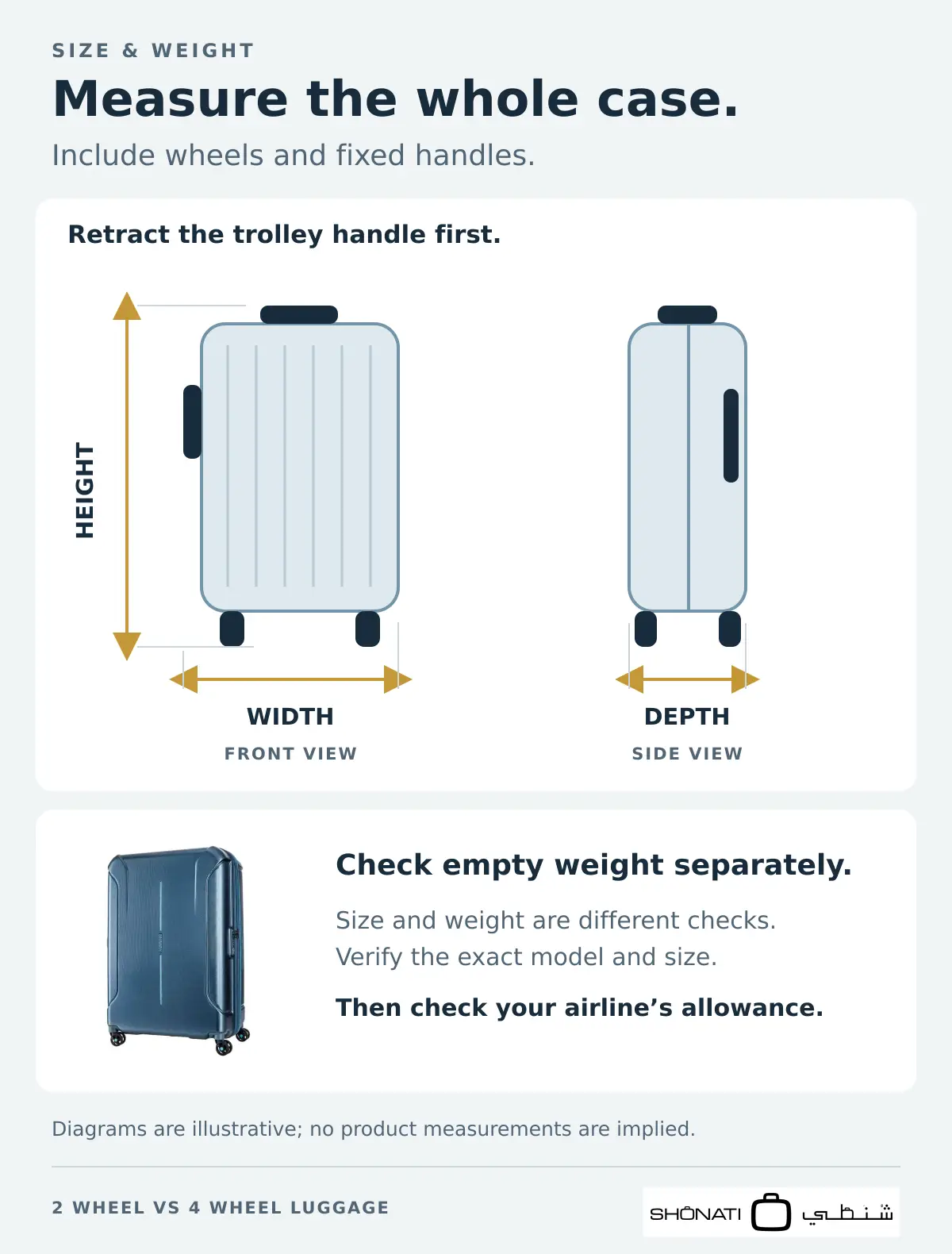
Measure the full external case with the trolley handle retracted, including wheels and fixed handles. Check empty weight separately.
Which wheels last longer, and what happens if one breaks?
Wheel layout is only part of durability. Look at the wheel, its housing and how the assembly attaches to the suitcase. A recessed wheel has some protection from its surroundings; an exposed assembly has different impact risks. Neither observation tells you how many trips a particular model will survive.
Claims such as “silent”, “double” or “360-degree” describe different things. They do not establish a shared quality grade. DELSEY’s guide to suitcase wheel types discusses wheel construction, attachments and maintenance. For a purchase, turn those details into questions about the exact case rather than judging from a label alone.
Ask about the repair route before choosing:
- Can the wheel, the complete assembly or both be replaced on this model?
- How is the correct replacement identified, and who supplies or fits it in the UAE?
- What does the applicable warranty cover, and what would be a paid repair?
- What happens if the housing or surrounding shell is damaged too?
Manufacturer guidance can be model-specific. For example, Travelpro’s wheel-replacement instructions tell owners to confirm the version and order the matching parts. Its repair process should not be assumed to apply to another brand or every wheel arrangement.
Keep proof of purchase and a photograph of the model label. Follow the maker’s care instructions and clear accessible debris from around the wheels. If a wheel starts dragging or the housing looks damaged, ask for advice before forcing it further. A warranty period, by itself, is not proof that every type of wheel damage is covered.
How to compare wheel handling before buying
Bring the travel arrangement you expect to use into the comparison. If you normally travel with a small bag over the trolley handle, ask whether you can try that combination too. Keep within the maker’s guidance and ask staff before adding any load to a display suitcase.
- Walk at your normal pace. Adjust the handle and notice whether the case follows or steers comfortably without catching your heels.
- Try the movement you will need. Compare a straight walk, a turn and stopping. For a spinner, include a sideways movement like the one you use in a queue.
- Compare on the same surface. One bag on smooth tile and another on carpet is not a useful comparison. Listen for scraping and notice hesitation, while remembering that noise changes with the floor.
- Check the bag as a complete arrangement. With any permitted companion bag attached, repeat the turn and stop. Consider whether you can see and reach your belongings easily.
- Connect the result to your route. Comfortable movement on a shop floor helps you judge immediate handling; it does not reproduce cobblestones, baggage handling or years of use.
For online shopping, look for clear views of the base, a movement demonstration, overall measurements and an identifiable model number. If a heading, photograph and specification table disagree about the wheels, ask the seller to confirm the exact item before ordering.
A useful request is: “Please show me the base and wheel layout for this exact model and size, confirm its overall dimensions and empty weight, and explain how wheel repairs are handled.”
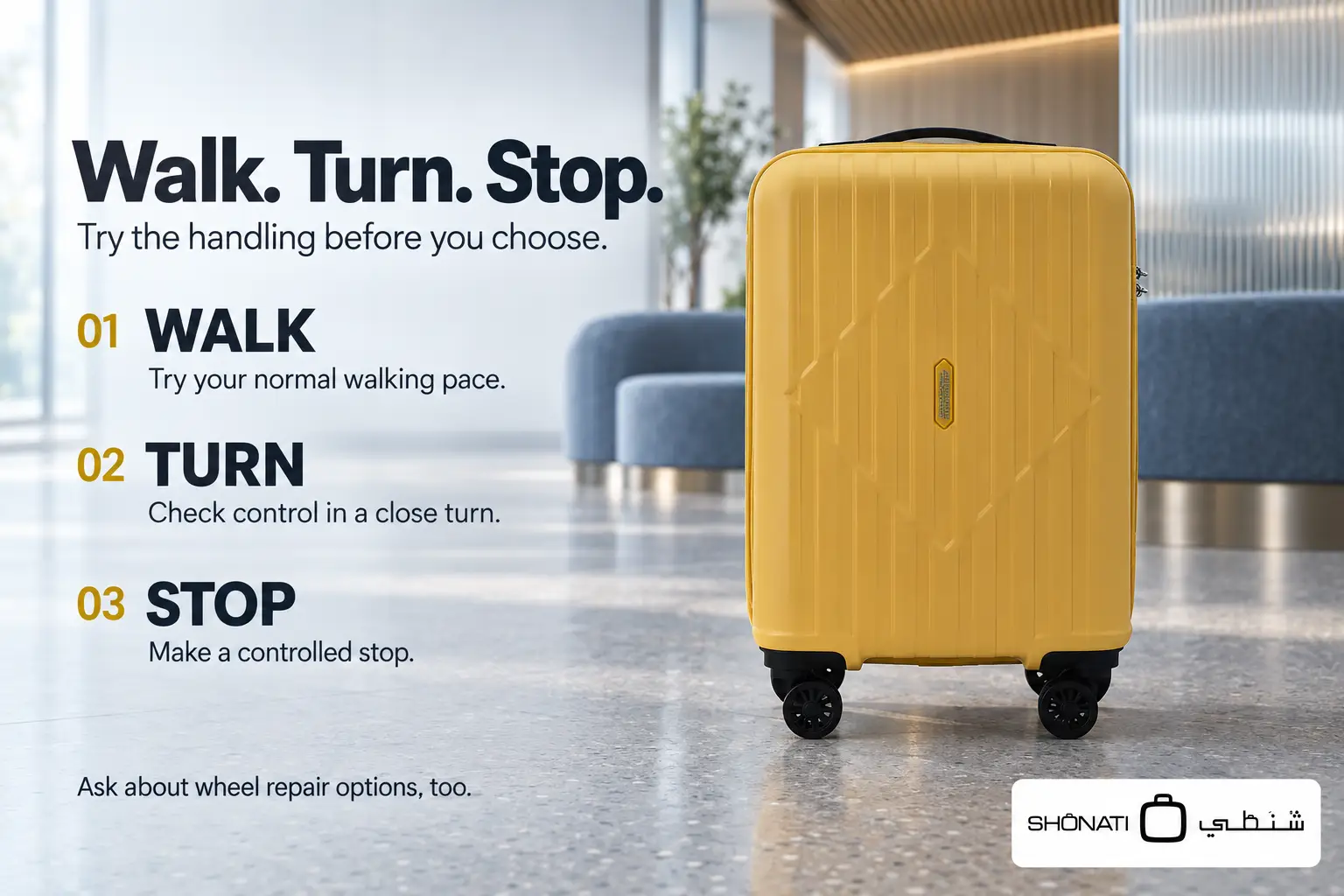
When trying a suitcase, walk at your normal pace, make a close turn and stop under control. Ask about repair options for the exact model.
Frequently asked questions
Is two-wheel or four-wheel luggage better for international travel?
Choose for the transfers as well as the flight. A spinner is a sensible starting point for smooth airport and hotel routes. A two-wheel case may suit substantial walking on uneven paving. Both still need to meet the baggage conditions that apply to your trip.
Can I pull a four-wheel suitcase on two wheels?
Many spinners can be tilted and pulled. Check the manufacturer’s guidance and the clearance on your particular model. Tilting does not change the wheel size, housing or ground clearance into those of a purpose-built two-wheel case; lift over obstacles that would catch the base.
Are eight-wheel suitcases better than four-wheel suitcases?
Eight wheels usually means four paired spinner assemblies. It is a different construction, not an automatic quality ranking. Compare the exact models for movement, mounting, overall weight and repair support.
Do suitcase wheels count in cabin baggage measurements?
Check the airline’s complete external measurement requirements, including wheels and handles. Do not compare a case-body-only measurement with an airline’s overall size limit.
Which wheel type is better for a heavy checked suitcase?
A spinner lets the case remain upright while you steer it on suitable smooth floors. However, the whole packed weight still matters when lifting, crossing steps and handling rough surfaces. Choose a size you can manage and compare how the actual bag moves.
Can I convert my two-wheel suitcase into a four-wheel spinner?
Do not assume a wheel swap will do this. The base, support points and mounting positions need to suit the intended layout. Ask the manufacturer whether an approved conversion exists for the model; replacement parts should match the design they are intended for.
Should I replace a suitcase just because it has two wheels?
If it handles your journeys well, fits the relevant limits and remains in good condition, wheel count alone is not a reason to replace it. If it rolls poorly, check whether cleaning or a suitable repair can resolve the problem before comparing a new case.
Compare your shortlist at SHONATI Sharjah
Start with your route, required size and budget. Then browse the SHONATI luggage catalogue and send the team the exact model or a screenshot to check current options. Ask which wheel layouts and sizes are available before making a special journey.
Visit our Sharjah store on Al Wahda Road, beside City Centre Sharjah, to discuss your shortlist and try normal handling on available models. Choose the suitcase that fits the way you will move, pack and travel.
About this guide: prepared from manufacturer guidance, specialist wheel information and official baggage guidance checked on 13 September 2026. The journey examples and comparison steps are SHONATI editorial guidance; no laboratory durability testing was performed for this article.