
Is Expandable Luggage Worth It? Pros, Cons and What to Check


The attraction is simple: one suitcase can offer a little more flexibility. The decision becomes clearer when you separate three things: the space inside, the size outside and the weight you will actually carry. An expansion feature changes the first two; it does not increase your baggage allowance.
This guide explains the trade-offs, compares two real product examples and gives you a practical way to decide whether the feature deserves a place on your shopping list.
How does expandable luggage work?
Many expandable suitcases have a separate zipper around the case that releases a folded fabric section, often called a gusset. Opening it creates extra packing space and usually increases the suitcase’s depth. The main compartment can remain zipped shut while this expansion section is open. Travelpro’s explanation of expandable luggage illustrates this common design.
Identify the expansion zipper before packing. It does a different job from the main opening zipper, a front-access pocket or the straps inside the suitcase. A convenient front pocket does not establish that the case expands.
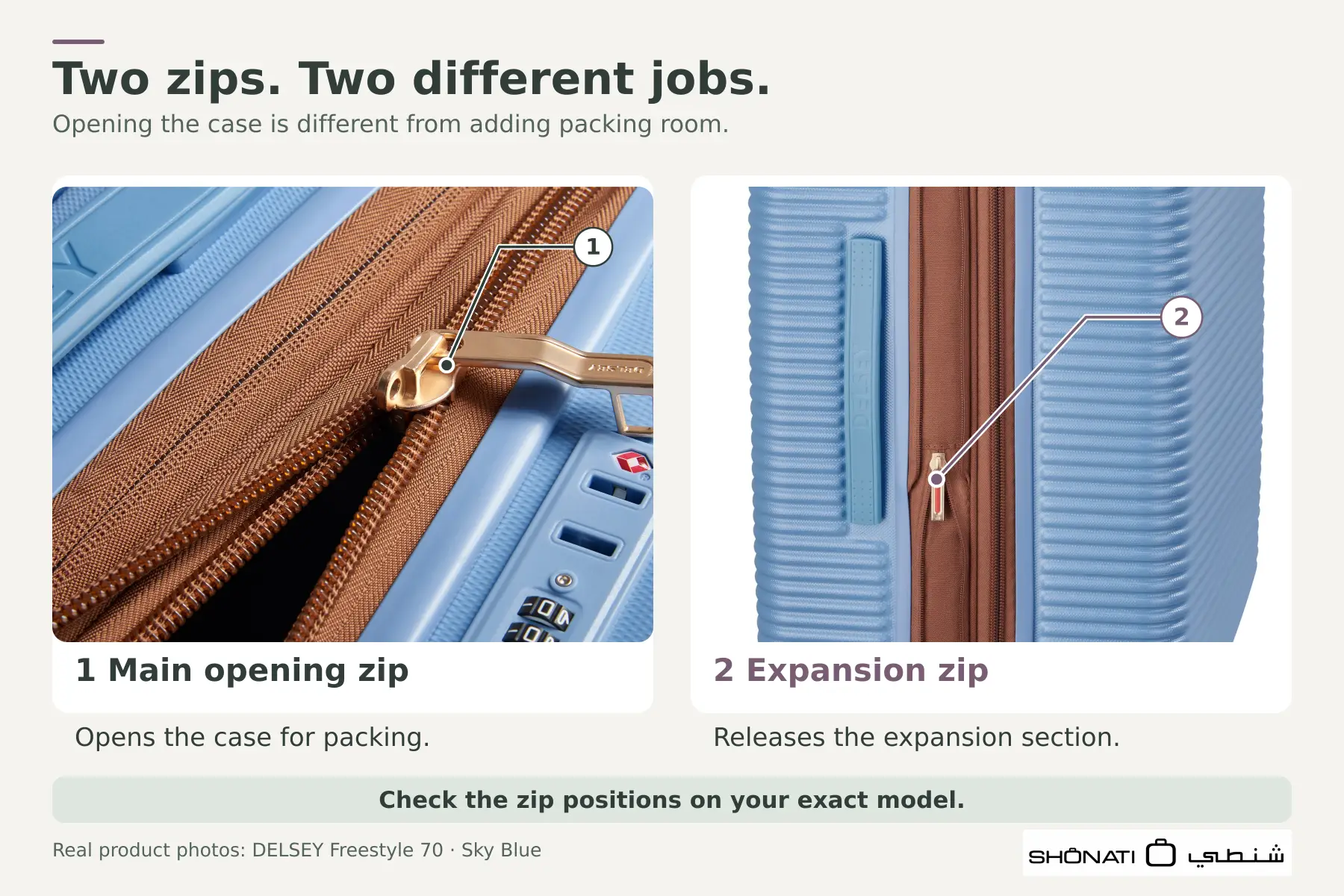
The main zip opens the case; the separate expansion zip releases extra packing room. Check the positions on your exact model.
There are also systems with a separate compress-back step. For example, Briggs & Riley describes its CX mechanism as expanding the case, packing and closing it, then compressing it down. Follow the instructions for that exact model: an ordinary expansion zipper does not automatically provide the same function.
Interior compression straps or compression packing cubes help organise and compress suitable contents. They are separate from external expansion, and compressing the same belongings does not make them weigh less.
Expandable vs non-expandable luggage: which suits your trips?
| Your situation | What expansion offers | What to check before choosing |
|---|---|---|
| You occasionally bring extra clothing or gifts home | Optional space beyond your usual load | The return journey permits the final dimensions and packed weight. |
| Light but bulky items sometimes take up the remaining room | More space without changing suitcases | The actual contents fit comfortably and the packed case remains manageable. |
| You travel with strict cabin-only limits | Flexibility on journeys where a larger packed case is permitted | Expansion may be unusable on your flight; compare the unexpanded case first. |
| Your suitcase reaches the weight limit before it is full | Space that you may not be able to use | Compare empty weights and reduce or reconsider the load. |
| You need the expander for every normal packing list | Enough room only in the larger state | Compare a larger base size rather than choosing by the smaller label. |
| Your usual belongings fit comfortably without expansion | A reserve feature you may rarely use | A non-expandable case may suit you equally well; compare the complete products. |
The main benefit is optional room. Keeping expansion available can help when the return packing list differs from departure. It is particularly useful when space, rather than weight, is the problem.
The trade-off is a larger packed footprint when you use it. Consider storage shelves, car boots and how comfortably you can move the case as well as the flight. Price, empty weight and construction also vary by model: neither the expandable nor non-expandable label tells you which complete suitcase is lighter, cheaper or better built.
How much extra space do you actually get?
Check the published figures for the exact model and size. There is no single capacity increase you should assume from the word “expandable”. These two American Tourister Paxtra examples show why.
| Model | Dimensions, unexpanded → expanded (H × W × D) | Listed capacity, unexpanded → expanded | Calculated gain | Empty weight |
|---|---|---|---|---|
| Paxtra 66 cm medium | 66 × 45 × 29 cm → 66 × 45 × 32 cm | 65 L → 75 L | 10 L; approximately 15.4% | 4 kg |
| Paxtra 75 cm large | 75.5 × 51.5 × 32.5 cm → 75.5 × 51.5 × 35 cm | 102 L → 112 L | 10 L; approximately 9.8% | 5.1 kg |
The SHONATI listings agree with the published specifications for American Tourister’s Paxtra 66 and Paxtra 75. Confirm the exact unit before buying; listed dimensions are reference values, and the table does not establish airline acceptance or current colour availability.
Both gain 10 litres, but the percentage differs because their starting capacities differ. Divide the added capacity by the unexpanded capacity to compare the relative increase. The expanded medium still has less listed capacity than the unexpanded large: expansion does not turn every medium suitcase into a large one.
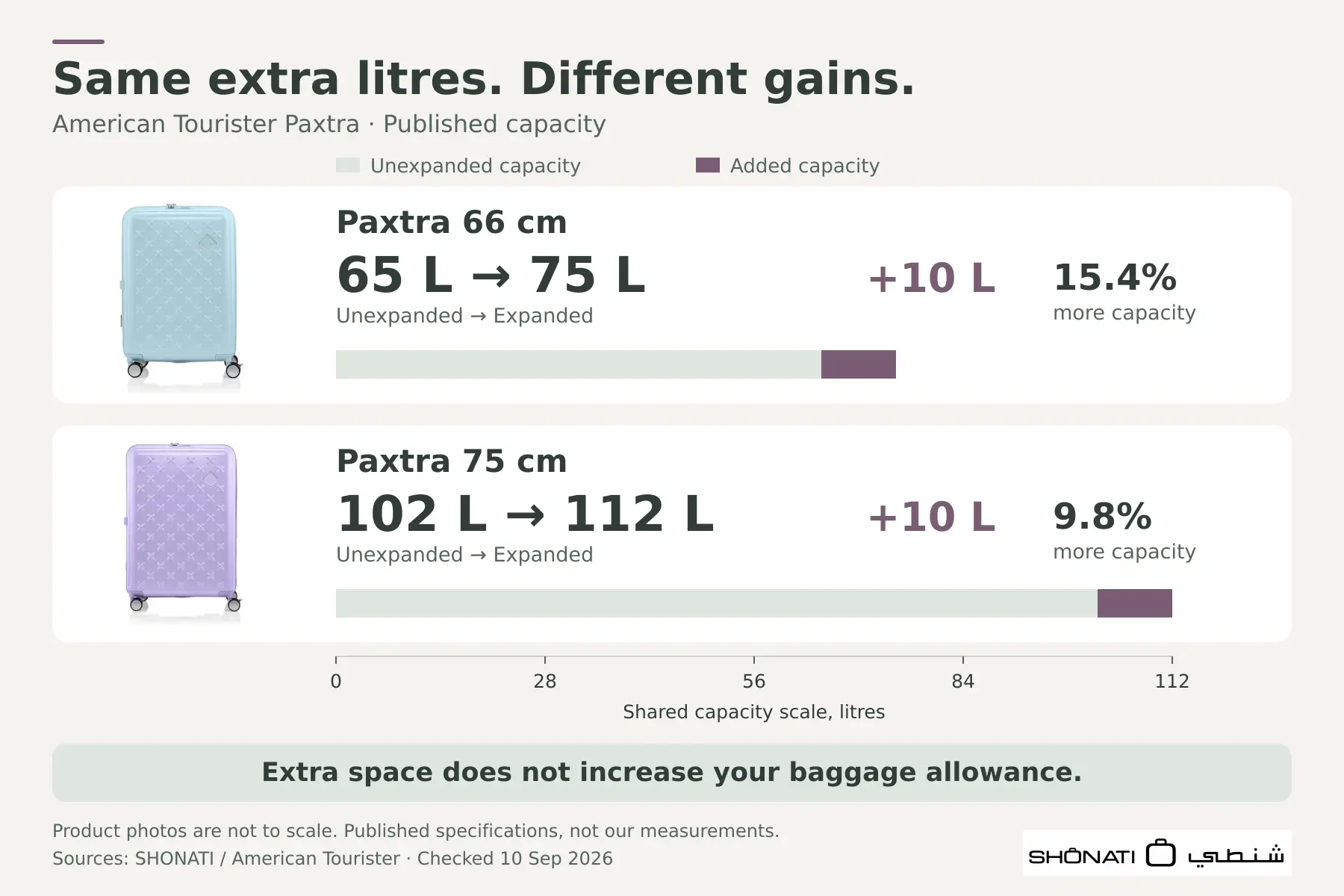
Both Paxtra sizes add 10 litres: approximately 15.4% for the 66 cm case and 9.8% for the 75 cm case, based on published capacities.
Read the capacity label carefully when comparing other brands. Eagle Creek distinguishes estimated internal capacity from overall dimensions, while DELSEY labels the litres on its Helium Ultimate page as external volume. Those are different measurements. Multiplying exterior dimensions does not establish usable packing space, and a litre figure cannot guarantee a particular number of outfits.
Can you use expandable luggage as a carry-on?
Yes, if the actual packed bag meets the rules for your booking. The feature itself does not decide acceptance. Check the final external dimensions, including wheels, handles and protruding pockets, as well as packed weight. IATA’s passenger baggage guidance explains that cabin allowances depend on the airline and other journey conditions.
For a concrete reference, Emirates currently lists standard Economy cabin baggage limits of 55 × 38 × 22 cm and 7 kg. Check the applicable class, route and booking details before travelling.
Illustrative size example: a hypothetical case measuring 55 × 38 × 22 cm closed, but 55 × 38 × 25 cm expanded, exceeds that depth limit when expanded. It can be light enough and still be too deep. This example is not a specification for either Paxtra model in the table.
If your cabin plan depends on keeping the expander closed, pack and measure it that way before departure. Recheck after adding purchases. “I will only expand it on the way home” works only if the return arrangements allow the resulting bag.
Extra capacity does not mean extra baggage allowance
For checked luggage, consider both the bag’s permitted dimensions and the allowance attached to the ticket. Airlines may use weight-based or piece-based systems; Emirates’ checked-baggage rules, for example, distinguish these by itinerary. A large suitcase is not automatically acceptable because it will be checked.
Illustrative weight example: suppose your ticket permits one 23 kg checked bag and your complete packed suitcase weighs 22.4 kg. You have 0.6 kg remaining under that allowance. An expander offering another 10 litres would not change that calculation. The suitcase, clothing and everything else inside all contribute to the packed weight.
Light purchases can run out of space first; dense purchases can run out of weight first. Think about what you intend to bring home instead of treating every unused litre as room you can automatically fill.
Use the narrowest applicable limits across the flights and transport you will actually take. Where airlines, fares or baggage arrangements differ between segments, check each one rather than applying the outbound allowance to the whole trip.
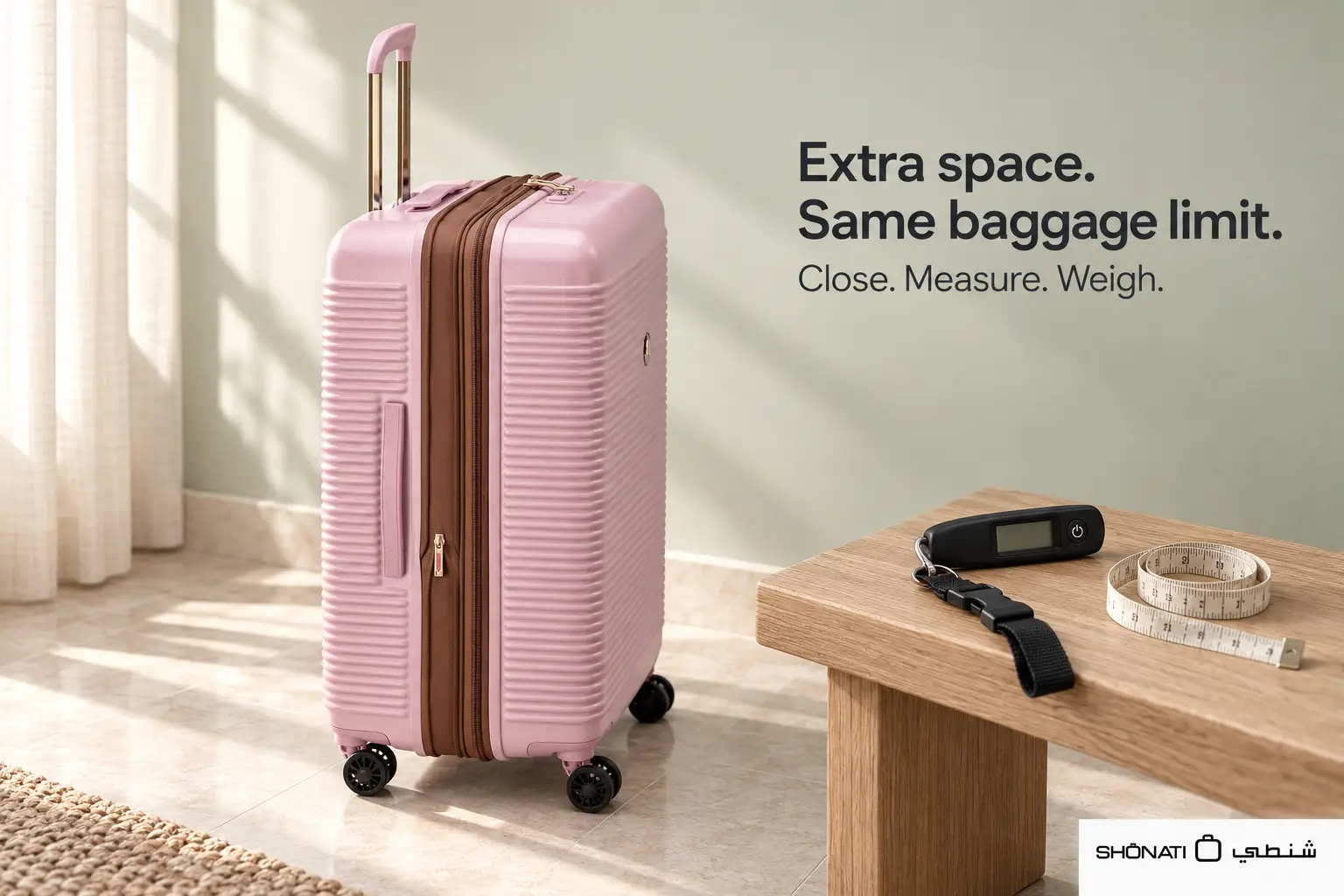
After packing, check the final outside dimensions and total weight against the baggage rules for your booking.
Six things to check before buying expandable luggage
- Find the actual expansion mechanism. Identify which zipper or control releases the extra space. Ask for a demonstration if it is unclear, and check whether there is a separate compression step.
- Compare both external sizes. Request normal and expanded dimensions for the exact size you are considering. If the listing omits expanded depth, have that case measured instead of borrowing a figure from another size in the range.
- Read the capacity labels. Look for a clear before-and-after pair in litres and check what those figures measure. A percentage alone does not tell you the starting capacity.
- Include the empty case in your weight plan. Compare empty weights on the same basis, then allow for your real belongings. More space is useful only if you can use and handle the final load.
- Check normal operation. Open and close the expander without force. Look for caught lining, uneven movement or visible damage. With permission, assess handling using a representative load; that is a practical fit check, not a long-term durability test.
- Picture the return journey. Decide when you expect to use expansion and where the packed case must fit. If it needs to stay expanded on every trip, compare its expanded size with a larger non-expandable alternative.
Also compare the exact warranty and repair terms if these affect your choice. The presence of an extra zipper alone does not establish which suitcase will last longer. If you are still choosing the starting size, use our luggage size guide; our 20 vs 24 vs 28-inch comparison explains why nominal size labels need checking against actual specifications.
Before the return trip: pack, close, measure and weigh
Try the normal configuration first. If the contents do not fit comfortably and your journey permits expansion, release the expander and rearrange the load. Keep fabric clear of the closure and avoid forcing the zipper.
Once packing is finished, measure the outside of the case in its final state and weigh the complete bag. Check those results against the return booking, then consider any onward flight or other transport. If either limit is exceeded, revise the load or arrange an allowed baggage option before reaching the airport.
Expandable luggage FAQs
Can a hard-shell suitcase be expandable?
Yes. The verified Paxtra 66 and 75 examples above are hard-shell cases with expansion. Check the exact size and version rather than assuming that hard-shell construction means fixed capacity.
Does expandable luggage weigh more?
Compare the published empty weights of the actual models. An expansion feature does not by itself tell you which complete suitcase is heavier. Opening the expander on the same case does not add weight; the extra belongings you pack do.
Is an expanded suitcase allowed as checked baggage?
It can be, provided the packed dimensions, weight and number of bags satisfy the relevant booking. Expansion does not waive oversize, overweight or additional-piece rules.
Do all sizes in an expandable luggage range expand?
Do not assume they do. Features can vary by size and version. The Paxtra 55 listing, for example, does not publish an expansion specification; do not transfer the larger models’ figures to it.
Are compression packing cubes the same as luggage expansion?
No. Compression cubes reduce the volume of suitable contents within the case; an expander increases the case’s available space and usually its outside depth. Neither increases the airline’s weight allowance.
Should you force the expansion zipper closed to meet a size limit?
No. Remove or redistribute items so the closure works normally, then measure the packed case again. Closing a zipper does not prove that bulging pockets or other parts are within the permitted dimensions.
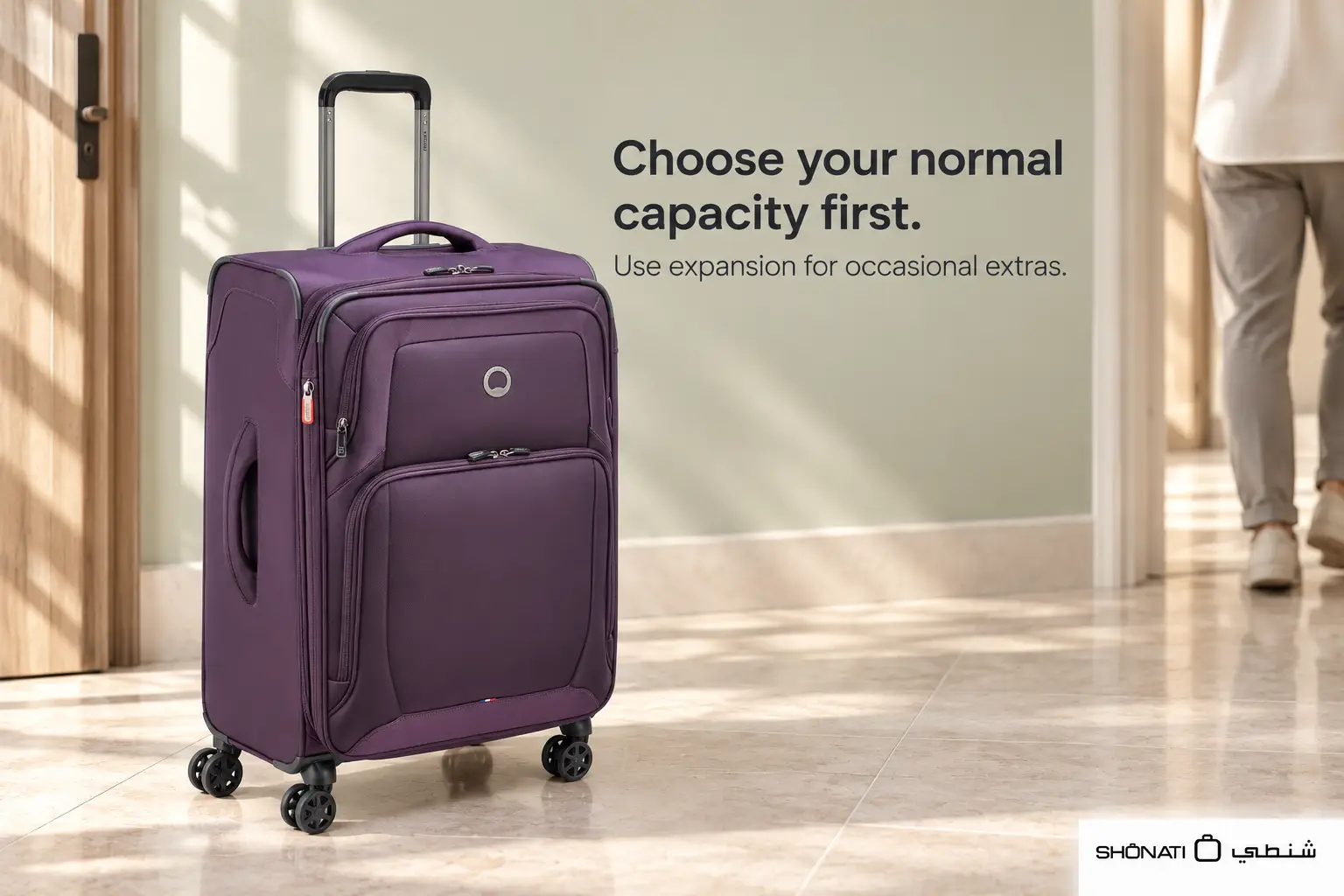
Choose a suitcase that fits your usual packing with the expander closed; keep extra room for occasional needs.
Compare expandable luggage at SHONATI Sharjah
Bring your usual packing list and the baggage limits for your next journey. At SHONATI Sharjah, ask to compare the normal and expanded dimensions of the exact models you are considering, and check current sizes and colours before visiting.
Start with a case that suits your everyday travel needs, then decide whether occasional extra room is worth having. You can contact SHONATI on WhatsApp or use the Sharjah store map to plan your visit.