

Blog
Lightweight Medium Check-In Suitcases in UAE: 18 Real Models Compared

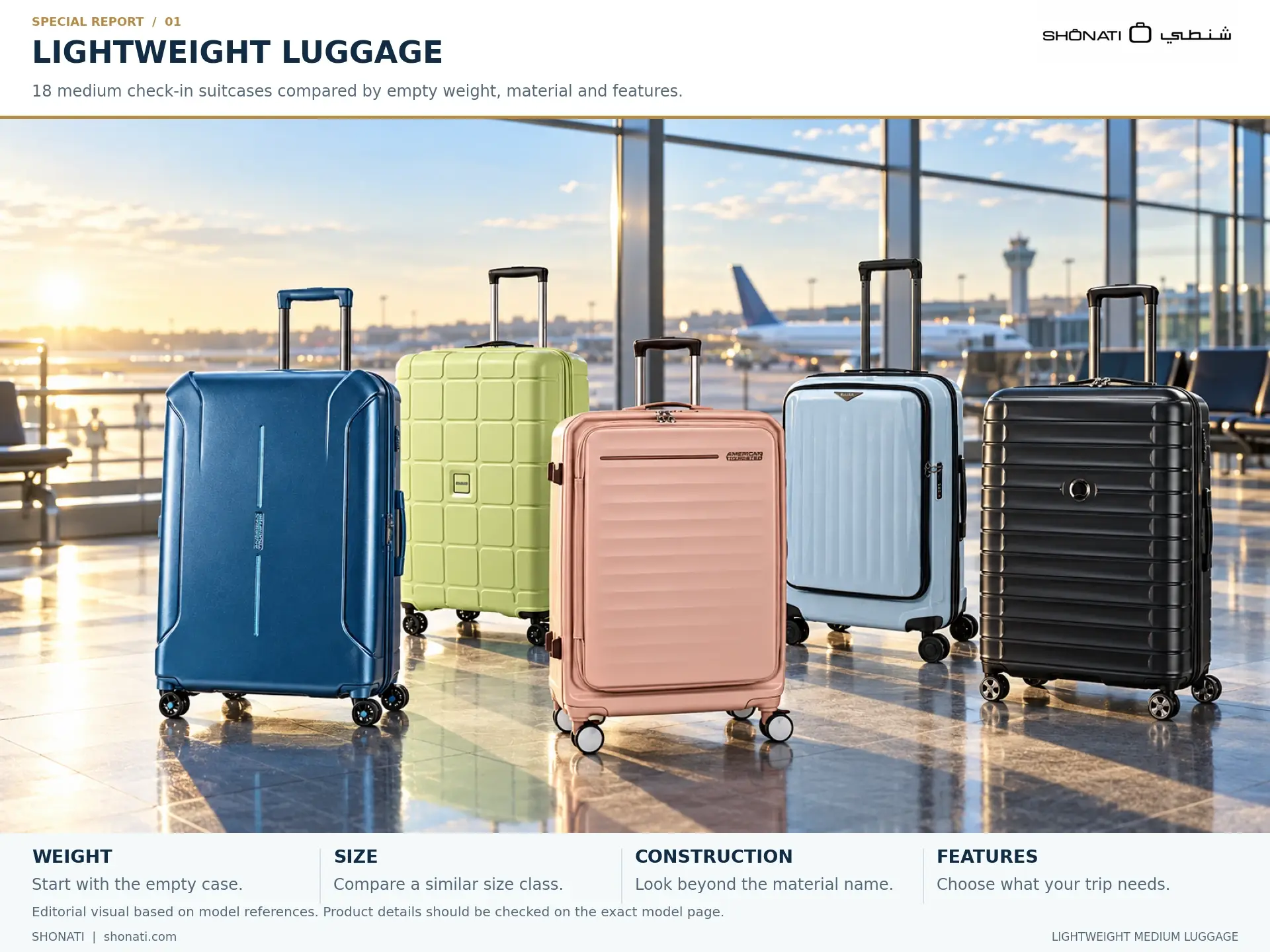
If empty suitcase weight matters to you, comparing only the words “Medium”, “25 inch” or “70 cm” is not enough.
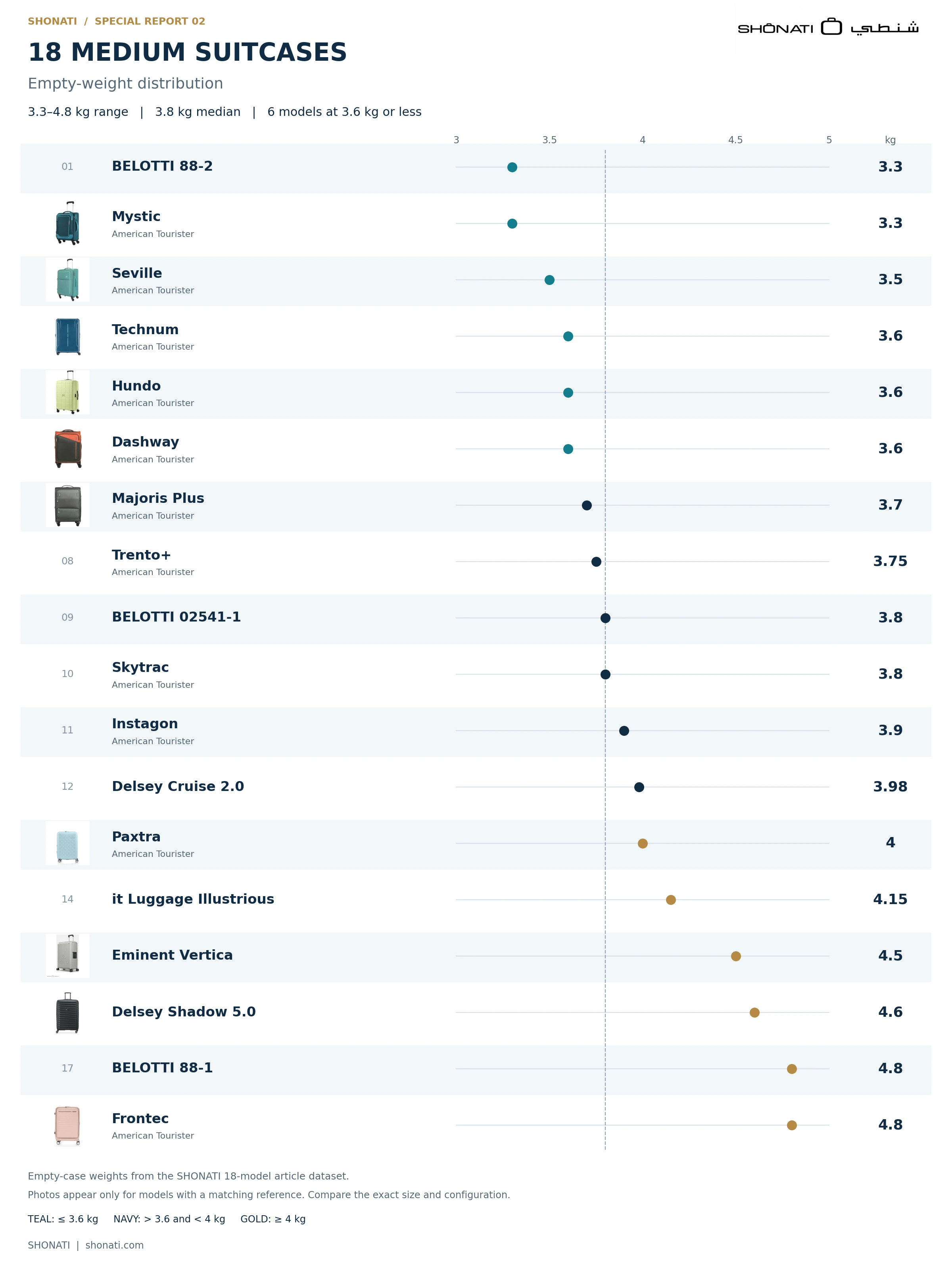
In the current SHONATI medium check-in luggage sample reviewed for this guide, 18 real suitcase models range from 3.3 kg to 4.8 kg empty.
The difference between the lightest and heaviest models is therefore 1.5 kg before anything is packed.
For a traveller working with a 23 kg checked-baggage allowance, that difference can mean 1.5 kg more — or less — available for clothing, shoes and other belongings.
But the lightest suitcase is not automatically the right suitcase.
Construction, packing space, opening style, wheels, locks, expansion and the way you actually travel also matter.
This SHONATI guide compares current Medium Check-In suitcases in the approximately 64–70 cm size class so the weight comparison stays as meaningful as possible.
Dataset reviewed: 30 September 2026. This comparison uses exact model-specific product specifications currently used by SHONATI, including product tags and verified brand or supplier information. Product availability and specifications can change. The statistics in this article describe this SHONATI sample only and are not presented as universal luggage-market averages.
Quick Answer: What Counts as a Lightweight Medium Suitcase?
There is no universal industry weight at which a medium suitcase officially becomes “lightweight”.
Different brands use terms such as:
- Lightweight;
- Lite;
- Ultra-light;
- and Lightweight Checked Luggage
without following one common kilogram threshold.
That is why SHONATI compares actual empty weights rather than relying on the marketing label alone.
In the current 18-model medium check-in sample:
| Dataset Measure | Current SHONATI Sample |
|---|---|
| Models reviewed | 18 |
| Empty-weight range | 3.3–4.8 kg |
| Sample average | ≈3.93 kg |
| Sample median | 3.8 kg |
| Lighter third (6 of 18 models) | ≈3.3–3.6 kg |
| Models at 3.6 kg or below | 6 of 18 |
| Models below 4.0 kg | 12 of 18 |
For this article, we therefore use 3.3–3.6 kg as the lighter end of the current SHONATI medium check-in sample.
This is a description of our current dataset, not a new industry standard.
How SHONATI Built This Comparison
To make the comparison more useful, we limit the main dataset to current Medium Check-In suitcases in approximately the 64–70 cm class.
This avoids comparing a 55 cm cabin suitcase with a 77 cm large suitcase simply because both are marketed as “lightweight”.
For each product we review:
- the exact model and size;
- published empty or net weight;
- external dimensions where relevant;
- shell or exterior material;
- hardside or softside construction;
- opening style;
- expansion where confirmed;
- published capacity where confirmed;
- wheel and security features;
- and the current product specification used by SHONATI.
Prices are not used to determine the weight ranking.
Published weight vs physical in-store weight
The weight shown in the comparison is the confirmed product specification for the exact model and size.
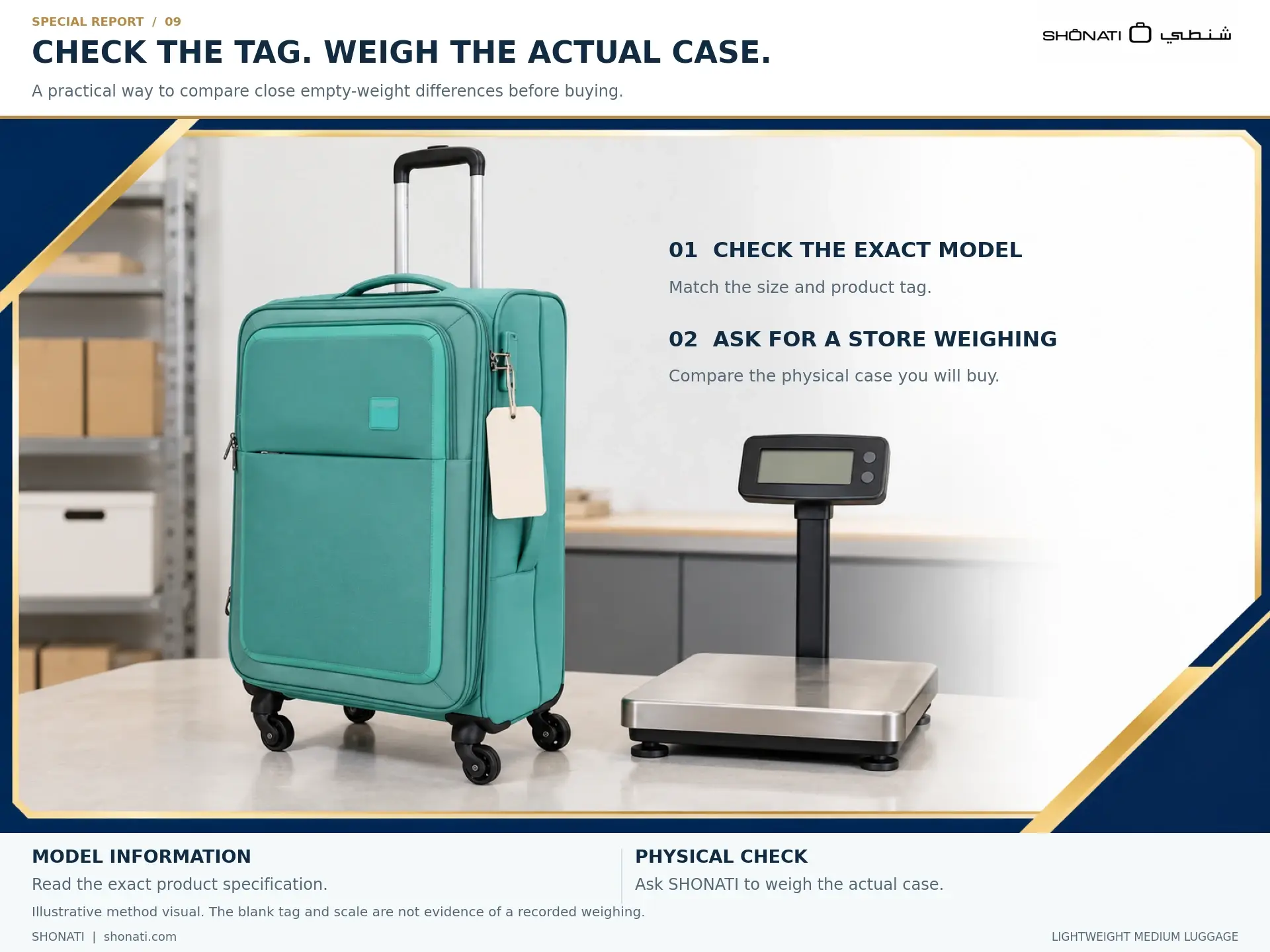
If a customer wants additional reassurance before buying, SHONATI can also place the actual physical suitcase on the in-store scale.
The two data types remain separate:
| Weight Type | Meaning |
|---|---|
| Published / Tag Weight | The verified model-specific product specification. |
| SHONATI Physical Scale Reading | A measurement of the individual suitcase physically present in the store. |
A reading for an individual suitcase is recorded separately from the model’s listed specification.
18 Medium Check-In Suitcases Compared by Empty Weight
The table below is ordered from the lowest published empty weight to the highest.
| Model | Published size label | Empty Weight | Material | Construction | Published Capacity |
|---|---|---|---|---|---|
| BELOTTI 88-2 | 64 cm / 24″ | 3.3 kg | PC / Polycarbonate | Hardside | Not confirmed |
| American Tourister Mystic | 68 cm / 24″ | 3.3 kg | Polyester | Softside | 60 L |
| American Tourister Seville | 69 cm / 25″ | 3.5 kg | Polyester | Softside | 75 L |
| American Tourister Technum | 68 cm / 25″ | 3.6 kg | Polycarbonate | Hardside | 73 L → 84.5 L expanded |
| American Tourister Hundo | 68 cm / 25″ | 3.6 kg | Polypropylene | Hardside | 76 L → 88 L expanded |
| American Tourister Dashway | 70 cm / 26″ | 3.6 kg | Polyester | Softside | 80 L |
| American Tourister Majoris Plus | 70 cm / 26″ | 3.7 kg | 100% Polyester | Softside | 65 L |
| American Tourister Trento+ | 68 cm / 25″ | 3.75 kg | Polycarbonate | Hardside | 74 L base |
| BELOTTI 02541-1 | 65 cm / 25″ | 3.8 kg | ABS + PC | Hardside | Not confirmed |
| American Tourister Skytrac | 68 cm / 25″ | 3.8 kg | Polypropylene | Hardside | 65 L |
| American Tourister Instagon | 69 cm / 25″ | 3.9 kg | Polypropylene | Hardside | Not used for cross-model capacity ranking |
| Delsey Cruise Hardside 2.0 | 70 cm | 3.98 kg | Exact shell material not confirmed | Hardside / Top-Lid Opening | Not confirmed |
| American Tourister Paxtra | 66 cm / 24″ | 4.0 kg | ABS + Polycarbonate | Hardside | 65 L → 75 L expanded |
| it Luggage Illustrious | 67 cm | 4.15 kg | Polypropylene | Hardside | 112 L published* |
| Eminent Vertica | 68 cm | 4.5 kg | 100% Premium Polypropylene | Hardside / Zipperless Frame | 84 L |
| Delsey Shadow 5.0 | 70 cm | 4.6 kg | 100% Polycarbonate | Rigid Hardside | Not used for capacity ranking |
| BELOTTI 88-1 | 66 cm / 25″ | 4.8 kg | PC / Polycarbonate | Hardside | Not confirmed |
| American Tourister Frontec | 68 cm / 25″ | 4.8 kg | Polycarbonate | Hardside / Book Opening | 77 L → 88 L expanded |
Size labels are not unit conversions: the centimetre and inch labels above are the model sizes used in the product listings. Check each model’s complete external dimensions for airline limits.
*The current it Luggage Illustrious specification publishes 112 litres, but does not clearly distinguish whether that figure represents base or expanded capacity. SHONATI therefore does not use that number for a precise capacity-efficiency ranking.
Likewise, published litre capacities from different brands should be treated as useful product specifications rather than assumed to come from one identical measurement protocol.
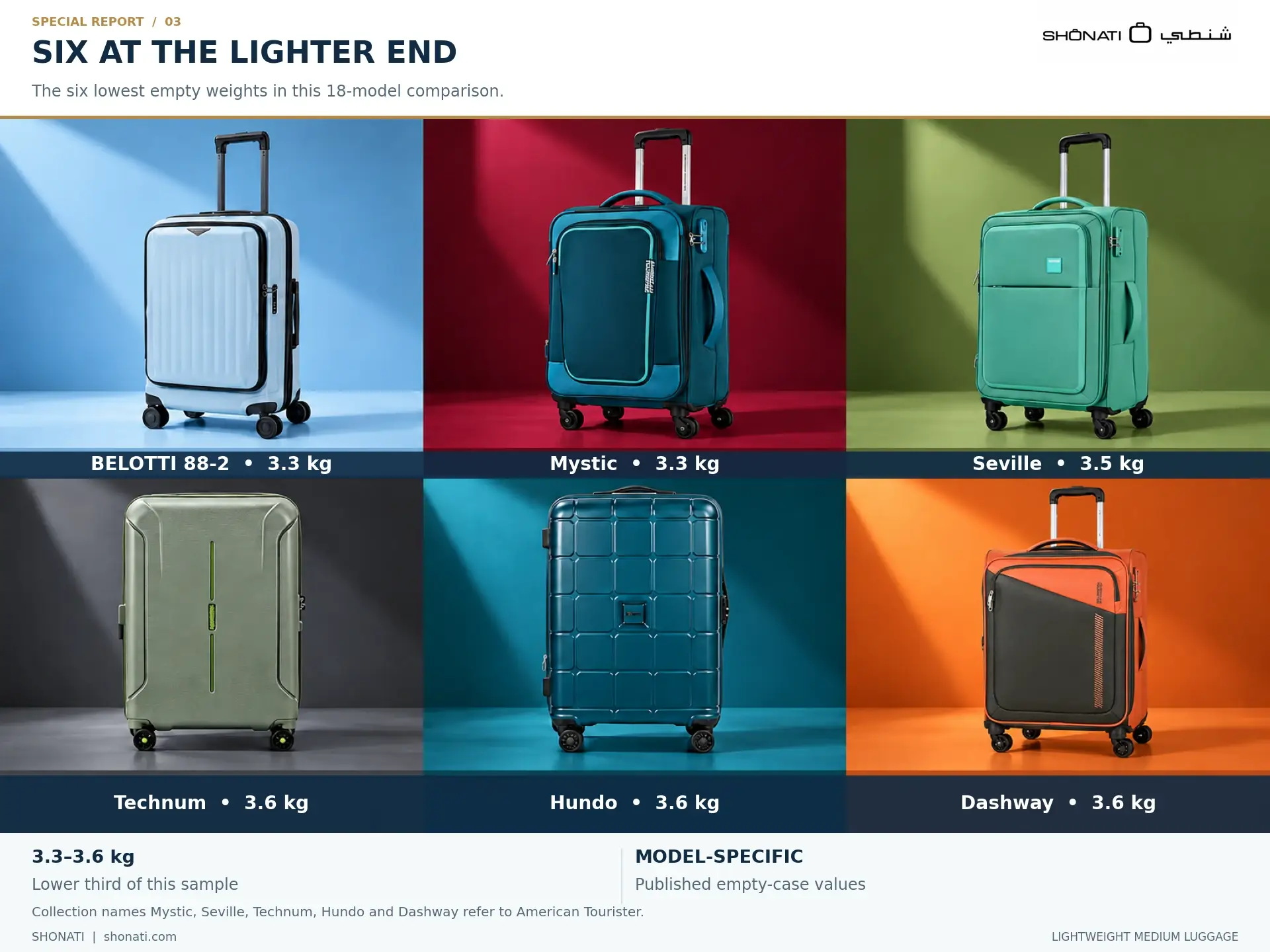
The Six Lightest Models in the Current SHONATI Sample
The lighter third of the current dataset falls between 3.3 and 3.6 kg.
| Model | Weight | Construction | What Makes It Different |
|---|---|---|---|
| BELOTTI 88-2 Medium | 3.3 kg | PC Hardside | Hinomoto double-spinner wheels, recessed TSA lock and anti-theft zipper |
| American Tourister Mystic 68 | 3.3 kg | Polyester Softside | Expandable design, front pocket and 60 L published capacity |
| American Tourister Seville 69 | 3.5 kg | Polyester Softside | 75 L published capacity, front storage and double spinner wheels |
| American Tourister Technum 68 | 3.6 kg | PC Hardside | Expandable 73–84.5 L capacity, TSA lock and DuoSaf security zipper |
| American Tourister Hundo 68 | 3.6 kg | PP Hardside | Expandable 76–88 L, DuoSaf security zipper and double spinner wheels |
| American Tourister Dashway 70 | 3.6 kg | Polyester Softside | 80 L published capacity, exterior pocket and expandable construction |
These six are not presented as the “best” six.
They are simply the six lowest published empty weights within this current comparable SHONATI medium-size dataset.
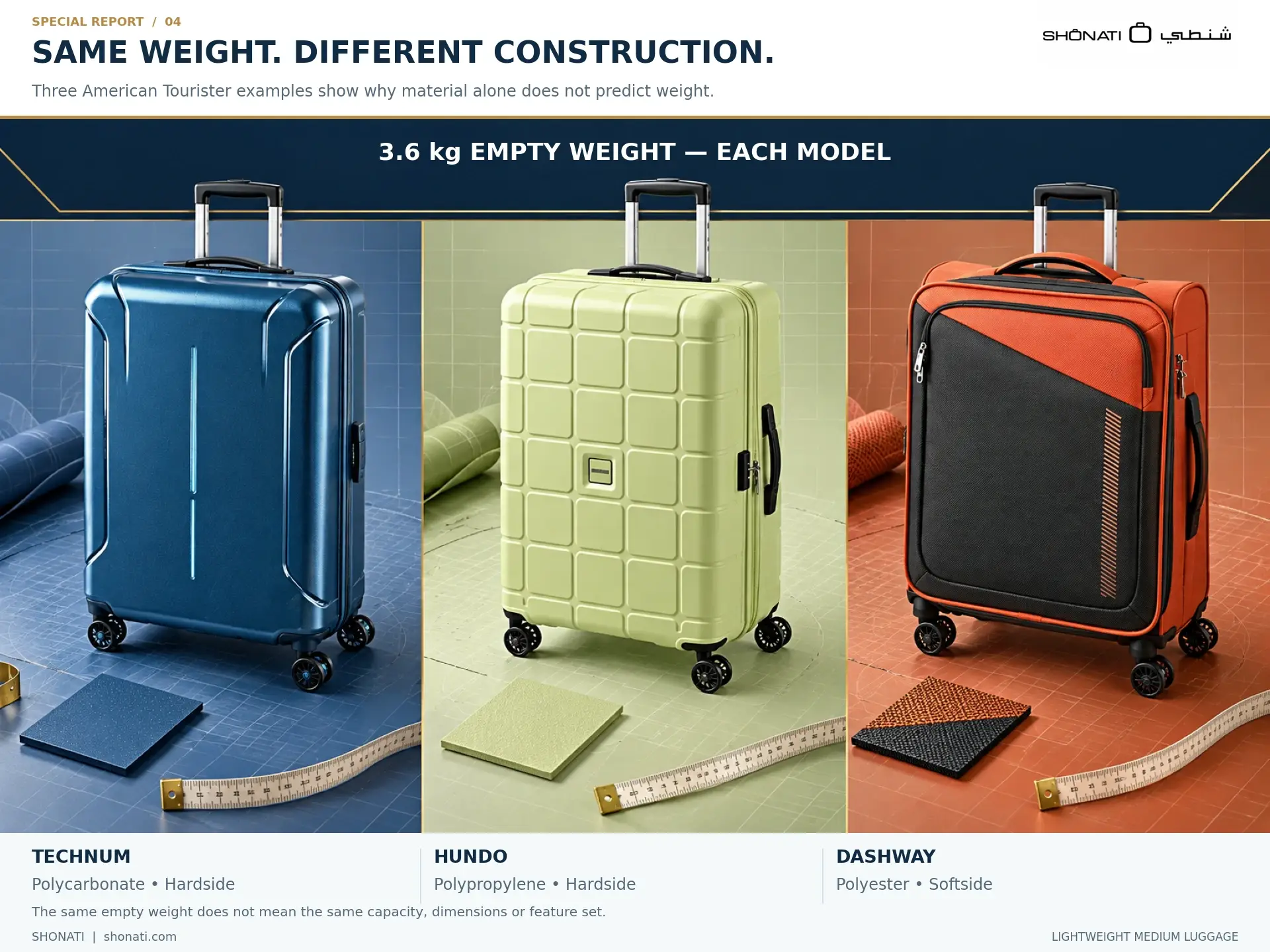
Three Suitcases at 3.6 kg — Three Different Designs
Weight alone cannot tell you what the suitcase will be like to use.
Three models in the current dataset all weigh 3.6 kg:
| Model | Material | Construction | Published Capacity |
|---|---|---|---|
| American Tourister Technum 68 | Polycarbonate | Hardside | 73 L → 84.5 L |
| American Tourister Hundo 68 | Polypropylene | Hardside | 76 L → 88 L |
| American Tourister Dashway 70 | Polyester | Softside | 80 L |
The empty weight is identical.
The construction is not.
So a good lightweight-luggage comparison needs to look beyond the kilogram figure.
Is Softside Medium Luggage Lighter Than Hardside?
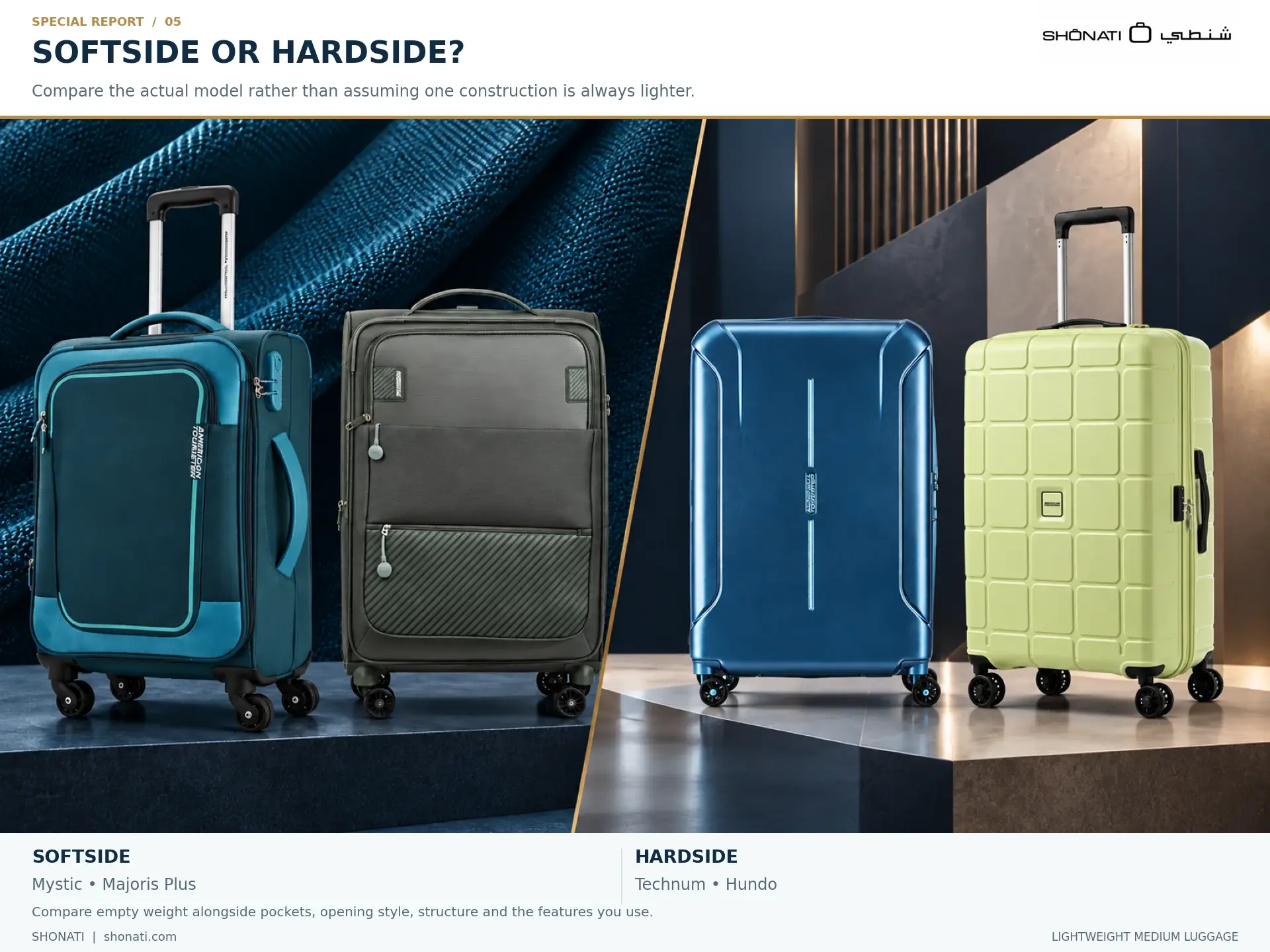
In this current SHONATI sample, the softside models happen to be lighter on average.
The four softside models reviewed are:
- Mystic — 3.3 kg;
- Seville — 3.5 kg;
- Dashway — 3.6 kg;
- Majoris Plus — 3.7 kg.
Their sample average is approximately:
3.53 kg
The 14 hardside models in the same dataset average approximately:
4.04 kg
That is an observed difference of about 0.52 kg between the two groups in this sample.
This is a sample observation, not a universal rule. The products do not have identical dimensions, capacities, wheel systems, reinforcement or feature sets, so the result does not prove that softside construction itself causes lower weight.
There are hardside suitcases in this dataset that are lighter than some softside models.
For example, the 3.3 kg BELOTTI 88-2 hardside is lighter than the 3.5 kg Seville softside.
For a broader construction comparison, see our hard shell vs soft shell luggage guide.
Does Suitcase Material Decide How Light It Will Be?
No.
Material is one factor, but the current dataset shows why it should never be used alone to predict final product weight.
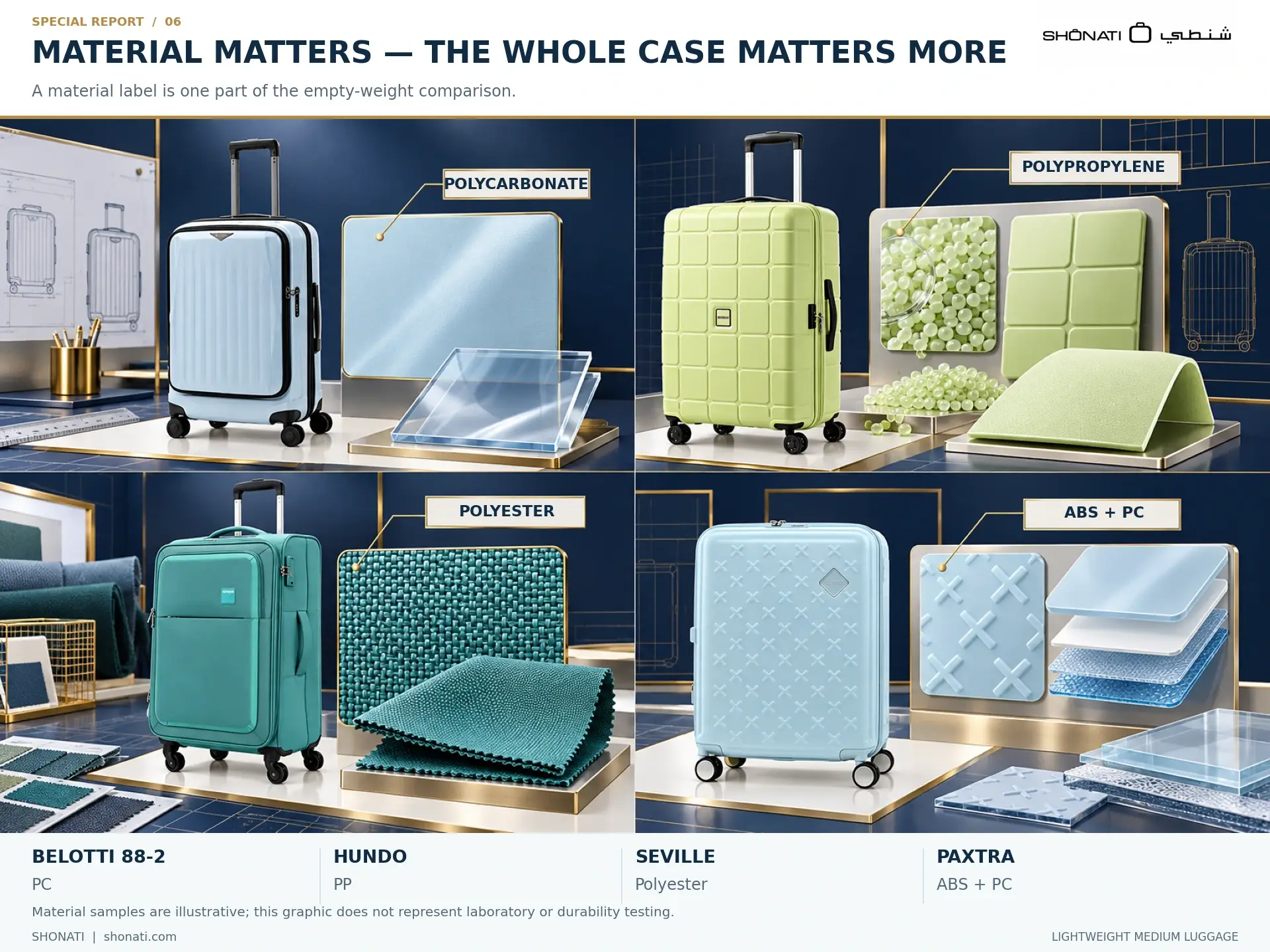
Polycarbonate examples
Current PC/polycarbonate medium cases include:
- BELOTTI 88-2 — 3.3 kg;
- Technum — 3.6 kg;
- Trento+ — 3.75 kg;
- Shadow 5.0 — 4.6 kg;
- BELOTTI 88-1 — 4.8 kg;
- Frontec — 4.8 kg.
The same broad material category spans 1.5 kg in this dataset.
Polypropylene examples
The PP examples also vary:
- Hundo — 3.6 kg;
- Skytrac — 3.8 kg;
- Instagon — 3.9 kg;
- it Luggage Illustrious — 4.15 kg;
- Eminent Vertica — 4.5 kg.
Again, one material does not produce one weight.
Size, shell thickness, frame design, wheels, locks, opening system, interior and other components all contribute to the completed suitcase.
What Difference Does 1.5 kg Make on a 23 kg Baggage Allowance?
Consider the two ends of the current SHONATI medium dataset.
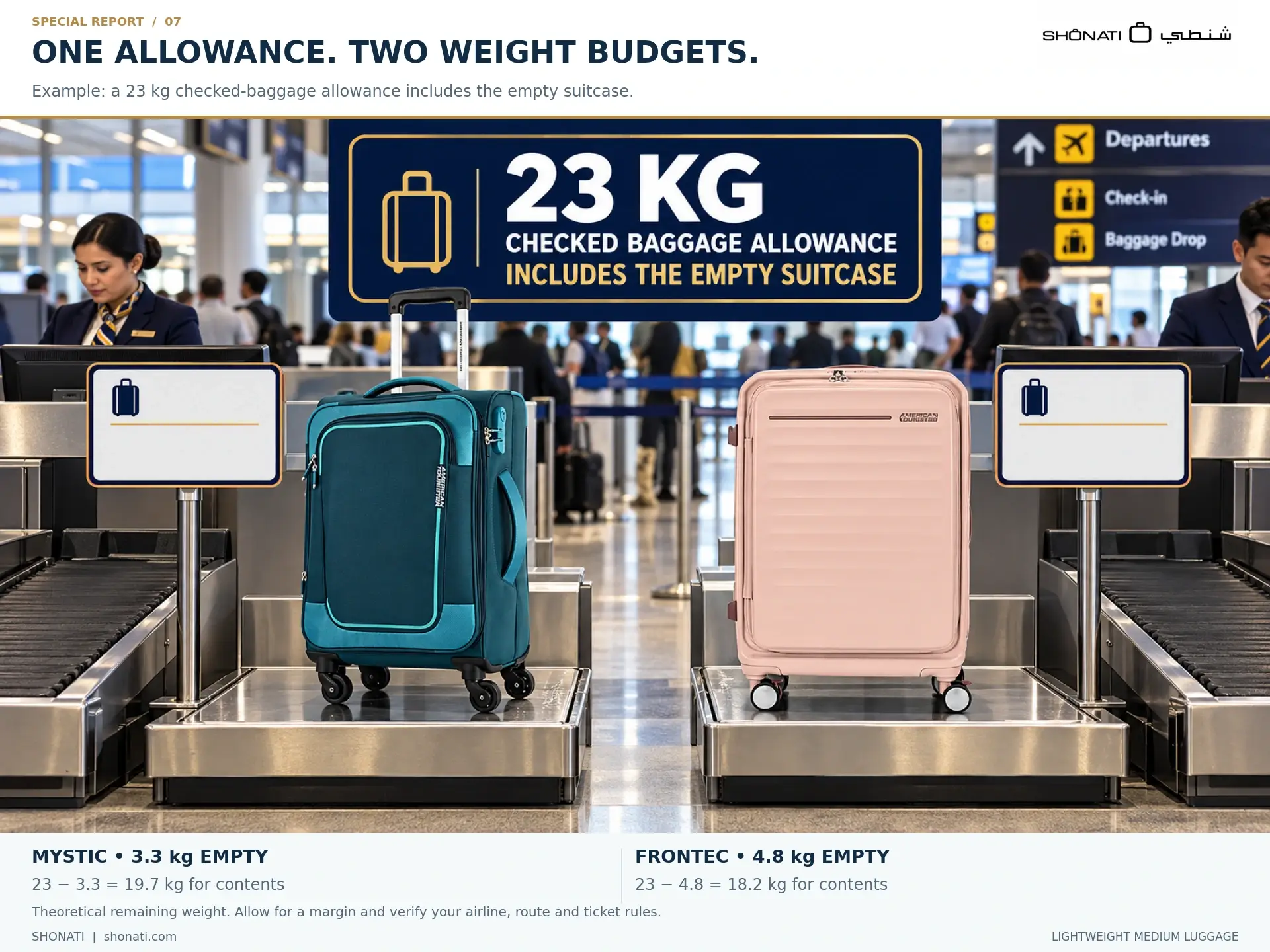
3.3 kg empty suitcase
23 − 3.3 = 19.7 kg of theoretical weight remains for contents.
4.8 kg empty suitcase
23 − 4.8 = 18.2 kg of theoretical weight remains for contents.
The difference is:
1.5 kg
or approximately 6.5% of a 23 kg example allowance.
This is why empty weight can matter even when two suitcases appear to perform the same basic check-in role.
23 kg is only an example in this section. Checked-baggage allowances vary by airline, route, fare and ticket. Confirm your actual allowance before travelling.
For the complete packing calculation, see our 23 kg suitcase packing guide. For current airline rules, see our UAE checked baggage guide.
Why Do Some Medium Suitcases Weigh More?
A heavier suitcase is not automatically worse, just as a lighter suitcase is not automatically better.
Some of the heavier models in this dataset use more specialised constructions or features.
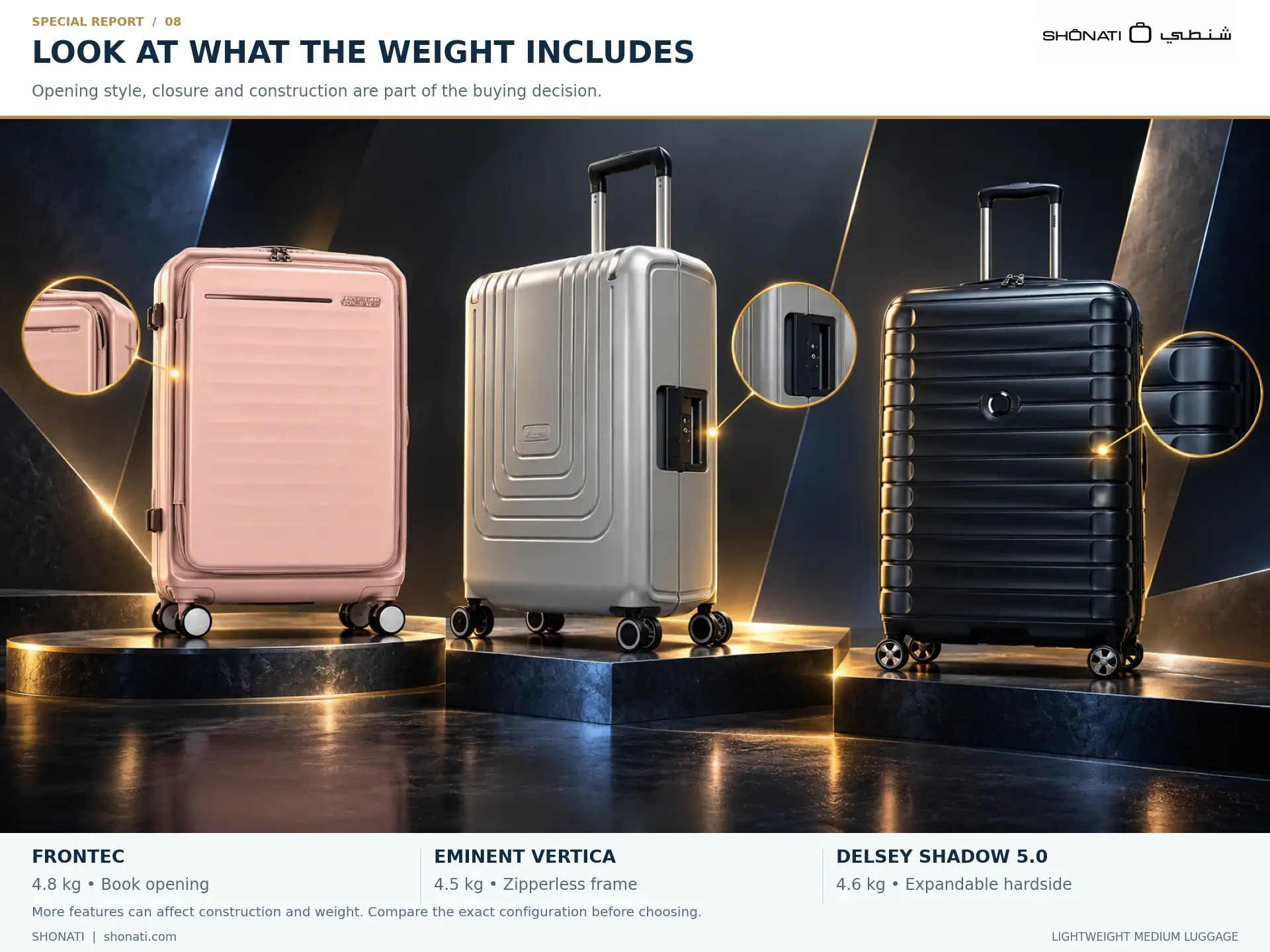
American Tourister Frontec — 4.8 kg
The 68 cm Frontec uses the book-opening layout specified by American Tourister for its medium size. Its features include:
- 77 L → 88 L expandable capacity;
- Optimov shock-absorbing wheels;
- STEPause wheel stopper;
- DuoSaf security zipper;
- and TSA locking.
Eminent Vertica — 4.5 kg
Vertica uses:
- a zipperless frame;
- a three-point closure;
- a central TSA-approved combination lock;
- two additional side locks;
- integrated corner protection;
- and an 84 L fixed-capacity interior.
Delsey Shadow 5.0 — 4.6 kg
Its published specification includes:
- 100% polycarbonate shell;
- SECURITECH 2 reinforced closure;
- expansion;
- quiet double wheels;
- removable washable lining;
- an integrated overweight indicator;
- and USB access.
These examples do not prove that one particular feature caused a specific amount of extra weight.
They show why suitcase weight must be interpreted together with the complete product design.
Is the Lightest Suitcase Always the Better Choice?
No.
A low empty weight can preserve more of your baggage allowance, but your suitcase still needs to solve the rest of your travel problem.
Also compare:
- external dimensions;
- usable packing space;
- opening style;
- expansion;
- interior organisation;
- wheel design;
- handle system;
- lock and zipper system;
- softside or hardside construction;
- and the type of journeys you take most often.
If saving 300 grams means giving up a feature you use on every journey, that may not be the right trade-off for you.
Likewise, carrying a heavier suitcase just because it has more features does not make sense if you do not use those features.
Which Lightweight Medium Suitcase Should You Shortlist?
Instead of declaring one overall winner, start with your priority.
If minimum empty weight matters most
Start with the lower end of the current sample:
- BELOTTI 88-2 Medium — 3.3 kg;
- Mystic 68 — 3.3 kg;
- Seville 69 — 3.5 kg;
- and the 3.6 kg group.
If you want a lighter hardside case
Compare:
- BELOTTI 88-2 — 3.3 kg PC;
- Technum — 3.6 kg PC;
- Hundo — 3.6 kg PP.
If you prefer softside access
The current lighter softside options include:
- Mystic — 3.3 kg;
- Seville — 3.5 kg;
- Dashway — 3.6 kg;
- Majoris Plus — 3.7 kg.
If specialised features matter more than the lowest possible weight
Models such as Frontec, Eminent Vertica and Delsey Shadow 5.0 may deserve comparison even though they sit higher in the weight range because their construction and feature sets are different.
The purpose of this guide is to help you build the right shortlist — not to force every traveller toward the same suitcase.
A Note About Comparing Luggage Capacity in Litres
Published litre capacity is useful, but it should not be treated as a perfectly standardised laboratory measure across every brand unless the measurement method is known to be identical.
For example, several products in this article publish useful capacity figures, while others do not.
Some brands also publish both base and expanded capacities.
For that reason, SHONATI does not create a false-precision ranking such as:
“Litres per kilogram = the best suitcase.”
Capacity remains an important product specification, but it should be interpreted alongside:
- internal layout;
- external dimensions;
- expansion;
- and how the specific brand reports capacity.
Want to Verify the Actual Suitcase Weight Before You Buy?
Every suitcase at SHONATI has model-specific product information, including size, dimensions and weight where supplied for that model.
If empty weight is particularly important for your journey, you can go one step further.
Ask the SHONATI team to place the actual suitcase on our in-store scale before you buy.
This can be especially useful if:
- you are comparing two cases only a few hundred grams apart;
- your airline allowance is strict;
- you want to verify the individual physical suitcase in front of you;
- or you simply want extra confidence before choosing.
The published product specification remains the official model reference.
The store-scale reading gives you an additional measurement of the actual physical case you are considering.
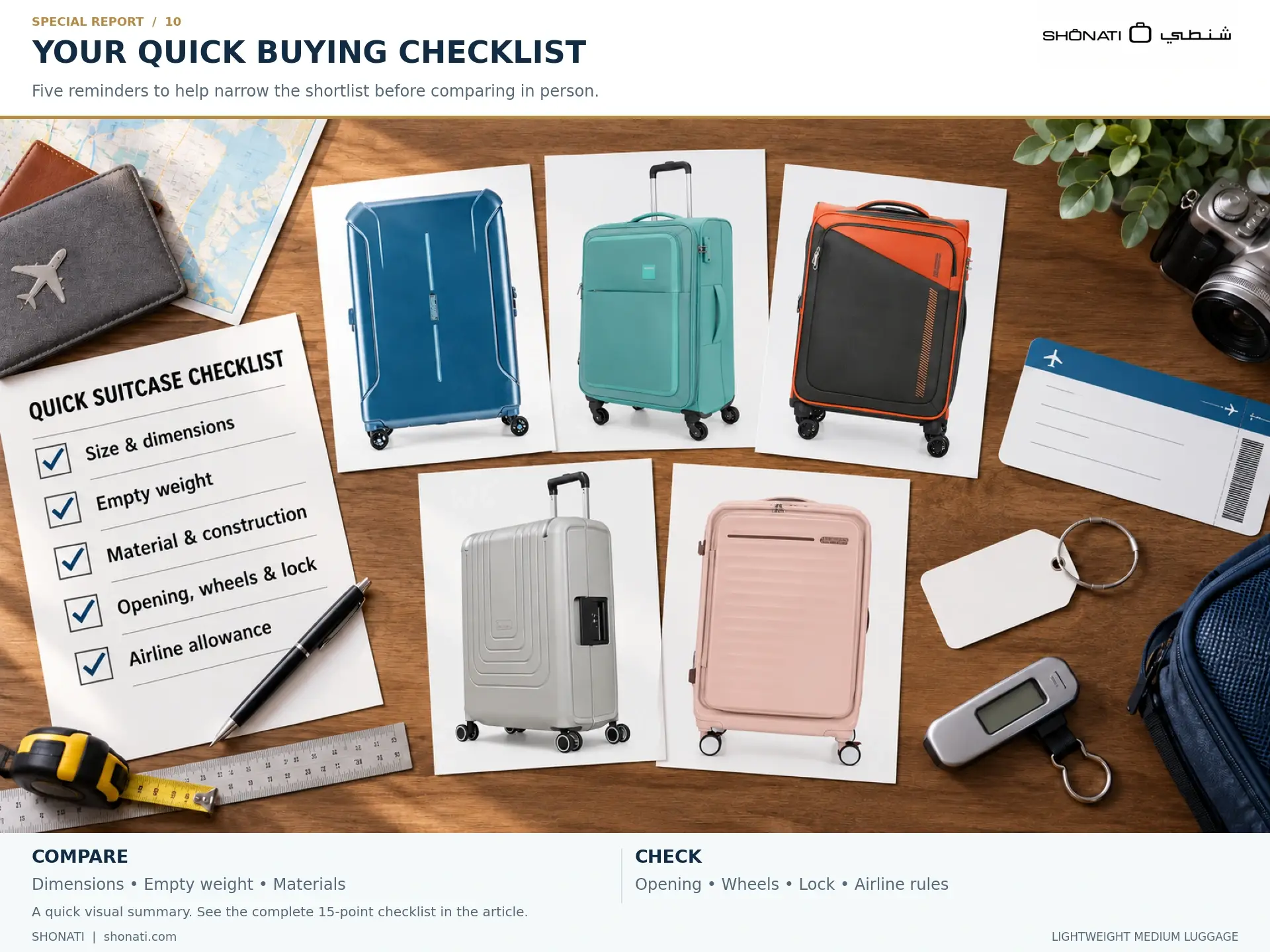
Lightweight Medium Suitcase Buying Checklist
- Compare only suitcases in a similar size class.
- Check the exact published empty weight.
- Check complete external dimensions.
- Confirm hardside or softside construction.
- Confirm the exact shell or exterior material.
- Do not assume one material is always the lightest.
- Check whether the suitcase expands.
- Review published capacity where available.
- Look at the opening style.
- Check the wheel and handle system.
- Review the lock and zipper design.
- Consider which features you genuinely use.
- Calculate how much of your baggage allowance the empty case will consume.
- Check your airline rules separately.
- If needed, ask SHONATI to weigh the physical suitcase before purchase.
Compare Medium Check-In Luggage at SHONATI
You can browse luggage at SHONATI online and compare current models by size, published empty weight, material, construction and features.
You can also visit SHONATI Sharjah beside City Centre Sharjah or SHONATI at Wafi Mall, Dubai to compare selected Medium Check-In suitcases side by side.
If luggage weight matters to your journey, bring your baggage allowance with you and compare the actual cases against the type of travel you are planning.
View SHONATI store locations and contact details.
Frequently Asked Questions
What is considered lightweight medium luggage?
There is no universal industry cutoff. In the current SHONATI sample of 18 Medium Check-In suitcases, empty weights range from 3.3 to 4.8 kg, and the lighter end of the dataset is approximately 3.3–3.6 kg.
How much should a lightweight medium suitcase weigh?
Compare the suitcase against similar medium-size products rather than using one global threshold. In this current SHONATI dataset, models around 3.3–3.6 kg sit in the lower third of the weight distribution.
Is 4 kg heavy for a medium suitcase?
Not necessarily. The median in the current SHONATI sample is 3.8 kg and the average is approximately 3.93 kg, so a 4 kg medium case sits close to the centre of this specific dataset.
Is 3.5 kg light for checked luggage?
For a medium check-in suitcase, 3.5 kg falls near the lighter end of the current SHONATI sample. The correct comparison still depends on size, construction and features.
What is the lightest medium suitcase in this SHONATI comparison?
The lowest published weights in the current dataset are 3.3 kg, shared by the BELOTTI 88-2 Medium and American Tourister Mystic 68cm.
Is softside luggage lighter than hardside?
In this particular SHONATI sample, the four softside models average less than the hardside group. That is an observation about this dataset, not proof that softside luggage is always lighter.
Is polypropylene lighter than polycarbonate luggage?
Not automatically. The dataset contains both lighter and heavier examples in each material family. Size, shell construction, wheels, locks, frame design and other components also affect final weight.
Is lightweight luggage less durable?
Empty weight alone cannot determine durability. Durability should be evaluated from the exact material, construction, components, warranty and real product evidence rather than inferred from weight alone.
How much difference does 1.5 kg make on a 23 kg allowance?
A 3.3 kg suitcase theoretically leaves 19.7 kg for contents, while a 4.8 kg suitcase leaves 18.2 kg. The difference is 1.5 kg before packing.
Does an expandable suitcase increase my airline weight allowance?
No. Expansion increases packing space, not the baggage allowance on your ticket. It can also increase the suitcase’s external dimensions when used.
Should I choose the lightest suitcase available?
Not automatically. Compare the weight together with dimensions, packing space, wheels, opening style, locks, organisation and the features you actually need.
Can SHONATI weigh a suitcase before I buy it?
Yes. If you want to verify the actual physical suitcase you are considering, ask the SHONATI team to place it on the in-store scale before purchase.
Final Takeaway
“Lightweight” is not one universal luggage specification.
The meaningful question is:
How light is this exact suitcase compared with other suitcases of a similar size and purpose?
In the current SHONATI Medium Check-In dataset:
- 18 models were reviewed;
- weights range from 3.3 to 4.8 kg;
- the average is approximately 3.93 kg;
- the median is 3.8 kg;
- and the lighter end of the sample is approximately 3.3–3.6 kg.
That makes weight useful for building a shortlist.
It should not be the only reason you choose the suitcase.
Compare the actual:
- weight;
- size;
- material;
- construction;
- packing space;
- opening;
- wheels;
- security;
- and travel features
before deciding.
And if the difference between two models matters to your baggage allowance, you do not have to guess.
Check the product specification and ask SHONATI to weigh the actual suitcase in store before you buy.
Explore luggage at SHONATI online, or compare selected Medium Check-In suitcases at our Sharjah and Wafi Mall Dubai stores.
How this guide was prepared: SHONATI reviewed 18 current Medium Check-In suitcase models in the approximately 64–70 cm class using exact model-specific published specifications. The statistical values in this article describe this dataset only. Published capacities are reported where confirmed but are not assumed to use identical measurement methods across all brands. Weight, material and construction are evaluated separately, and no individual feature is claimed to cause a specific weight difference without controlled testing.