
Sling Bag vs Waist Bag: Choosing a Hands-Free Everyday Bag

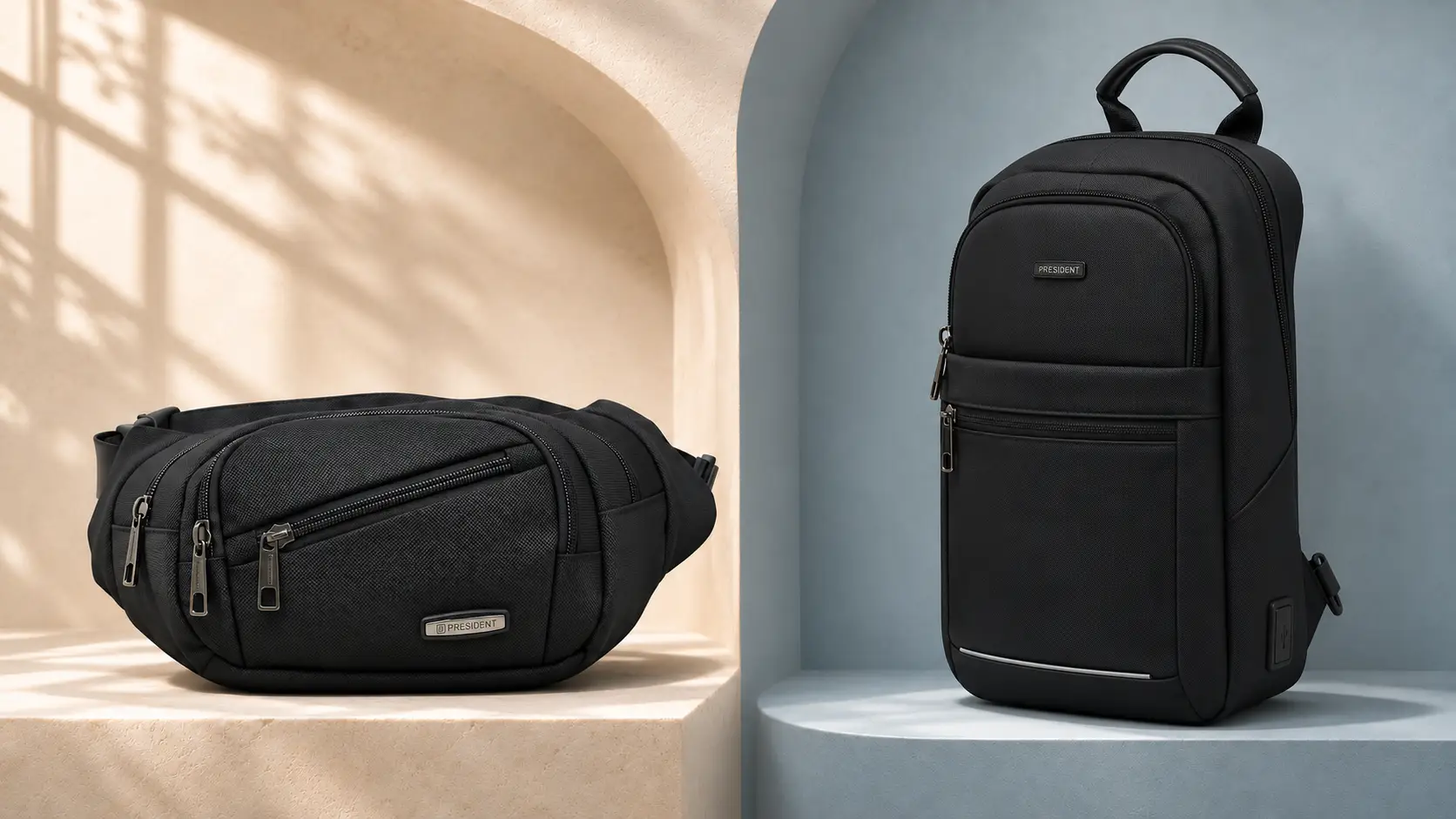
The main difference between a sling bag and a waist bag is the carrying system: a waist bag uses a belt around the waist or hips, while a shoulder sling uses a strap over one shoulder and across the body. Some designs support both. For everyday use, the useful choice is the one that fits your carrying position and lets you reach the opening with your usual belongings inside.
A waist bag is a useful starting point if you want to keep your shoulder clear; check the belt and buckle when seated. A shoulder sling is worth trying if you prefer not to fasten a belt around your waist; check the shoulder attachment and opening direction. This guide compares those practical trade-offs using real PRESIDENT examples from SHONATI.
Product information reviewed on 14 November 2026. Specifications are attributed to the individual listings; the fitting checks below are suggestions for your own comparison, not results of a SHONATI wear test.
Sling bag vs waist bag: choose your carrying position first
Start with where you want the bag to sit during the part of the day when you use it most. Shopping may involve reaching for your phone repeatedly. A commute adds sitting down and standing up. A city walk with a backpack introduces another set of straps. Compare bags in that situation, rather than choosing from an empty bag on a shelf.
A starting point for comparing individual bags
Keep the strap off your shoulder
Start by considering: A waist bag worn at the waist or hips
Check before choosing: Both ends of the belt adjustment range, buckle position and seated fit
Carry across your torso
Start by considering: A sling designed for shoulder carry
Check before choosing: Which shoulder it supports and where the opening faces
Switch between waist and chest
Start by considering: A model explicitly supporting both
Check before choosing: Fit and access separately in each position
Carry alongside a backpack
Start by considering: Either format that works with your backpack
Check before choosing: Hardware position, access with both bags on and removal order
No useful fit with your normal load
Start by considering: A different model, size or carrying format
Check before choosing: Keep your necessary belongings in the comparison; do not force the fit
Sling, waist, belt, bum and crossbody: what do the names mean?
Waist bag, waist pack, belt bag, bum bag and fanny pack commonly describe overlapping styles with a belt passing around the waist or hips. Retailers use the terms differently, so look at the attachments and fastening as well as the title.
Sling bag can describe a compact pouch with a long strap or a more vertical, single-shoulder design. Crossbody describes a way of wearing a bag across the torso; it does not specify one shape, capacity or fastening system.
Some products genuinely cross these categories. For example, Thule describes its EnRoute 2L as suitable for sling or waist-pack use. That is evidence about that model, not permission to wear every sling around the waist.
A secondary strap described as a waist stabiliser is not automatically a waist-carry belt. It may be intended to work alongside a shoulder strap, rather than replace it. Check the model’s stated carrying modes before treating the extra strap as evidence of waist-only use.
For any candidate, separate three questions: what is it called, how is its strap attached, and which carrying positions does the maker or seller actually support? If you are still deciding between broader bag formats, our tote, shoulder and crossbody guide covers that earlier decision.

Check both ends of the adjustment range
The shortest setting matters as much as the longest
A long strap is useful only if it can also tighten enough for your intended position. On a smaller waist, the adjuster may reach its limit while the bag still sits too loosely. Across the torso, a strap may be long enough but leave the body of the bag lower than you want. Neither problem is solved by the word “adjustable”.
For a larger body or thicker clothing, check the other end of the range: can you fasten the bag and position it without stretching the strap, pulling the attachments or forcing the buckle? Try the garment you expect to wear. A measurement taken over a thin top does not settle the fit over a jacket.
Long or loose clothing also deserves a practical check. Place the bag where you would normally wear it, then sit, stand and reach for an item. Look for fabric caught around the buckle or gathered underneath the bag. Personal preference and the actual garment matter more than a gender label on the product page.
Ask what the strap measurement includes
A published strap length may describe webbing alone, a detached strap or a length measured between particular points. The complete fastened route also involves the bag body, buckle and overlapping adjustable sections. You cannot reliably convert an unexplained strap number into a supported waist circumference.

If you measure yourself, follow the route where you want to wear the bag, over your usual clothing. Treat that as information to compare with a clearly explained product measurement, not a guarantee of comfort. For diagonal carry, your waist measurement alone does not describe the route over your shoulder.
If the strap is too short, ask whether the maker offers an extender compatible with that exact model and buckle. No compatible extender has been verified for the PRESIDENT examples in this guide.
When both waist and crossbody use are supported, adjust and check each separately. Changing the route can move the buckle, change the angle of the bag and leave a different amount of loose webbing. Use any provided strap keeper as intended, and check that loose ends do not obstruct the opening.
Check your hand, the zip and the buckle together
Choose the shoulder that works for you
Put the bag on the shoulder you expect to use, then bring it into the position where you would open it. Can your preferred hand reach and operate the zip while the other hand supports the bag if necessary? Try the actual pull and buckle rather than judging their usability from a photograph. You do not have to follow a universal “left-handed” or “right-handed” rule; the useful arrangement is the one that works with your movements.
Check the attachment system before assuming you can switch sides. A length adjuster changes length. A detachable strap allows removal. Neither feature, by itself, proves that the bag supports equivalent carry on both shoulders. Look for an explicit reversible design or ask to see the supported attachment positions.
Also examine the opening after moving the bag forward. Are loose items still held inside, or does the opening face downwards? Can you return the item and close the zip without twisting the bag? A workable strap position does not automatically mean a workable pocket position.
Try access without repeatedly taking the bag off
For a phone you use often, compare the whole action: bring the bag within reach, open it, remove the phone, return it and close it. Notice whether you must loosen the strap, release the buckle or remove the bag. None of these actions is automatically wrong, but repeated extra steps may be inconvenient for your day.
With a waist bag, check the opening at your preferred front or side position. If you plan to rotate it for access, test that movement with the usual contents and clothing. Do not assume a bag that rotates easily when empty will behave identically after loading.
Sit down and add your second bag
Check where the buckle and adjuster meet your body when seated. Lean back normally and notice whether hardware sits between you and the chair. Bend as you ordinarily would to pick something up, while keeping the bag closed. Reposition or choose a different model if the arrangement obstructs your movement. If you wear a trouser belt, check whether its buckle or belt loops sit beneath the bag or its hardware, especially when seated.
If you also carry a backpack, put both on. Inspect the places where straps cross and where a buckle may sit beneath the backpack. Try removing each bag in the order you normally would. You should know whether one must come off before you can release the other.
For a day with a rolling suitcase, try reaching for your phone or documents with the hand you normally leave free. A bag that works well when both hands are available may require a different position when one hand is holding the suitcase handle.
Check the opening while the bag is loaded and worn
Take your actual phone with its case, wallet, keys and any glasses case or other essentials you need. These are examples, not a compulsory packing list. Check the complete set together: separate demonstrations of each item fitting do not establish that they fit at the same time.
Pay attention to how the packed bag sits against you. A rigid case may fit inside but alter the shape or press the opening into an awkward angle. A full front pocket may affect access to the section behind it. Try retrieving the item you use most without emptying another section first.
Then return everything and close the bag normally. If the zip needs force, or you must hold the contents down to close it, reduce the load or compare another shape. Extra pockets are useful only when their openings and usable space suit your belongings.
Litres and nominal inch sizes cannot answer this whole question. For the general method of checking external dimensions, openings and interior fit, see our bag size and fit guide. Here, repeat that check in the carrying position you intend to use.
Two PRESIDENT examples that show different strap structures
These examples show two different strap layouts. Use them to identify which design you want to try; the published figures are not a like-for-like test of capacity or comfort. More complete specifications for one model do not, by themselves, make it the better bag.
Published information and points still worth checking
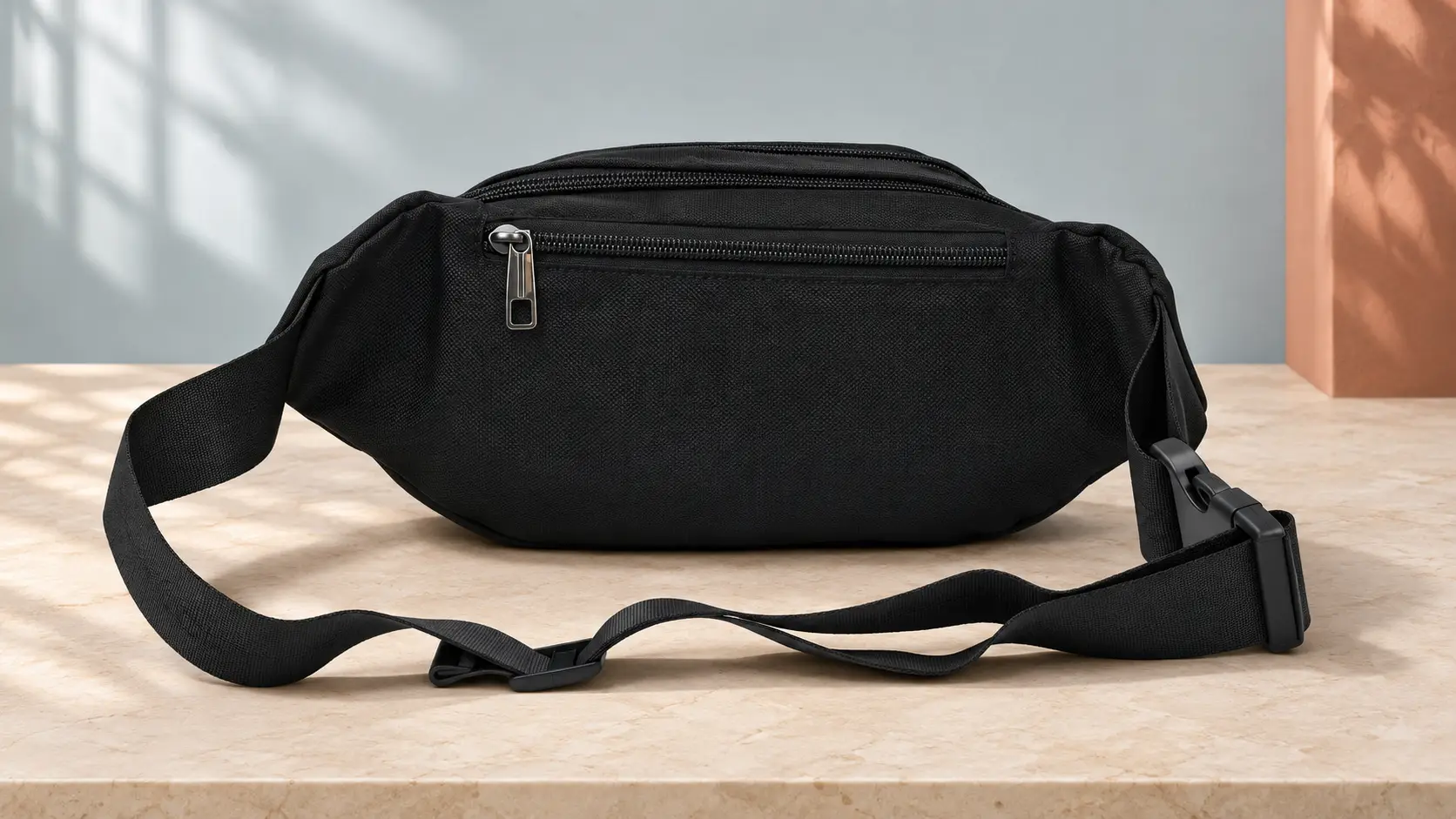
PRESIDENT WBP62002
What the listing shows: Black waist pack with an adjustable belt and quick-release buckle. Published dimensions: 36 × 10 × 16 cm (L × W × H); capacity 3.5 litres; weight 0.35 kg.
What to check for yourself: The listing gives a 132 cm strap length without explaining the measuring method. Minimum and maximum complete fit remain unconfirmed; 132 cm is not a verified waist-size limit.
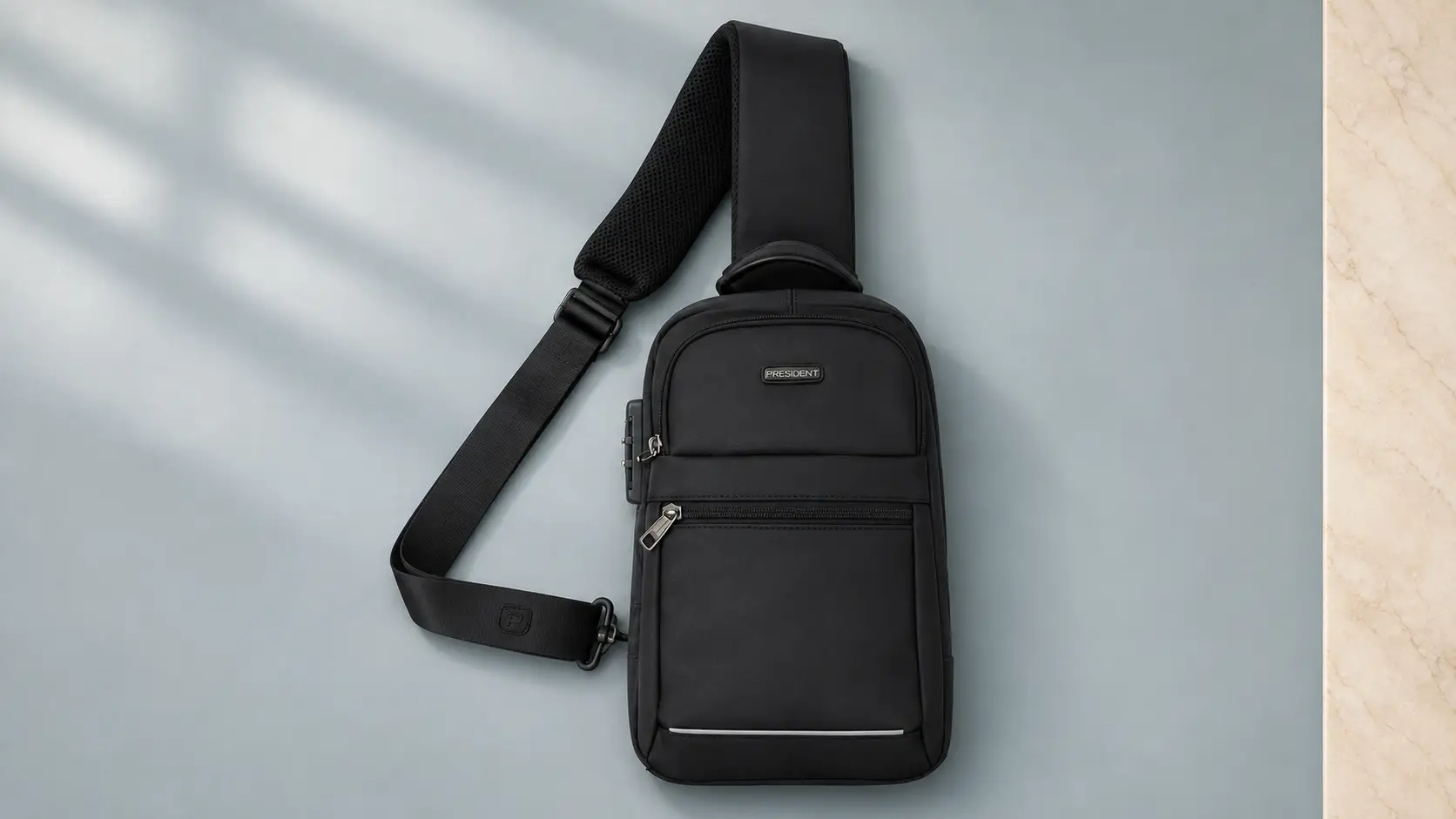
PRESIDENT CBP94550
What the listing shows: Black vertical sling with an adjustable single shoulder strap, padded mesh rear panel, external USB pass-through and side security lock.
What to check for yourself: The full strap range, internal dimensions, capacity and empty weight are not published in the reviewed listing. Confirm shoulder preference and access with your belongings.
What to resolve first: for WBP62002, establish the complete belt fit. For CBP94550, confirm your preferred shoulder and the opening position before letting the USB port or lock influence your choice.
CBP94550 carries a published “up to 13 inches” compatibility statement, but that does not confirm your device and case will fit. Its USB port needs a separate power source; a power bank is not listed as included. The exact lock type is not published, so it should not determine the comparison on an assumed security advantage.
For a conditional crossover example, the WBP62006 listing says crossbody use may work for some users, depending on body size and strap fit. Treat that as a reason to check the position, rather than a promise that it will suit everyone.
When neither format is the right answer
If you cannot achieve a suitable strap setting, the opening is awkward on your preferred side, or the hardware remains uncomfortable when seated, compare another design. You do not need to choose the less inconvenient of two unsuitable bags.
For a substantial work kit, a larger device, lunch and other bulky items, consider whether a laptop briefcase or backpack better matches the whole load.
Running, cycling and longer outdoor activities create different demands from ordinary walking. A “sport” label does not establish that one of these everyday bags stays stable during vigorous movement or carries the equipment you need. Choose equipment intended for that activity and check its specific features.
A short comparison to try before buying
Use the same belongings and usual clothing for each candidate. If you need two supported carrying modes, repeat the sequence in both.
- Load: put in your normal essentials, including cases and covers.
- Adjust: set the strap for the intended waist or shoulder route. Check that you have a usable setting, not simply enough length to fasten it.
- Check the buckle: locate it and the adjuster; try the supported way of putting the bag on and taking it off.
- Walk and sit: take ordinary steps, sit and stand, then add your backpack if you use one. After moving, check whether the adjustment and bag position are still where you set them.
- Retrieve and return: use your preferred hand and check the direction of the opening.
- Close: fasten the bag normally and confirm it remains in a useful position.
Adjust the fit or choose another bag?
- Still too loose at the shortest setting? Try a design with a suitable minimum fit. Extra maximum strap length will not solve this problem.
- The strap fits, but the opening faces the wrong way? Try another supported shoulder or carrying position. If access remains awkward, compare a different layout.
- It works until you add your essentials? Recheck the loaded shape and closure. Remove optional extras; if the necessary load still prevents normal use, choose another size or format.
- The setting or bag position keeps changing as you move? Recheck the adjustment against the maker’s instructions. If ordinary movement still requires repeated corrections, compare another design with the same load.
If both bags work, use your most frequent action as the deciding factor: paying at a till, retrieving your phone or sitting through your commute. Choose the one that makes that action simpler.

Security, weather and air travel
Is a sling or waist bag safer for valuables?
Neither name guarantees protection. Check the actual closure, any documented security feature and how you will keep track of the bag. A rear pocket or front carrying position is not theft-proof. RFID protection, where specifically documented, is a separate feature; do not infer it from a lock or zipped pocket.
Does water-resistant mean I can use it in heavy rain?
Not by itself. The PRESIDENT listings reviewed describe water resistance, but do not establish a verified protection level for the whole bag. Do not infer waterproof performance from the material name or an unexplained marketing label. Check the maker’s guidance and use appropriate separate protection for moisture-sensitive belongings.
Does wearing the bag mean it will not count as cabin baggage?
Do not assume an exemption because it is worn on your body. Check your airline’s current allowance for your booking. Our UAE cabin baggage guide explains what to verify before travelling.
To compare a specific PRESIDENT model, contact SHONATI with its product link and preferred location. Confirm the model and colour at your preferred branch before visiting, and use the fit question above for any missing measurements.