
Polycarbonate vs ABS vs Polypropylene Luggage: Which Should You Choose?

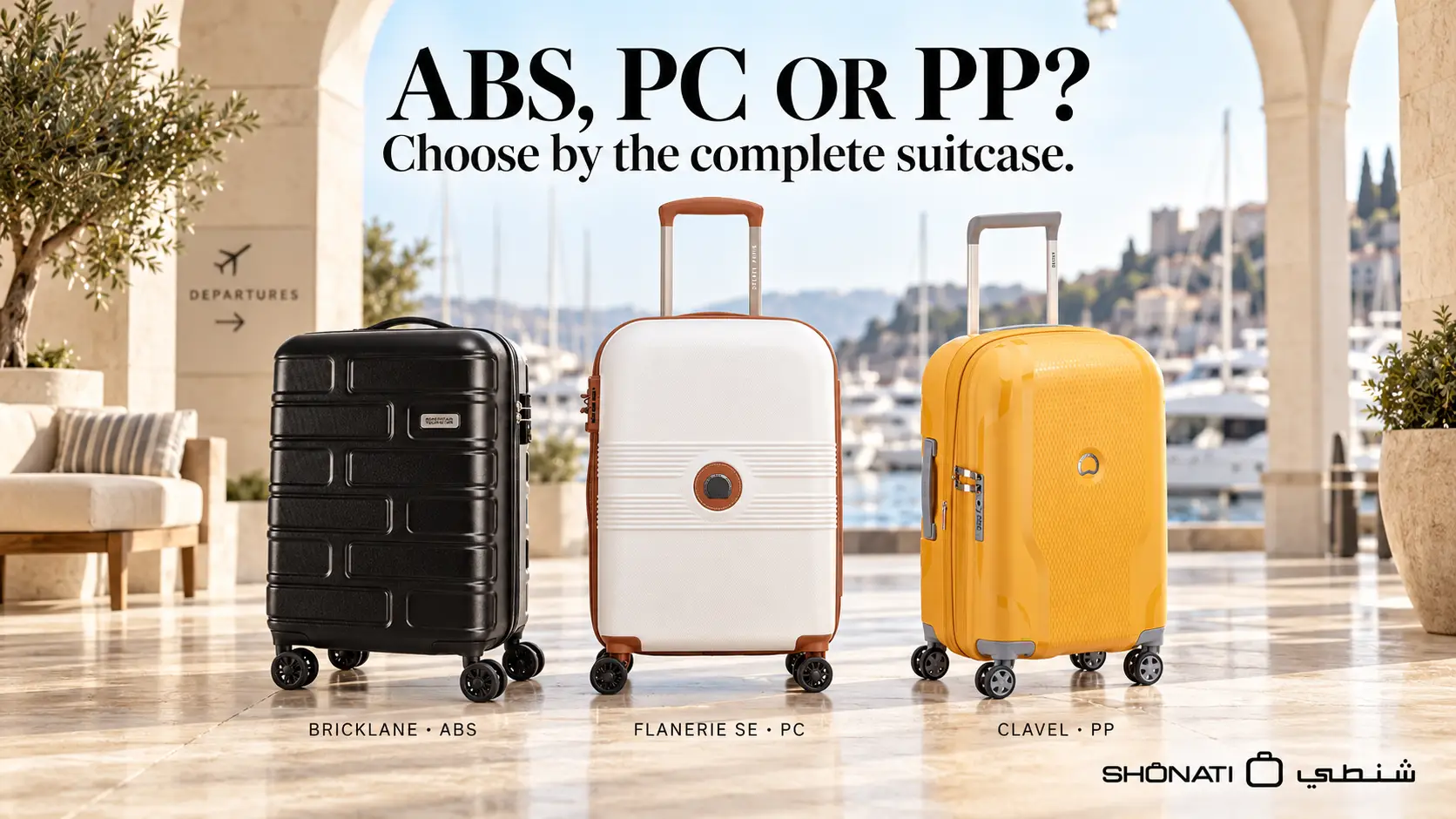
Polycarbonate vs ABS vs polypropylene luggage: quick comparison
| Material | Why consider it? | Main buying caution | Useful starting point |
|---|---|---|---|
| Polycarbonate (PC) | Tough, impact-resistant plastic used in many hard-shell designs. | The PC label alone does not establish shell thickness, whole-case weight or service life. | Comparing cases for regular travel where protection and construction matter. |
| ABS | A rigid plastic commonly offered in more affordable luggage. | Check the complete build and exact material declaration; price alone does not establish quality. | Occasional trips and a limited purchase budget. |
| Polypropylene (PP) | Low-density material available in grades suited to impact-resistant luggage. | Low material density does not guarantee the lightest finished suitcase. | Comparing weight-conscious designs and alternatives to PC. |
These are starting points, not a performance ranking. Travelpro’s shell-material guide provides useful buying context; the manufacturer references below explain why material grades and finished construction also need attention.
Polycarbonate luggage: toughness is its main attraction
PC stands for polycarbonate. Material producer Covestro describes its Makrolon polycarbonate range as tough and impact resistant, with different grades for different applications. This helps explain its appeal for protective shells.
For a buyer, PC is a sensible material to shortlist for regular travel. Still compare the actual suitcase: a PC shell does not tell you how well its wheels are attached, how much its front compartment holds or which repairs are available. Also check whether the specification says PC, PC/ABS or a coated construction.
ABS luggage: assess value across the whole bag
ABS stands for acrylonitrile butadiene styrene. Its use in affordable luggage makes it relevant for travellers who take occasional trips or need to keep the initial cost down.
ABS is a family of materials, with performance differences between grades. INEOS Styrolution identifies a specialist ABS grade suitable for suitcases, illustrating why dismissing every ABS case as fragile is too simplistic. That does not establish which resin grade an individual suitcase uses. Judge the model’s specifications, components and support alongside its price.
Polypropylene luggage: low density, varied construction
PP stands for polypropylene. LyondellBasell supplies several PP resin families for luggage, with properties selected for impact performance, rigidity and appearance.
PP is worth including when comparing lightweight hard-shell options, but the complete case still needs weighing. A substantial closure system, handle assembly or different shell design can change the result. PP cases also vary in feel; flexibility under gentle pressure is not, by itself, evidence of poor quality or superior durability.
Is PC/ABS luggage the same as polycarbonate?
No. A PC/ABS blend contains both polymers. Covestro’s Bayblend range includes PC+ABS blends engineered for particular combinations of properties. The letters alone do not reveal the blend ratio or guarantee how a finished suitcase will perform.
A blended resin and an ABS shell with a PC surface layer are different constructions. A label naming both plastics may not explain which construction is used.
| Label | What to check |
|---|---|
| Polycarbonate / PC | The declared material is PC. Only describe it as 100% PC when the manufacturer explicitly does. |
| PC/ABS or ABS + PC | Both materials are named. Look for a clear description of the composition and construction; do not assume a percentage. |
| PC-coated ABS | A surface coating and the underlying shell are different parts of the construction. Ask for the manufacturer’s full specification. |
| Hard shell, premium plastic or hybrid | These descriptions alone do not identify the polymer or mixture. |
If a page title says one material and its specification table says another, pause before comparing prices. Match the model, size and product code, then request confirmation. You cannot reliably identify the polymer from a photograph, gloss level or shell pattern.
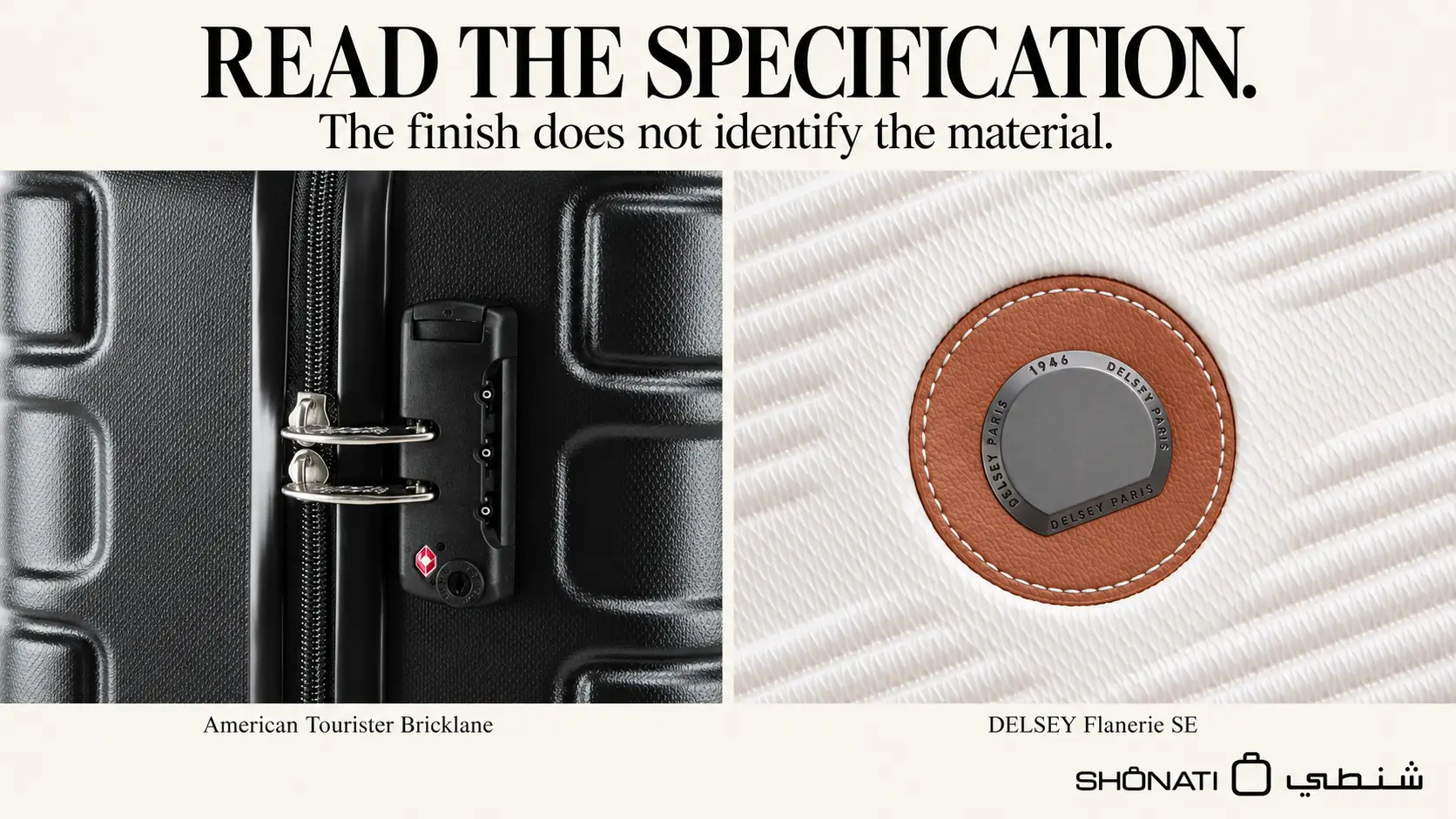
Check the exact model specification: a shell’s texture, gloss or pattern cannot reliably identify its material
Which material makes the lightest suitcase?
Compare the empty weights of the actual models you would buy. Material density describes how much a given volume of plastic weighs. A finished suitcase also includes its lining, wheels, handles, closures and internal organisation.
ExxonMobil’s PP range includes low-density grades with different stiffness and impact properties. This supports lightweight design opportunities, but it does not predict the weight of a complete retail suitcase.
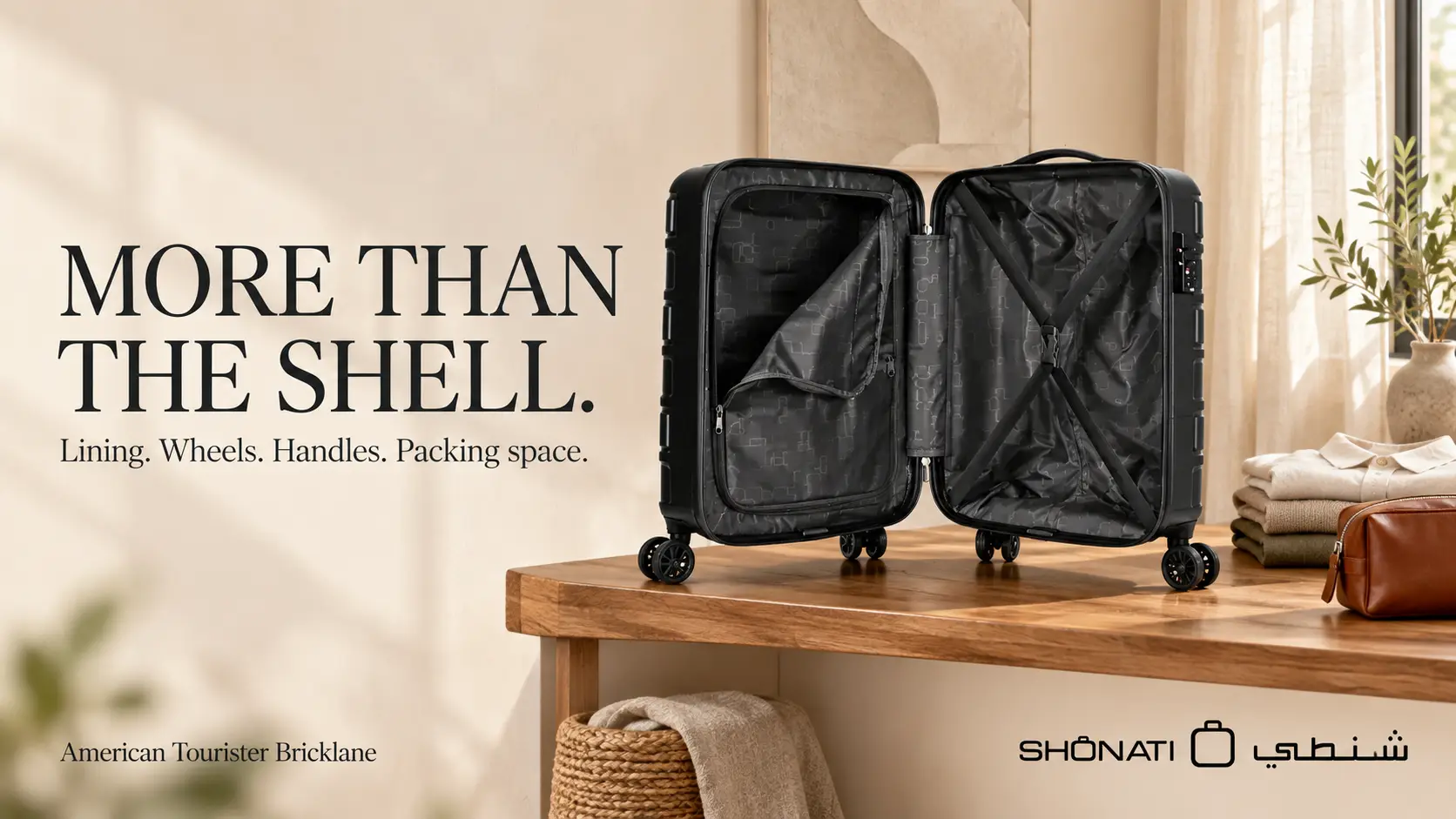
A finished suitcase includes its lining, packing system, wheels and handles. Compare the actual model’s empty weight, dimensions and layout.
For a useful comparison, shortlist cases with similar external dimensions and usable packing space. Check the exact size and version, then consider what any extra weight buys you: a front compartment, a particular closure or an opening layout you prefer. A lighter case with awkward access may be less convenient for your routine.
For cabin travel, the full packed dimensions still need to fit your airline’s rules. Use our cabin luggage measurement guide and airline cabin size guide alongside the allowance on your booking.
Three real models: ABS, PC and PP at SHONATI
These examples connect the material labels to real designs in the SHONATI catalogue. They illustrate different features; they are not a matched-size laboratory comparison. Confirm the available size, colour and version before ordering or visiting.
| Model | Shell material | Design detail to compare | Manufacturer reference |
|---|---|---|---|
| American Tourister Aerojoy 55 | ABS | Cross ribbons and a mesh divider for organising the interior. | Aerojoy specification |
| American Tourister Frontec 54 | Polycarbonate | Front-opening design with expansion. | Frontec specification |
| American Tourister Trigard 55 | Polypropylene | Zipperless closure with a three-point locking system. | Trigard Black 55 specification |
The practical lesson is that shell material and opening design are separate choices. Frontec’s front access may matter more to you than a small weight difference. Trigard offers a latch-based closure to compare with zippered designs. Neither feature follows automatically from the polymer name.
Which should you choose for your travel?
Occasional holidays with a limited budget
Include ABS in your shortlist. Compare its price with similar-size PC and PP options, then check the wheels, handle and closure. If you travel infrequently, paying extra should buy a feature or level of support you value, rather than just a more expensive material label.
Frequent flights and checked baggage
Start by comparing well-built PC and PP models. Look for published model-specific testing information and a practical repair route. Samsonite’s testing overview covers shells, wheels, handles and zippers separately, showing how many components contribute to suitcase durability. It does not provide a universal ranking between PC, PP and ABS.
Cabin trips where every gram matters
Choose by verified complete-case weight and airline fit. Keep all three materials in consideration until you have compared actual models. Check that any extra compartments or expansion features suit your packing habits.
A priority on appearance
Inspect the finish and consider how visible everyday marks will be. Impact resistance and scratch resistance describe different kinds of wear. A material label cannot promise a suitcase will stay mark-free, and a cosmetic scuff alone does not establish that the shell has failed.
Five checks before you buy
- Confirm the material: match the exact model and size with a clear manufacturer specification.
- Compare the complete case: check empty weight, outer dimensions and usable packing space. Our luggage size guide can help narrow the size first.
- Try normal operation: roll the case, extend the handle and open each zipper or latch. Check alignment and whether the layout suits you.
- Ask about repairs: confirm whether replacement wheels, handles and closures are available for that model.
- Read the warranty: check coverage, exclusions and the service process that applies to your purchase in the UAE.
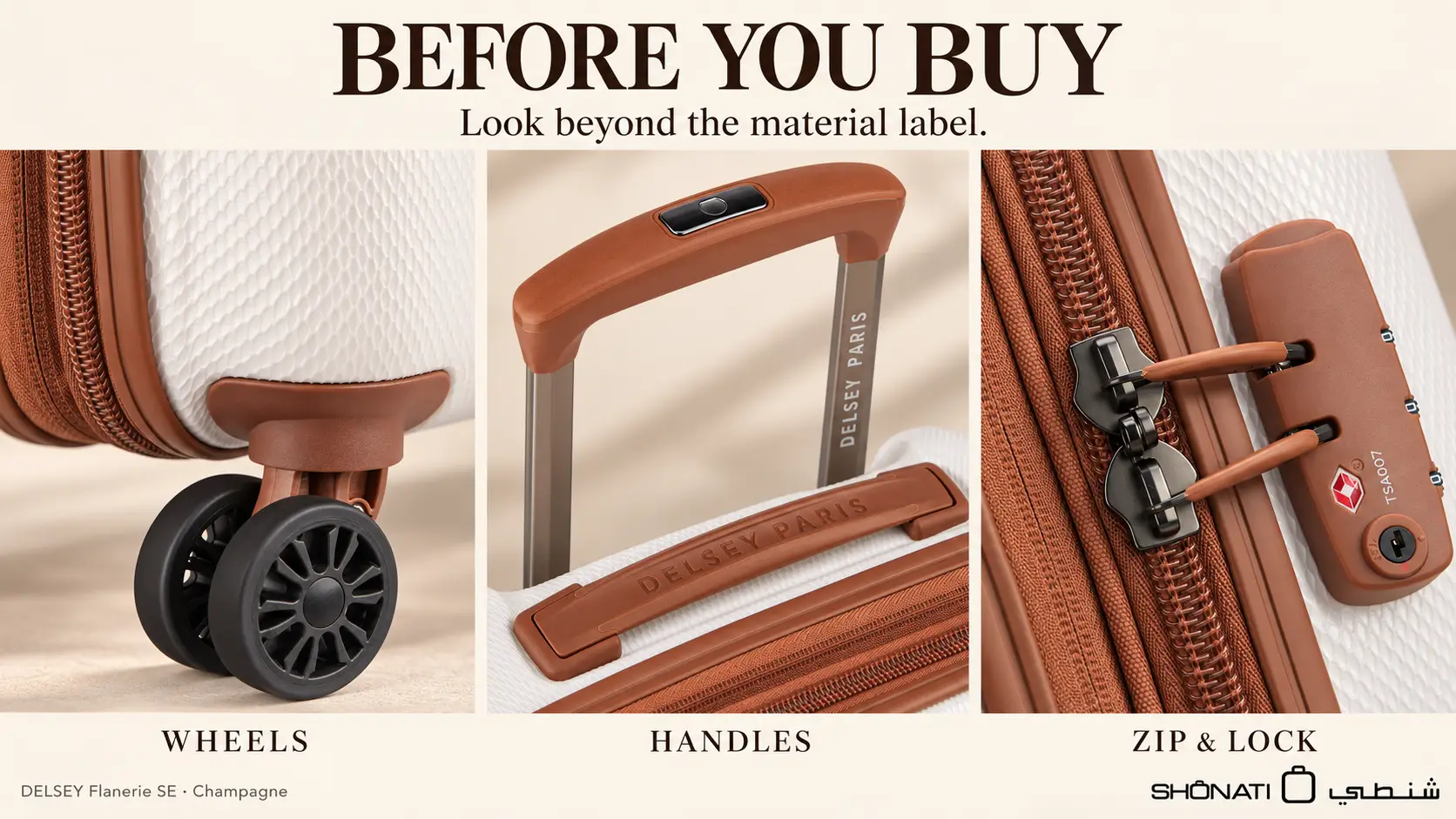
Flanerie SE details: inspect the wheels, handles and closure when comparing a suitcase, alongside its material specification
For storage in the UAE, follow the model’s care instructions and choose a cool, dry place away from direct sunlight. Samsonite’s care advice notes that temperature and humidity extremes can age luggage. A plastic’s technical heat-resistance figure is not a safe storage limit for the entire suitcase.
Frequently asked questions
Is polycarbonate better than ABS luggage?
PC is worth shortlisting when shell toughness is a priority; ABS can offer good value for occasional use. Compare the specific cases, including components, weight and support, before deciding whether the price difference is worthwhile.
Is polypropylene better than polycarbonate?
Both can be suitable for travel. PP offers low-density design opportunities, while PC is valued for toughness. The better purchase depends on the finished model and the features you need.
Can ABS luggage be used as checked baggage?
ABS is used in checked-luggage designs. Choose a suitable model and comply with your airline’s size and weight rules. Its material alone cannot predict how it will perform through repeated baggage handling.
Are PC/ABS blends always inferior?
No. Blends can be engineered for particular properties. Ask what the manufacturer declares about the composition and judge the finished case; do not assume that an unspecified blend performs like a particular PC model.
Are hard-shell suitcases waterproof or unbreakable?
Neither claim follows from PC, ABS or PP alone. Travelpro notes that water can enter through zippers. Damage also depends on the construction and impact. Look for a specific whole-product claim with supporting evidence.
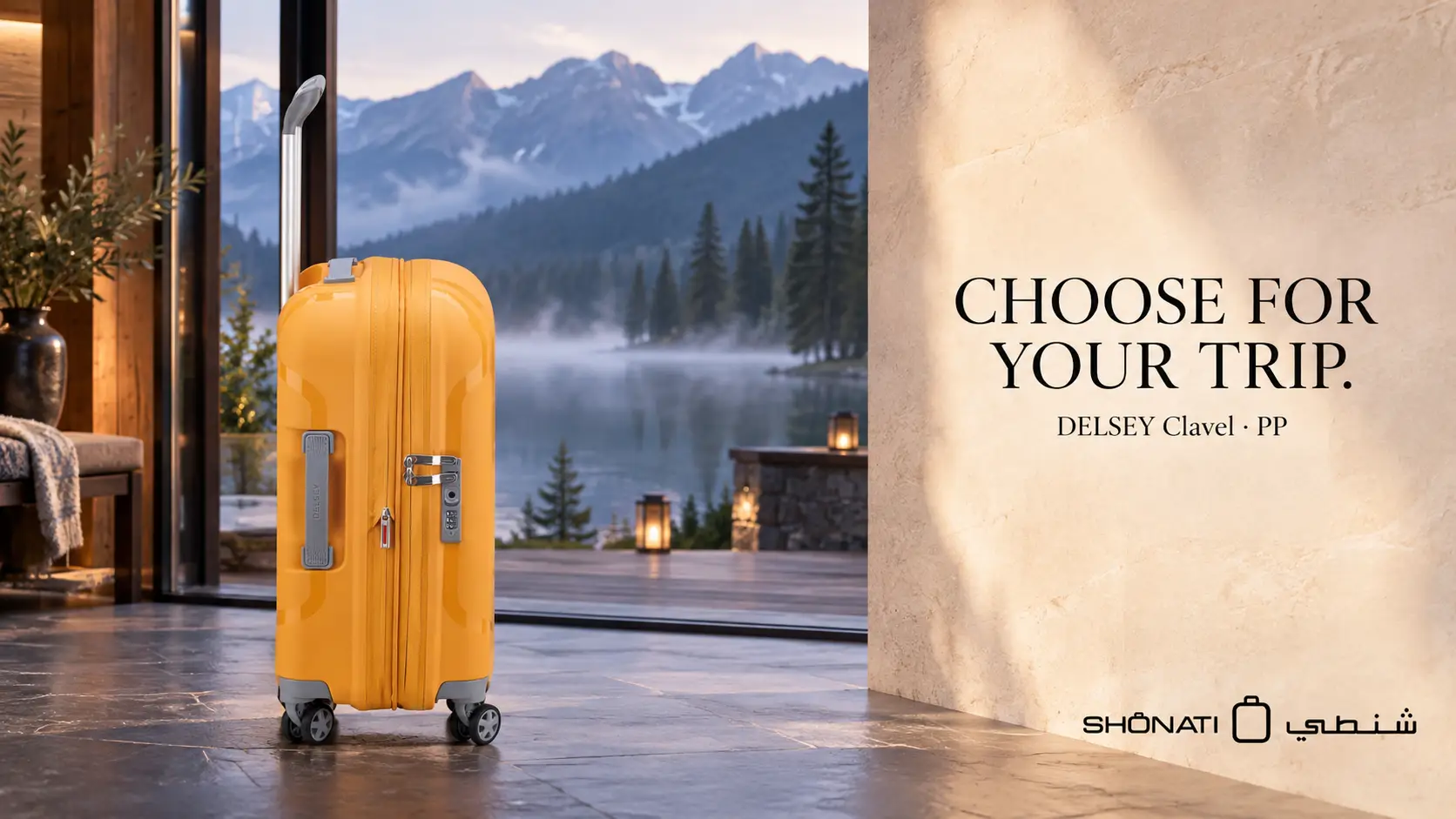
Shortlist the size, layout and features that suit your trips, then confirm the available model and colour with SHONATI
Compare your shortlist with SHONATI
Browse our hard-shell luggage collection, or message SHONATI on WhatsApp with your preferred size, budget and travel routine. We can help you check the available options before you visit our Sharjah store.
Manufacturer specifications and source pages checked on . Recommendations are based on published information; this article does not report physical testing by SHONATI.