
How to Check a Suitcase Before Buying: 8 Practical In-Store Checks

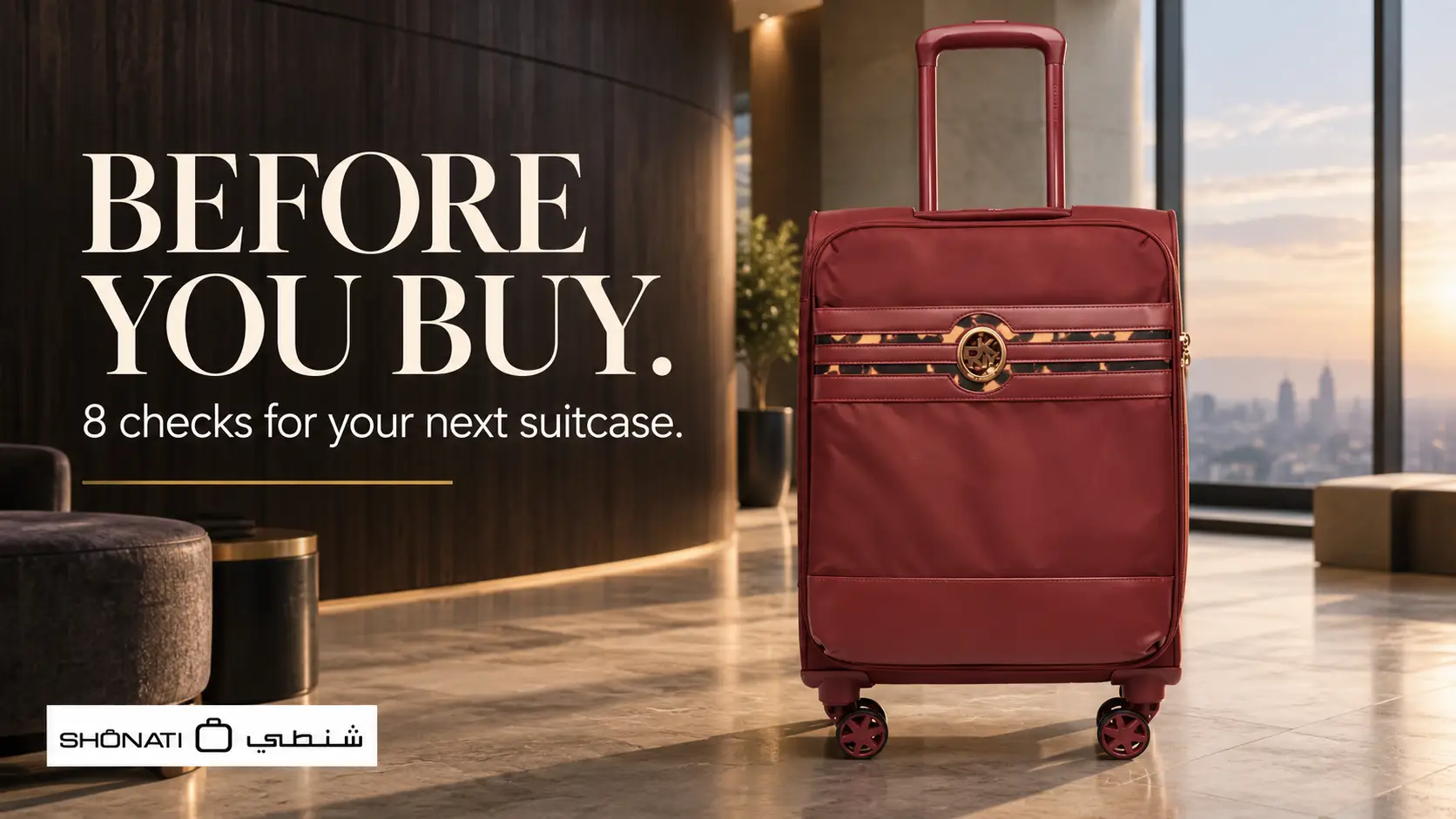
A suitcase can look ideal on a shelf yet feel awkward as soon as you turn a corner, lift it into a car or open it beside a hotel bed. The useful question is not simply which bag has more features. It is whether those features work for the way you travel.
This suitcase buying checklist takes you through eight practical checks you can make in a luggage shop. It is a guide to inspecting and comparing a bag, not a report of laboratory testing or a prediction of how many trips it will survive.
Suitcase buying checklist: the eight checks at a glance
| Check | What to do | What you need to establish |
|---|---|---|
| 1. Size and weight | Confirm overall dimensions and empty weight. | It suits your baggage allowance and intended load. |
| 2. Wheels | Roll, turn and stop on the same indoor surface. | It moves comfortably without repeated catching. |
| 3. Trolley handle | Extend, lock, walk and retract. | The usable height and operation suit you. |
| 4. Carry handles | Try a controlled lift using the fitted carry handles. | You can grip and lift the case comfortably. |
| 5. Zips and lock | Open and close every everyday closure. | You can operate them without forcing anything. |
| 6. Interior and access | Open it fully and check your packing layout. | Your belongings and opening space work together. |
| 7. Finish and fittings | Inspect seams, corners, attachments and lining. | Any marks or irregularities are understood before purchase. |
| 8. Warranty and service | Read the applicable terms and ask about repairs. | You know what is covered and whom to contact. |
Bring your airline allowance, a short packing list and the dimensions of any awkward item you regularly carry. A familiar packing cube or clean shoe bag can help you judge usable space. Ask staff before placing items inside, adding a small representative load or changing a lock combination. Keep the comparison indoors and within normal use; dropping, standing on or forcing a suitcase is not a useful shopping check.
1. Check overall dimensions and empty weight
Start with the exact size variant. A collection name or a label such as “cabin” does not tell you whether the particular suitcase matches your booking. Confirm whether the stated dimensions include the wheels, fixed handles and other protruding parts, and whether the depth is measured with expansion closed.
IATA’s passenger baggage guidance makes clear that allowances remain airline-specific. Check the airline’s current conditions for your journey, then use our cabin luggage measurement guide if you need help measuring the bag.
Compare empty weights for cases that offer the space you need. The suitcase itself uses part of a weight allowance that applies to the packed bag. If one candidate is heavier, decide whether its particular layout, handles or other features justify that difference for your trip.
Ask: “Are these overall dimensions and the empty weight for this exact size? What changes when it is expanded?”
2. Roll the wheels through turns, not just in a straight line
Walk a short route on a clear, level section of the shop floor. Start, turn in both directions and stop. For a spinner, try moving it beside you in the way you expect to use it. For a two-wheel case, try its normal tilted rolling position.
Compare the same route and surface with each candidate. If staff can add a small, evenly distributed load, use a comparable load in both bags. An empty case and a loaded case are different comparisons; note which one you tried.
Notice whether a wheel repeatedly catches, rubs against its housing or makes the case difficult to steer. A change in sound across different flooring is not, by itself, a diagnosis. If something feels wrong, ask staff to inspect it or compare another unit of the same model. A smooth showroom floor also tells you little about performance on rough pavements.
Ask: “If a wheel needs replacing later, is there a repair route for this exact model, and how would I arrange it?”
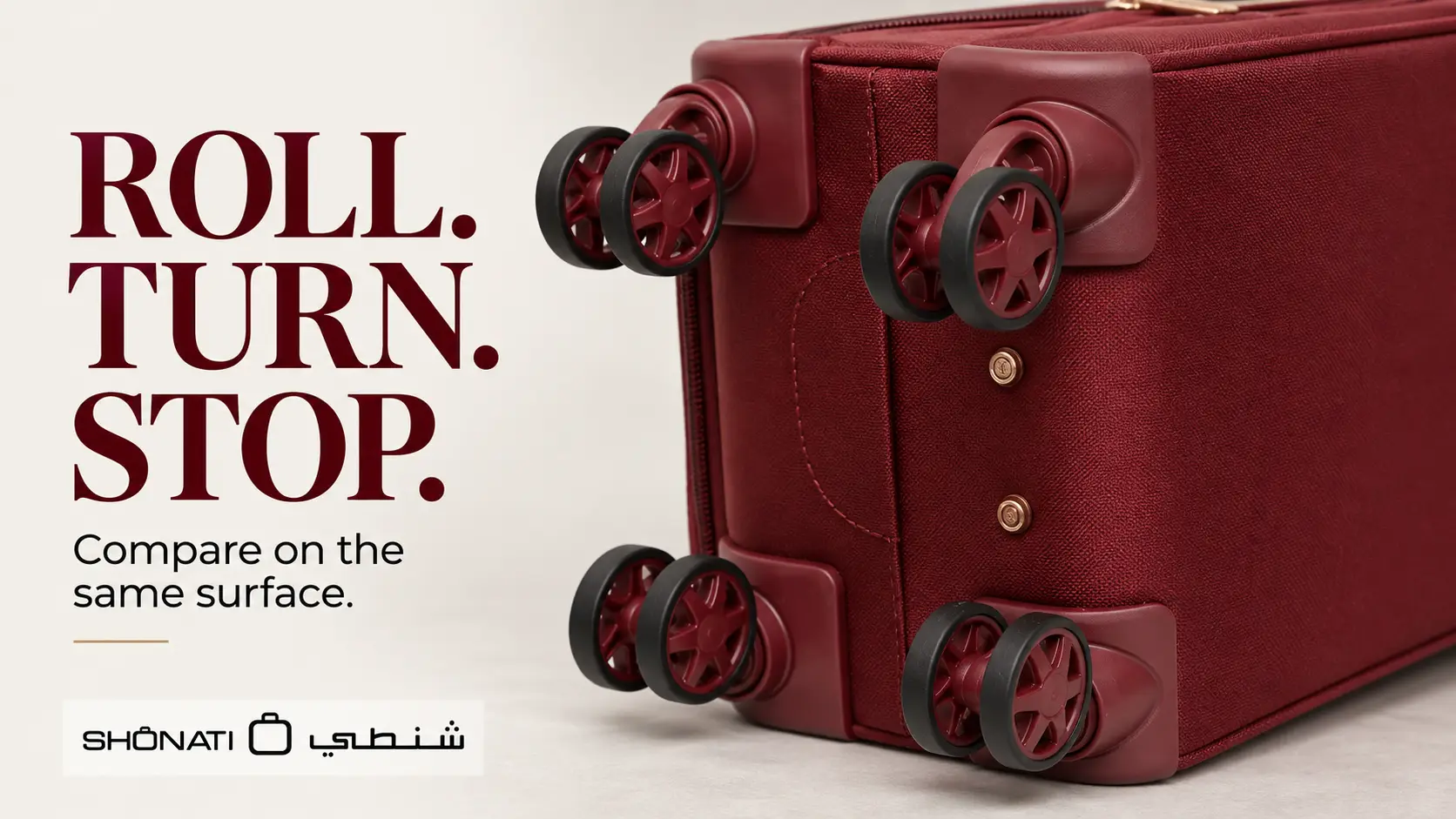
Roll each shortlisted suitcase along the same indoor route, turning and stopping to compare how it handles.
3. Find a trolley-handle height that works for you
Extend the telescopic handle through its intended positions. Release the button and check that it stays at the selected height during ordinary rolling. Retract it and repeat. You should be able to operate the release without an awkward grip or repeated forcing.
Walk at your normal pace. Check whether the case catches your heels, whether you have to shorten your stride and whether the grip feels comfortable when turning. The tallest handle is not automatically your best fit.
If the handle jams, drops unexpectedly or feels unusually loose during use, pause and ask for an explanation. Compare a second unit if available. Do not diagnose the construction from a side-to-side shake alone; the relevant questions are how the mechanism operates and whether it behaves as the manufacturer intends.
Ask: “Which positions should this handle lock into, and can you demonstrate the correct operation?”
4. Try the carry handles and lifting balance
Rolling is only part of a journey. You may also need to lift your case into a car boot, onto a luggage rack or over a doorstep. Check the fitted top and side carry handles, where present, and the space available for your fingers.
With staff’s agreement, make a short, controlled lift of a comfortably manageable case using the intended carry handle. Notice whether the grip presses into your fingers, whether a fitting rubs your hand and whether you can keep the case close enough to control. Use carry handles for lifting; the telescopic trolley handle is for rolling.
If you are comparing with a small load inside, keep its distribution similar between cases. Balance can change with packing. An easy lift of an empty suitcase does not establish that you can comfortably lift it fully packed.
Ask: “Which handles are intended for lifting, and which position would I use to put this case into my car?”
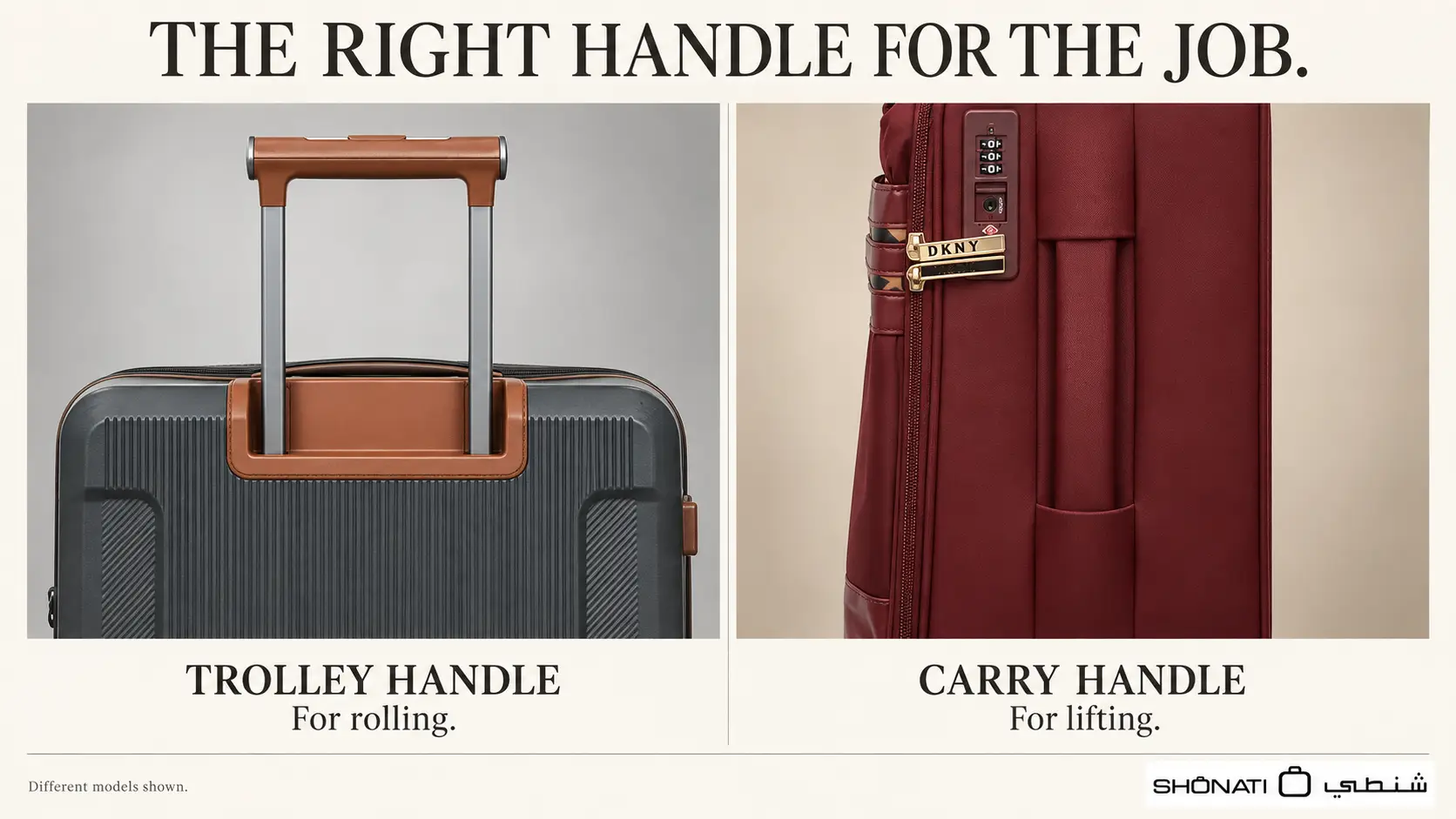
Use the trolley handle for rolling and the fitted carry handle for lifting. Different models are shown.
5. Operate the zips, expansion and lock
Open and close the main zip around its full path, including the corners. Repeat with the interior dividers and any external pocket you expect to use. Check for lining caught in the slider, sections that repeatedly snag and pulls that are awkward for your fingers.
If the case expands, identify the expansion zip separately from the opening zip. Check the mechanism in both positions without overfilling the bag. On a case with latches, ask staff to demonstrate how the two sides align and close. Do not force a reluctant closure.
Ask for a demonstration of the fitted lock and the instructions for that exact mechanism. For a Travel Sentry combination lock, the keyhole is for security personnel; the traveller normally uses the combination and does not receive that key. Travel Sentry’s official help page explains the distinction and provides instructions for different lock types.
A security-inspection lock is not a theft-proofing guarantee. Before leaving with your purchase, make sure you understand how to open it and where to find its instructions. Change a display unit’s combination only with staff’s agreement.
Ask: “Can you show me the correct opening and combination-setting procedure for this lock?”
6. Open the case and check how you would pack it
Place the case on a suitable surface and open it fully. Look at how much space the open suitcase occupies, how the contents are divided and which side you would reach into most often. Imagine doing this beside a bed or on the luggage rack you normally use.
Use your packing list to check the actual compartments. Can a familiar packing cube or shoe bag sit where you want it? Do handle channels or shaped corners interrupt that space? Do straps adjust around your intended contents, and can the divider close without squeezing everything beneath it?
If there is a front compartment, see how it connects with the main packing area. Do not assume a pocket fits or protects a laptop just because it looks suitable. Check the device, its sleeve, the opening and the manufacturer’s stated protection for that model.
Ask: “Can I reach the item I need without unpacking the rest, and will this layout close comfortably with my usual belongings?”
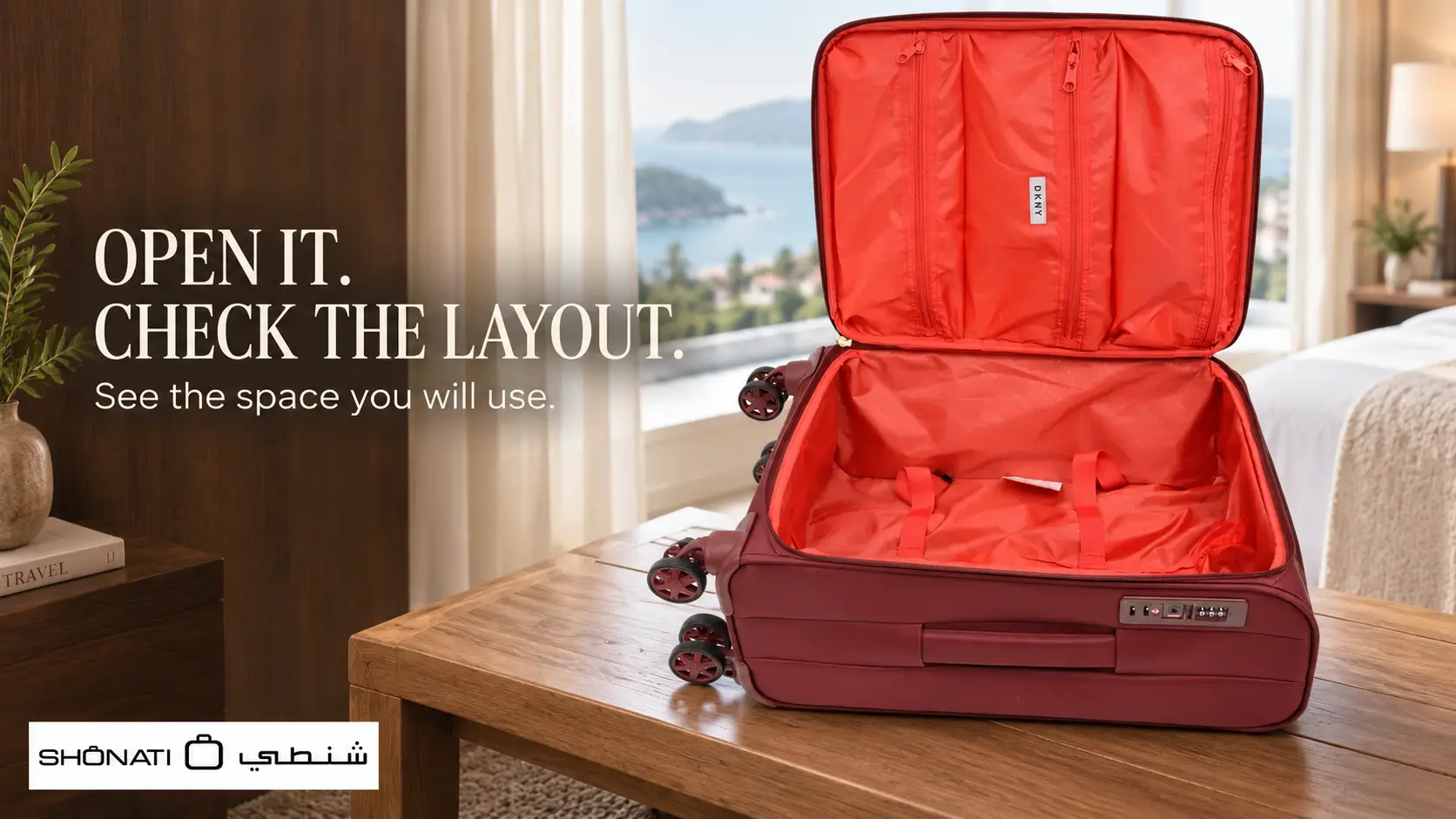
Open the case fully and check the compartments, straps and access against the items you usually pack.
7. Inspect the finish and the exact unit you will take home
Look around the corners, wheel attachments, carry-handle mounts, zip edges and accessible lining. On fabric cases, inspect the seams and stitching. On a hard-shell case, look for cracks, damaged edges or distortion that interferes with closing.
Point out marks, loose fittings or repeated misalignment before paying. A cosmetic mark and an operating problem are different issues, but both deserve a clear explanation on a new purchase. If you are offered a different boxed unit, check that unit’s size, colour, closures and visible condition too.
Do not choose a material by pressing the shell and guessing its composition or impact resistance. Confirm the specification for the model. Likewise, a neat finish is useful to inspect, but it cannot prove waterproofing or long-term durability.
Ask: “Is this the unit I will receive, and can we check any marks or fittings before completing the purchase?”
8. Confirm warranty coverage and the repair route
Read beyond the number of years on a tag. Ask what the applicable warranty covers, what it excludes, which documents you must keep and where a claim would be assessed. Establish whether the terms apply to your exact model and purchase, including any display or discounted item.
Coverage differs. SHONATI’s warranty information explains that duration, exclusions and the available resolution depend on the product and its applicable terms. Keep the receipt and relevant model details, and check the documentation supplied with your purchase rather than assuming every brand or collection follows the same policy.
Ask separately about wheel, handle and lock repairs. A part that looks removable does not establish that a replacement is available locally, that labour is free or that repairs can be completed before your next flight. If you live outside the UAE, ask how service would work after you return home.
Warranty cover and changing your mind are separate matters. Read the returns and exchanges policy before assuming that a home trial, used bag or discounted purchase qualifies for a return.
Ask: “What should I keep with the receipt, who handles service, and how do I confirm parts, costs and timing if a repair is needed?”
How to decide between two shortlisted suitcases
First check that each case meets your non-negotiable needs: the relevant size limit, enough usable space, comfortable handling and a clear service route. Then compare price and the extra features you will actually use. A discount does not solve a handle that is uncomfortable for you.
| What you find | What to do next |
|---|---|
| Both work well, but one suits your grip or packing layout better. | Choose around that practical advantage and your budget. |
| A component repeatedly catches, collapses or fails to close normally. | Ask for inspection or another unit before making a decision. |
| Dimensions, warranty wording or repair arrangements remain unclear. | Get the missing information before relying on the claim. |
Save a short note on your phone for each candidate: model and size, overall dimensions, empty weight, what felt comfortable, anything unresolved and the quoted price. Record whether you handled it empty or with a small load. Those details are more useful later than remembering that one bag “felt premium”.
Frequently asked questions
Can I judge suitcase quality just by rolling it empty?
An empty roll gives you an initial feel for movement and grip. It does not tell you how the suitcase will handle your packed belongings. Where the shop permits it, compare a small representative load under the same conditions, and keep the limits of that check in mind.
Does movement in a trolley handle mean it is faulty?
Movement alone is not enough to diagnose the mechanism. Check its intended locking positions and ordinary operation. If it drops, jams or feels unstable while rolling, ask staff to inspect it and compare another unit rather than ignoring the issue.
Should a TSA combination lock come with a key?
A Travel Sentry combination lock normally does not include a traveller’s key. Its keyhole is for security inspection. Follow the instructions for your particular lock; separate keyed padlocks work differently.
Can an in-store check prove that a suitcase is durable?
No. Ordinary checks help establish present condition, operation and suitability for you. They do not reproduce baggage handling over repeated journeys or establish a laboratory durability rating.
What should I ask before buying luggage online?
Request the exact variant’s overall dimensions, empty weight, interior photographs and applicable warranty. Check the seller’s return and indoor-trial conditions before assuming you can pack or use the bag and still return it. A video can demonstrate a feature, but it cannot tell you how the grip will feel in your hand.

Before visiting SHONATI Sharjah, confirm which models are available and bring your shortlist and warranty questions.
Compare your shortlist at SHONATI Sharjah
Bring this checklist when you visit SHONATI in Sharjah. You can browse our luggage collection to start a shortlist. Before travelling to the store, send your preferred size, budget and any model you have in mind so you can check which options are currently available to compare.
Still choosing a size? Start with our complete luggage size guide. If you already have a shortlist, focus your visit on the wheels, handles, opening layout and purchase details that are difficult to judge from a photograph.
Ask SHONATI about current options on WhatsApp · Open the SHONATI Sharjah location
Sources checked: 10 September 2026. Product specifications, airline rules and purchase terms should be checked for the exact model and journey.