
Front-Opening vs Clamshell Luggage: Which Layout Works Better?

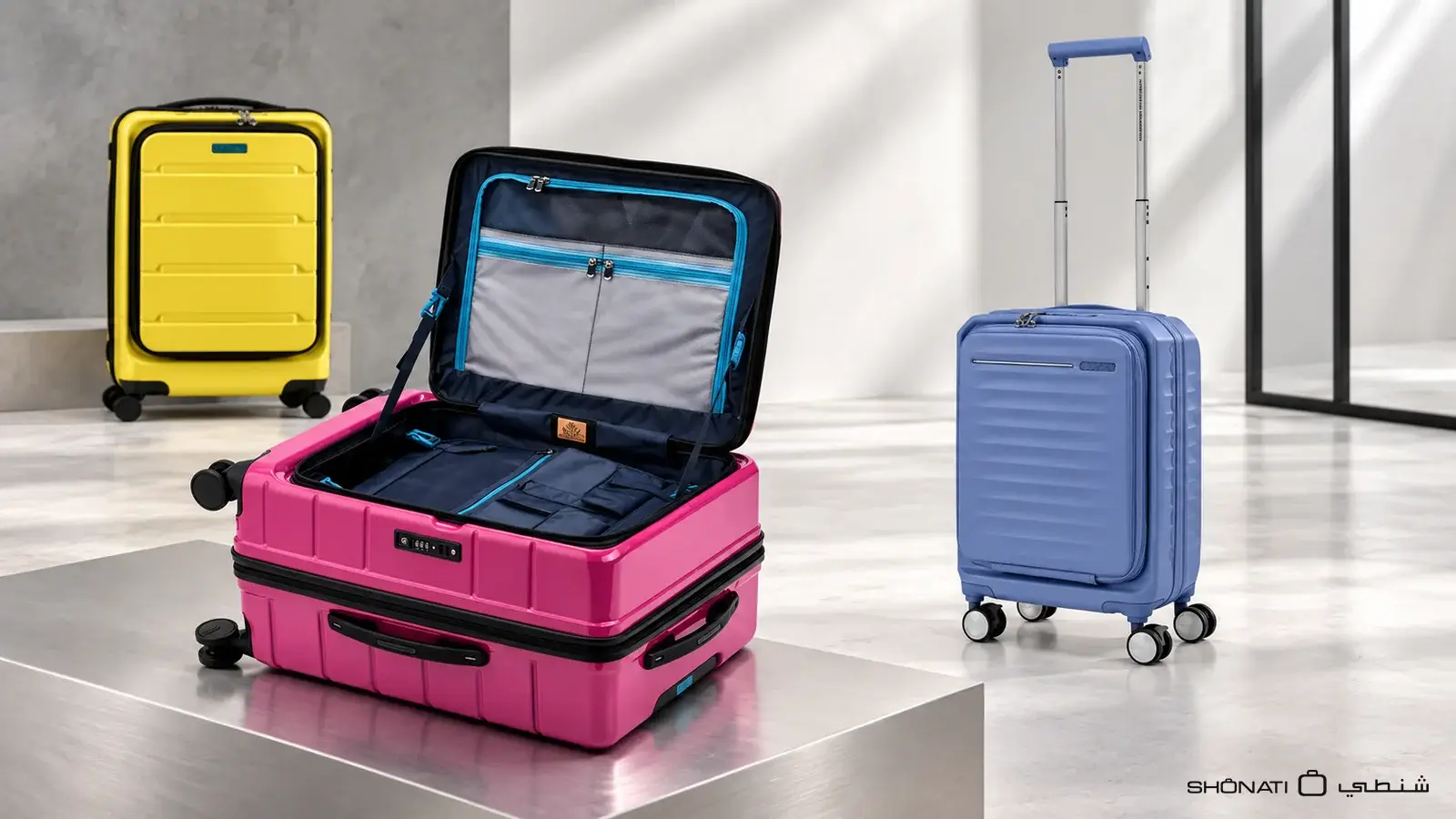
You arrive at your hotel, put your suitcase down and reach for a clean shirt. How much of the case do you need to open—and what has to move before you can find it?
That is the useful starting point when comparing front-opening vs clamshell luggage. Front access can help you reach selected belongings without opening two large sections. A conventional clamshell layout lets you spread your packing across two sides. Neither arrangement is automatically better: the difference becomes clearer when the suitcase is packed.
There is also an important overlap. Some suitcases combine a front-access panel with a clamshell opening, while others have a front pocket that reaches only a laptop compartment. Before choosing, look at where the opening leads, how your belongings sit inside and how you will put everything back.
Front-Opening vs Clamshell Luggage: What Is the Difference?
These terms describe related features, but they do not always describe opposite designs. Separate the entrance into the suitcase from the arrangement of the packing compartments.
Front access: an entrance through the front of the case
A front-opening suitcase has a panel that opens from the front. Depending on the model, it may provide access to electronics, the main packing compartment or both. An internal divider may sit between the front panel and your clothes.
The key question is simple: what can you actually reach through this opening? A photograph of the closed suitcase cannot answer that.
A front pocket: useful access to a separate compartment
A front pocket may hold a laptop, documents and smaller essentials without connecting to the main clothing compartment. That can be useful on a working trip, but it will not necessarily help you retrieve a shirt or a packing cube.
If your laptop already travels in a backpack, consider whether another dedicated compartment solves a problem you actually have.
A shallow lid over a deeper packing compartment
Some suitcases open with a relatively shallow lid over one deep main section. You may see this described as top opening or lid opening. The deeper section can accommodate stacked packing cubes or bulkier belongings, although reaching an item at the bottom may require lifting things above it.
“Top opening” does not, by itself, mean the suitcase is designed to be opened while standing on its wheels. Check the intended position and how the lid is supported.
A clamshell opening: two sections that open apart
A conventional clamshell opens like a book, exposing two packing sections. This can make it easier to keep different groups of belongings apart and see what is on each side.
The sections are not always equally deep. Descriptions such as 50/50, 70/30 or 80/20 are shorthand for the layout; they should not be treated as precise usable-capacity measurements.
Some designs offer more than one route inside. For example, TUMI describes its Dual Access Expandable Carry-On as providing access to the main compartment through either the front lid or the split-case opening.
Opening layout is also separate from shell material and closure type. A zipperless case can still open into two packing sections. For the material decision, see our hard-shell vs soft-shell luggage guide.
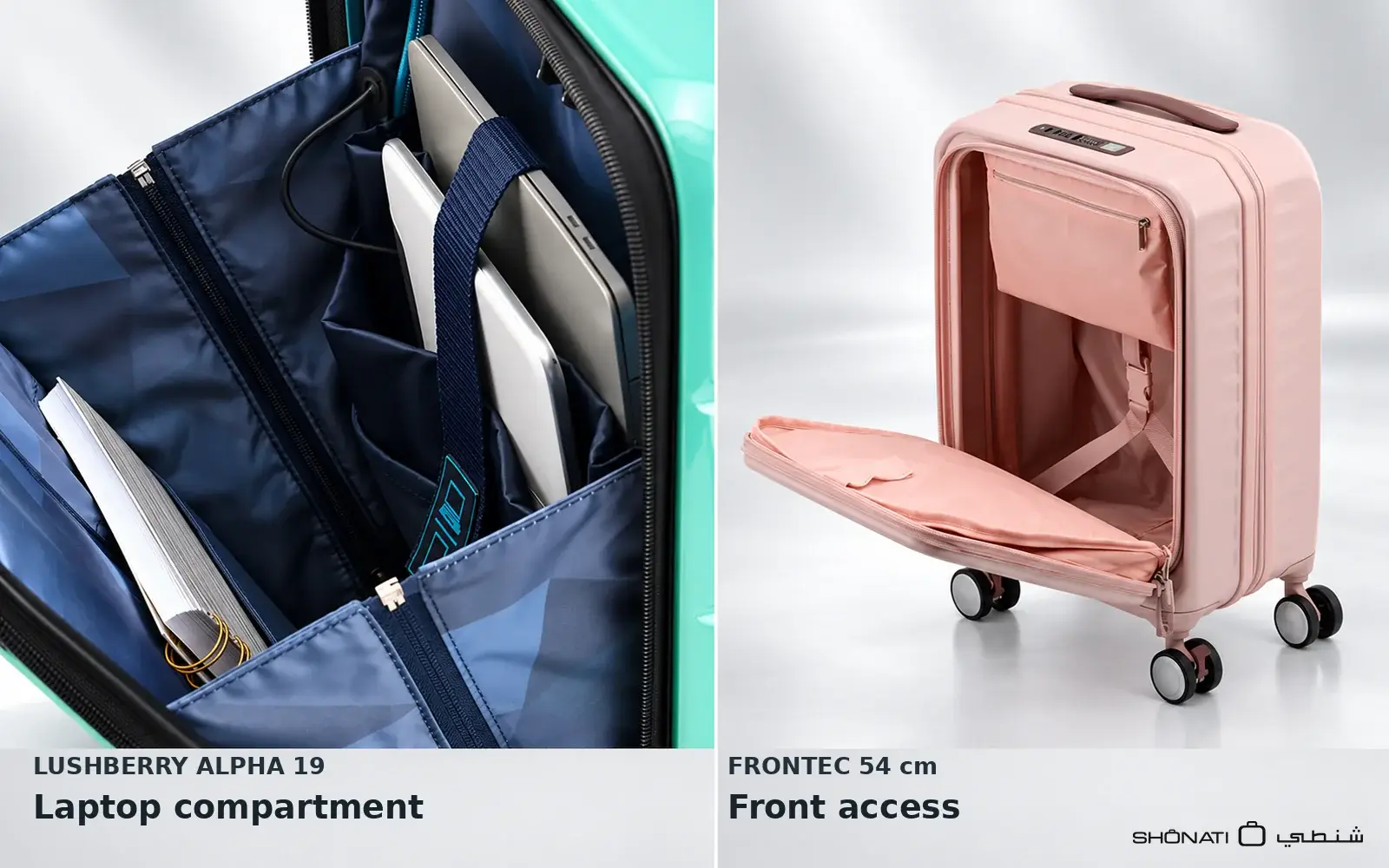
A laptop pocket and access to the main packing compartment serve different needs. Check where each opening leads.
Which layout suits the way you travel?
Start with the moments when you need your belongings, rather than choosing from the label alone.
| Your priority | A feature worth considering | What to check |
|---|---|---|
| Taking out a laptop during a journey | A dedicated front technology compartment | Can you remove and replace the laptop with its sleeve when the suitcase is packed? |
| Reaching an outfit without unpacking everything | Front access to the main compartment, or an accessible upper packing layer | Does a divider or another packed item block the route? |
| Keeping two groups of belongings separate | Two packing sections with suitable dividers or straps | Can each side hold your intended items without forcing the case closed? |
| Using stacked packing cubes | A deeper main compartment | Do the cubes fit through the opening as well as inside the case? |
| Opening a suitcase in a small room | A lid or panel that works with the available space | Is there support for the body and enough clearance for the lid? |
| Unpacking everything into drawers | Either layout may work | Which is easier for you to pack, close and repack? |
Four product examples that make the differences clearer
These examples illustrate different features, rather than ranking differently sized suitcases against one another. Pay attention to the exact model and size: a collection name does not guarantee the same opening arrangement throughout the range.
American Tourister Frontec 54cm: front access to your packing
The American Tourister Frontec 54cm illustrates a front-opening design with access to the main compartment and a listed 15.6-inch laptop pocket.
For this type of layout, imagine where your first-night clothes will sit. The front opening is most useful when the item you want is positioned behind it and any internal divider is easy to move. Check laptop fit with the device and sleeve you actually use.
Lushberry Alpha 24-inch: a shallow lid and deeper body
The interior images of the Lushberry Alpha 24-inch show a shallow lid opening over a deeper packing section with the case laid down.
This arrangement is worth comparing if you prefer packing in layers. Place frequently needed belongings near the top; otherwise, a deep compartment can leave you lifting several items to reach one underneath. The layout alone does not establish an exact compartment ratio or prove that the case can be used upright.
Lushberry Alpha 19-inch: why a laptop pocket is a separate question
The Lushberry Alpha 19-inch lists a front laptop compartment for a device up to 15.6 inches.
It is a useful example of why laptop access and clothing access should be assessed separately. Choose a technology pocket for the belongings it is designed to hold; do not assume it also provides a route into the main packing area.
American Tourister Tribus 69cm: two packing sections, with a different closure
The interior gallery of the American Tourister Tribus 69cm shows two packing sections, with a divider on one side and packing straps on the other.
Its zipperless closure is a separate feature from that internal arrangement. If you like seeing two organised sections when the case is open, examine how your clothing and packing cubes fit on each side rather than assuming both sides have identical capacity.
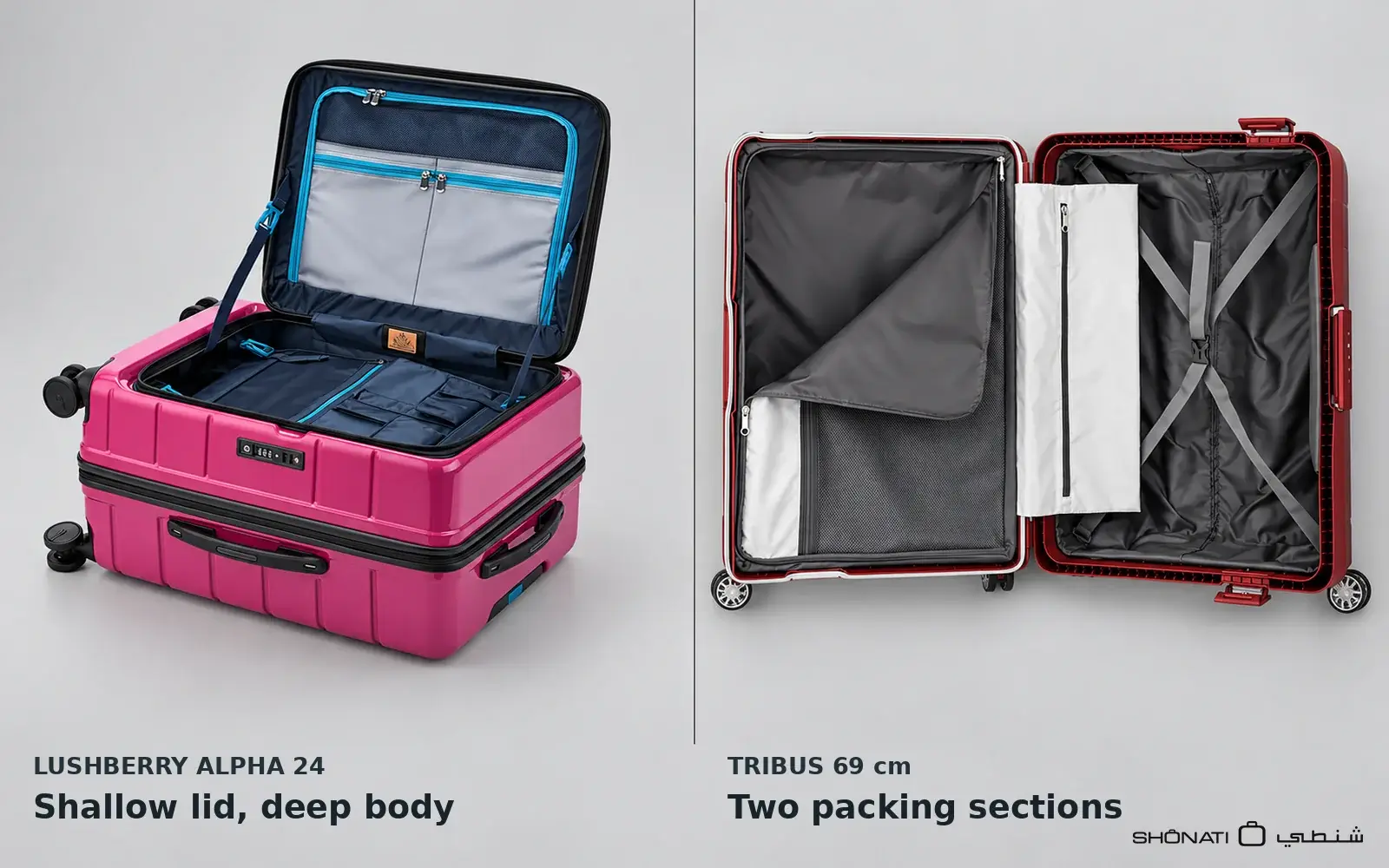
A shallow lid over a deeper body and two packing sections offer different ways to organise belongings.
Think through your first evening—and the next morning
If you arrive late and need only a few things
Pack a small arrival kit: sleepwear, a fresh outfit and the personal items you expect to use first. Put it behind the intended access point or at the top of your main compartment.
A front opening will not make an outfit easy to retrieve if it is buried beneath everything else. Equally, a clamshell case can work well when your arrival kit sits together on one accessible side. Packing order matters alongside the opening design.
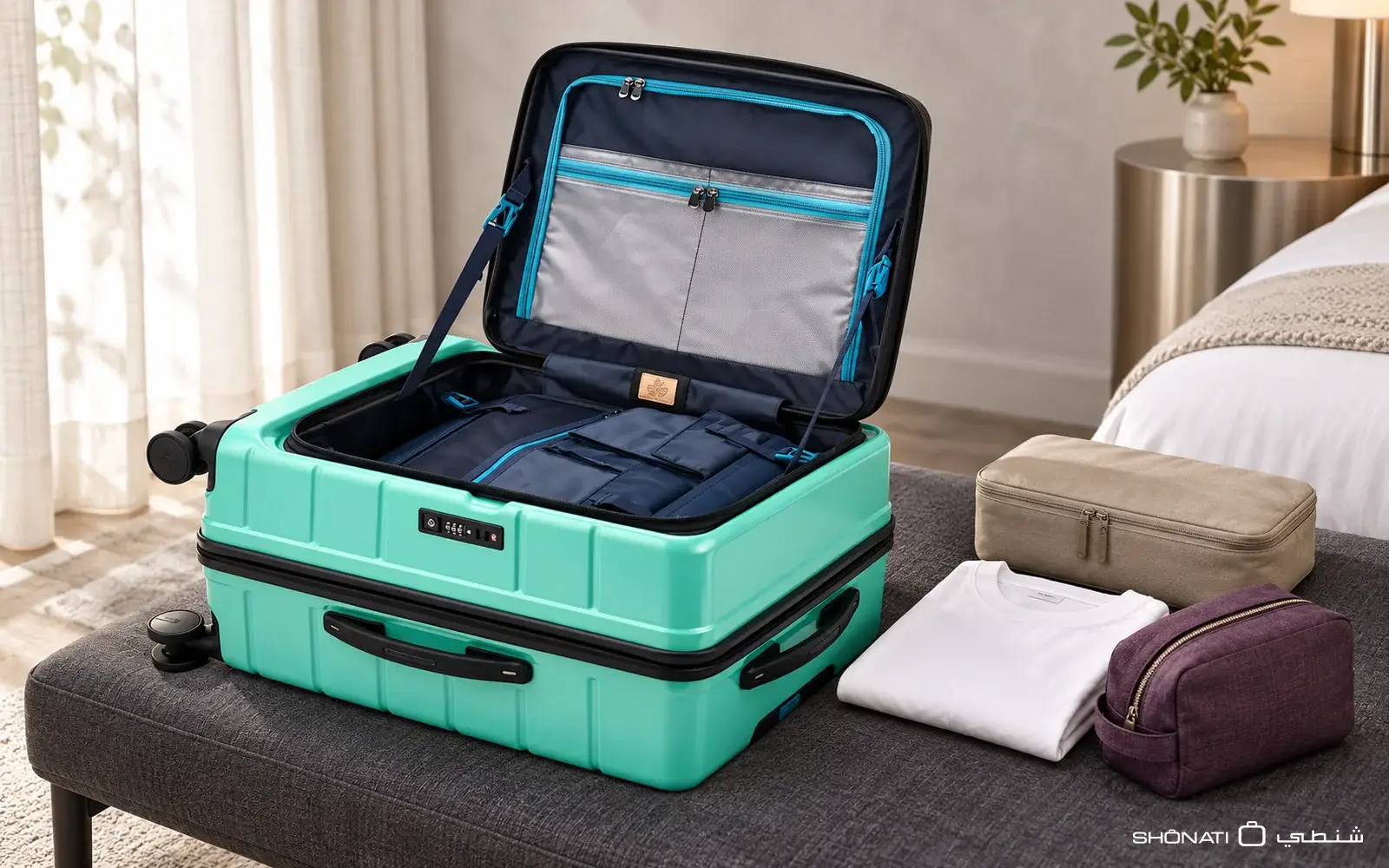
Keep your arrival essentials together and pack them near the access point you plan to use.
If you stay in a compact hotel room
Consider the full open case, including its lid. A shallow-lid design may suit the available space, but the body still needs a stable surface and the lid needs clearance. A two-section case may need a wider area when both sides are laid open.
A luggage rack is not automatically suitable for either arrangement. Check its support and avoid relying on an unsupported lid or an overhanging packed section. Product photographs taken in an empty studio do not show how a suitcase will fit beside your hotel bed.
If you change hotels several times
Think beyond the first neat packing session. After a few days, clean clothes, worn clothes and partially used packing cubes may need different places.
Two sections can help you maintain separate groups. A deep compartment can also work with separate bags or cubes, provided the items you need next remain accessible. Before checking out of your hotel, the practical question is whether you can replace everything and close the suitcase without reorganising the whole load.
If you normally unpack into a wardrobe at every stop, access during the stay may matter less than how comfortably you pack and repack.
Check usable space, laptop fit and locks
Depth is not the same as extra capacity
A deep compartment changes how belongings can be arranged. It does not automatically mean more usable packing space than a two-section case of similar external dimensions.
Handle channels, internal panels, pocket construction and the shape of your belongings all affect fit. A cube that sits comfortably inside the case may still be awkward to pull through a smaller front opening.
Check three things together: whether the item fits inside, whether it passes through your preferred opening and whether the suitcase closes comfortably afterwards.
Try the laptop with its normal sleeve
A screen-size label is a starting point, not a complete fit check. Laptop bodies and protective sleeves differ in width, height and thickness.
Try removing and replacing your device with a representative load in the suitcase, if the retailer permits it. Also look at whether filling the technology compartment changes the space available for your other belongings.
Identify how each entrance locks
Do not assume the main suitcase lock secures every pocket. Trace each opening and ask which zipper pulls or latches it protects.
This varies by model. Briggs & Riley says the tech compartment of its Sympatico Essential Front Pocket Carry-On has lockable zips; the cable lock is sold separately. The useful lesson is to check every access point on the suitcase you choose.
A practical in-store test: open, retrieve, replace and close
An empty-case demonstration shows the mechanism. A representative load tells you more about how you will use it. With the retailer’s permission, try this sequence:
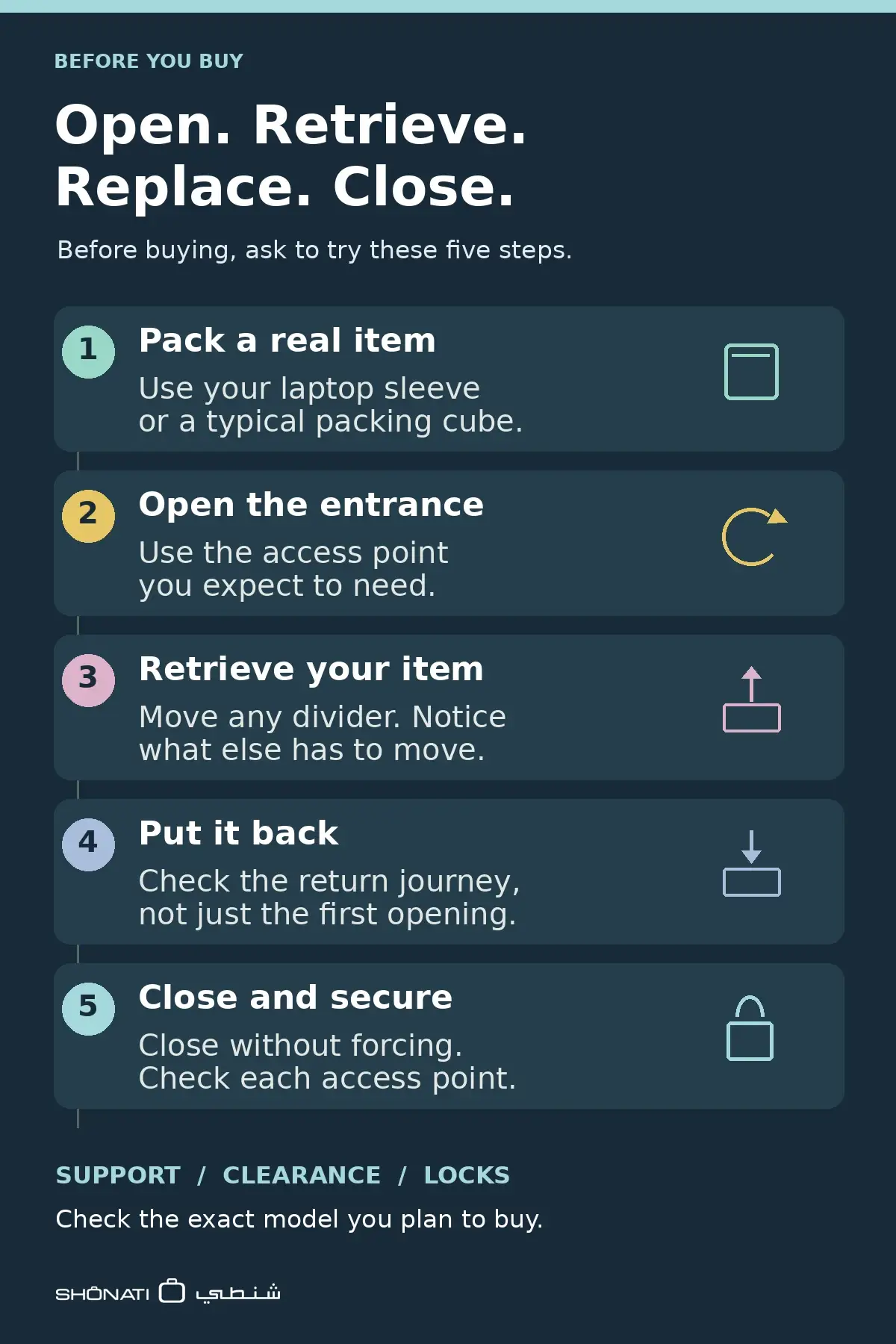
With the retailer’s permission, try the full access cycle using your usual laptop sleeve or a typical packing cube.
- Choose a realistic item. Bring your usual laptop sleeve or a typical packing cube.
- Place the case in its intended opening position. Check support for the body and clearance for the lid.
- Open the entrance you expect to use. Release any divider or straps needed to reach the item.
- Take the item out. Notice what else has to move and whether you need to hold a panel out of the way.
- Put it back. This is where a tight opening or crowded pocket can become more noticeable.
- Close and secure the case. It should not depend on forcing the lid, zipper or latch into place.
Then try the same task on another layout. The more useful choice is the one that suits your packing habits through the whole sequence.
For the other buying checks, including wheels and handles, use our suitcase buying checklist.
Frequently asked questions
Is front-opening luggage better for small hotel rooms?
It can be helpful when you can reach what you need through a smaller panel or use a lid within the available clearance. However, the suitcase body still needs support. Compare the actual open arrangement rather than assuming every front-opening model takes less space.
Can I open a front-opening suitcase while it is standing?
Only use it that way if the model’s design and instructions support it. “Front opening” describes the access position; it does not guarantee stability with a packed panel open or a laptop being removed.
Does a clamshell suitcase always have a 50/50 split?
No. A suitcase can open into two sections of different depths. Look at the interior and the manufacturer’s description rather than treating “clamshell” as an exact capacity ratio.
Does front opening make a suitcase suitable for cabin travel?
No. Opening style does not determine airline acceptance. Check the airline’s current size and weight allowance against the exact suitcase, including its wheels and handles. Our luggage size guide explains the measurements to compare.
Which layout is better for packing cubes?
Both can work. A deeper compartment allows stacking; two sections let you distribute cubes across the case. Match the cubes to the internal dimensions and check that frequently used ones can pass through your preferred opening without disturbing the rest.
Choose the opening that works with your packing habits
If your priority is reaching a laptop, focus on the technology compartment. If it is getting clothes out during a short stop, follow the route into the main packing area. If you prefer seeing two organised groups at once, compare two-section layouts.
Before buying, try the complete task: take something out, put it back and close the case. That tells you more than opening an empty suitcase once.
Planning to compare models in person? See our guide to buying luggage in Sharjah, or message SHONATI on WhatsApp to confirm the exact models and sizes available before visiting.
Product examples are based on published descriptions and available interior images. This guide does not report hands-on performance testing. Features can differ between sizes within the same collection.